Spotify

 Apple Podcasts

 Amazon Music

 Overcast

 Castro

 PocketCasts

 Castbox

 RadioPublic

 RSS Feed
105: Ease the Pain: David Soden and Aptimyz
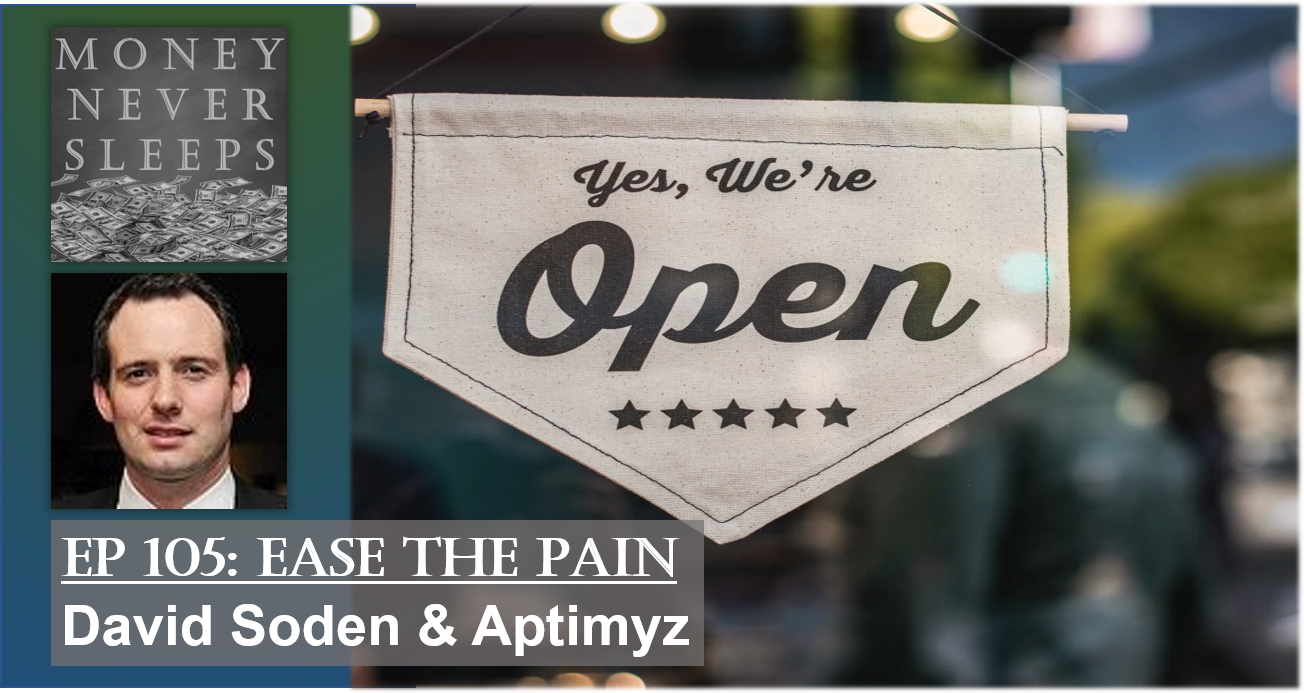
David Soden, Co-founder and CEO of Aptimyz, talks with Pete Townsend about early entrepreneurial influences, finding purpose in a move from pharmaceuticals to B2B SaaS, the end-all-be-all of delivering customer value….and doubling down during lockdown!
For insights delivered to your inbox beyond the spoken word, subscribe to our MoneyNeverSleeps newsletter right here on Substack.
EPISODE OVERVIEW:
This week Pete talks to David Soden, co-founder and CEO of Aptimyz, an Irish tech startup delivering a complete and affordable EPOS (electronic point of sale) and back-office management solution providing stability for retail in challenging times. If David and Pete had recorded this right after they met pre-lockdown in February, this conversation would’ve been much different!
Think about it this way - you build some hard-fought traction with your startup and climb right up to the edge of hitting the market in a big way. Then, the unthinkable happens to not only your target market, but the entire world around you, and the physical interactions between consumers and small businesses that were a critical lever to your business, basically drops through the floor. Well, that’s pretty much a masterclass in “Dealing with Adversity” that you can’t get in any business school on Earth.
HIGHLIGHTS:
Being the youngest of five boys in an entrepreneurial household with both parents and two brothers running their own businesses: “It never looked easy, but it was always exciting, and I think I had the bug from that point.”
On one of the biggest takeaways from his days in pharmaceuticals: “It was amazing as a young guy to be involved in a product launch going from zero to $1.5bn in 18 months, with that kind of scale, and see the pre-launch activity through to launch activity through to hyper growth.
On his purposeful move from pharmaceuticals to SaaS: “It was always important to have that north star and know what you’re working for and why you enjoy doing it.”
On his mantra as a startup founder: “It’s not worrying about the money, it’s worrying about whether you’re truly relieving a pain point for the customer.”
On his thoughts on startups: “For anyone interested in doing a startup, it’s isn’t easy, and if it is easy, there’s a good chance you’re fooling yourself that you’ve found something that’s really worth it.”
On digitalizing retail: “It isn’t about having a till or a PoS and then going online, it’s about having a digital business with a physical connection to the customer in store, and the virtual connection with the customer online, but managing it all in one place.”
On the pandemic: “When it hit in March, it was kind of a hold-your-breath moment, and then we realized we could give up, or double down. We doubled down and expanded the team.”
On delivering value: “There are a lot better things that retailers can be doing with their money right now than spending it on old PoS hardware.”
On lessons learned from pitching to investors: “Be sure of what you want going into it because you can’t cry about it afterwards if you end up with a bad deal.”
On looking ahead: “It’s a huge challenge, but we’ll be successful if we deliver customer value. It’s not about the shiny buttons, it’s about helping customers run their businesses more efficiently. “
To learn more about Aptimyz, get in touch at info@aptimyz.com.
Follow us on Twitter @MNSShow, @PeteTownsendNV and @EoinFitzgerald9
0:11 Hey there, this is Pete, Townsend for norio ventures, and welcome to money. Never sleeps podcast, that looks inside the head of entrepreneurs, and at the crossover of startups, Enterprise Finance, technology and Life. As we know it this week. We talked to David soudan co-founder, and CEO of apptimize and Irish Tech startup delivering a complete and affordable electronic. A point of sale or E pause and back office management solution, providing stability for retail and challenging times. If David, and I had recorded this right after we met in February. I'm sure the conversation would have been much different. That's what made this interview. So interesting for me to do when you build some hard-fought traction with your startup climb, right up to the edge of hitting the market in a big way, but then the unthinkable happens to not only your target market but the entire world around you. Yeah, you know, that's pretty much a master class dealing with it.
1:00 City that you can't get in any business school on Earth. So let's just jump right into it with David's Odin on this week's episode of money, never sleeps. Here We Go. Again, recording from the home studio with David soudan co-founder and CEO of optimized for founding apptimize, David had a 13 or 14 year stretch and pharmaceuticals before stepping into some entrepreneurial Ventures about five years ago, which have become apptimize with that backdrop. Welcome. To the show. David, thanks Pete. Thanks for having me, great to have you here. Listen, I've been really wanting to have this chat since we met that day and coffee angel on Pembroke Street in Dublin. And, you know, but a little thing called a global pandemic is kind of caused us to shift gears a bit. Obviously, how we record these podcasts, now being fully remote.
1:49 I'm glad we reconnected recently to kind of have this discussion. Yeah, feed it was, it was great to meet you that day. And have you following the podcast ever? Since? I'm delighted to be here. Awesome. Well, Jump right into it. Maybe just for the listeners sake because you know, I kind of know where you came from now, but for the listeners, can you share your back story and how you got to this point? Yeah. Sure. I suppose, you know, getting into this, the were lasas and what we're doing today and it's it goes right back as opposed as a kid. I loved to grow up playing sports and, you know, playing 19 games, but I love to win. And, you know, I also love Making things being involved in projects and I suppose, you know, I grew up with in an entrepreneur that house as well. So my parents work for themselves and being second youngest of five sons and watched my older brothers set up their own Ventures to never looked easy, but it was always exciting.
2:47 So, you know, I think I kind of had a boat from that point and I suppose for doing and what I've seen and what I've come through to now, you know, I think importantly, it's never been about working for myself. It's about being All this, something that was meaningful, a project that you could make a meaningful change in in an area that you're working it. So working for someone to work for yourself, It's always important that you kind of have a North star for yourself that you know what, while you're doing it. And if you enjoy doing it, so I studied iconic to college. And then as you said, I moved to the pharmaceutical industry, where I worked in the sales and marketing side of things for a number of years. And it was really the marketing side of it that look was a real eye-opener for me.
3:28 I was involved in a huge. Product launch back in 2009, 10 onto the 11 to 12, but it was a massive product and is working with the team here in Ireland and the UK. So you're kind of working across functional teams, and it was just brilliant. People involved in the project. And then it was also involvement with the corporate side of it. So the product went from zero to one and a half billion internal for an aging months. So, you know, from that side of it. It was amazing. As a young guy to be involved in a project with Of scale and to see, you know, pre-launch activities through to launch activity to hyper growth. And that was all this time. It's just you know to actually to see that happening and I'm Dale in front to you to be involved in.
4:11 That was just, it was brilliant. I suppose it wasn't easy but you know and it was fired burning everywhere. Even in big works like that GE, you know, the challenges as I said, this was true. 2009 211. Really and pricing would have been a huge issue at that point. So, you know trying to negotiate CA pricing supply chain based on demand all of this stuff. It was just a real real challenge, but it was exciting. It was, you know, when again, as I said you work in great team, so, you know, from the sales, they the medical side of things that we worked at. We had a great partnership with everybody with that suppose. At the end of the day we felt like we keep success with it. So it was great. It was really enjoyable. So they started out doing looking at doing something for myself in 2016, and I've moved into the entrepreneurial space you said and then we ascend Higher the stock of space initially just kind of getting a feel for it, looking at different projects that you different ideas. We eventually settled around start to 17 with apptimize. That's really what the beginning of the journey. So I knew that really interesting. You talk about the North Star, couple minutes ago. And the way that being involved in a massive product launch were within 12 months, you scale up to one and a half billion Revenue.
5:20 That's pretty intense. How did that experience form your North Star or perhaps? Impact that North Star? I think to be a part of something that's successful in skills like that. It's not about being an individual in the team. It's about being part of a bigger team. And, you know, having the right people around you, it's funny. We spoke. I've spoken in the course of his journey over the last couple of years, especially even this year, and we've had a lot of good shots with some really good people. I spoke with the former CFO of Revolution and one of his key advice was, you know, make sure you the right team, make sure you have a strong team around you because he said from his experience team is critical. For that kind of success.
6:01 And I was able to, I suppose connect with that because I worked with a very strong team in my previous career. In pharmaceutical industry, who's generally a strong team across the board and yet at that for me was the key to have a good product because the absence of themselves you need to have the right strategy. Need to believe in the people that are doing their other jobs, you know, you can't micromanage you have to be able to, you know, work alongside people and let them do their thing, and let the do it to the abilities they have. And that for me. Me was I think it was a key learning going into this. So, you know for me setting up apptimize there was myself and my co-founder Robin. There's I'm the business side of him and he's the development side of it.
6:41 And you know, we talked be back sheds, but we always come to an agreement in terms of what to do next and we always keep the customer at the Forefront of what we're trying to do. I kind of have a mindset of dementia that, you know, it's not worrying about the money. It's worrying about making sure that you are really a pain point for a customer making sure that you're making it better sometimes. Same point isn't always obvious. The customers, don't sometimes. See a second reports. If you ask them what they want, a lot faster horses. So having that I think the North Star for me, it's about enjoying what you're doing is low. Like, it's not easy as it said, you'd say that over and over, start up for those listening, if anyone's interested in doing a start-up, it isn't easy. If it is easy, then it's a high chance. You fooling yourself that you got something because if it does not work doing.
7:23 Yeah, so it is the case of, you know, enjoy what you do. Make sure what you're doing is Meaningful. And absolutely, yeah. So it's a great quote recently, and I believe I had never seen it before. It was Winston. Churchill saying the only place that success comes before work is in the dictionary. Yeah. Yeah, you know, you know, you just imagine folks that are in the space that you're in that you look at and you say gee, is there, they've been incredibly successful things have gone really well for them. And, but if your to watch the actual how it unfolded in the 5, to 10 years, it took them to get to that point. It's a much different story, right? Yeah, so, With optimized specifically tell us about optimize what it is and why you're doing this specifically, you know, I can get the the usual spiel about optimized and please do please do. So after my eyes is a cloud-based pause and Erp system.
8:15 We have chosen to launch that on the silver platform and stepping back from what that is. What we believe is optimizes unlock the true value of pause. And it's by creating a data-driven, scalable software solution, and For more companies attorney to pause to solve their business needs with smart Solutions. Pausing itself is old, and I think there's a risk of being associated with a historic Legacy product, rather than actually what we're trying to deliver today, you know, at the end of the day after my eyes enables businesses to get on with their business strategy, while you take care of everything else and how does that happen? And we built a software product that's easy to use. It's easy to get up and running and it's also see seriously cost-effective for businesses to take on. So, There's no from costs compared to traditional pause models where this High upfront costs. It's a changes at the options for merchants and retailers to go from a calf X expenditure model to a operational expenditure model, which is just it's in this day and age especially now covid.
9:15 That's you know, if they're looking to upgrade and they're looking to switch over to a better solution. It's it doesn't cost them which is fantastic. Very good. And for all of our listeners out there that may not be aware of what pause is point of sale. Exactly. And it Really interesting context again, going back to, you know, when you and I first met just before lockdown would have been in February, and we'll come back to that in a minute. But just kind of thinking about, you know, your inspiration to do this after 13, 14 years in Pharmaceuticals. Clearly heard the experience like we talked about of that product launch and you starting to think about these type of things, but it feels like a big shift right away from Pharmaceuticals and into point of sale. Technology, right?
10:00 And everything around that can you can you talk about that for a minute? Yeah, it's funny. I it was more Pete. It was a big jump to go from one to the other boss. The end of the day is like when I was doing my first forecast, so you have to help me build you through your plans. We were dealing with a local Enterprise offices, Enterprise, Ireland, and everyone's asking for three or four casts, and at the end it when I was filling the software as a service business plan, while I was looking at was, you know, you're like, what's your customer acquisition? Look like what's your churn look? Like what it was exactly. The same as what I built when I was in the pharmaceutical industry. Okay, your customers are your patients. You churn is the people who compliance issues or there's end of life and it nearly replicated. I actually think I could have taken our existing model and just put in the products instead of the, it was, it was a switch. So the transition actually in the mechanics behind was very similar in some shape or form.
10:50 We have been dealing with retail with with pharmacies. So I had an understanding of what was going on there and in terms of front to house as well, so but I think there was a lot of learning. It was a great Challenge and it was really exciting. But I also think that there was a benefit for us because we said point-of-sale, tills cash, registers. It's old. It's a legacy. It hasn't changed like, it changed from punch buttons to a digital electric till 2:00, you know what we have today, and there hasn't been a massive transition in terms of how it works. I was on the call yesterday with the association here in Ireland, who represents a large number of merchants. And he was saying, oh, you know, I remember when you're going to get your tail and it calls 15,000 euros per till / such and we're saying, well, ours is 0. We have an MRI.
11:38 It's a monthly recurring, subscription model and he was just like, that's brilliant. And that's a significant change, but then he started listing off, you know, four and five other. Pause companies in that space with them. And in Ireland, we love our country, but we know it's a small market. So when you start to hear, there's a list of people selling a product, you know, then the price point is going to be high. A small market for volume. So, we're coming in saying, well, actually that's gone. Here's the new way doing it. You know, it's talked about the new normal. Well, like, that's worrying for with optimized, has become the new normal in terms of pricing and, and, and service for for merchants and retailers. I get it, I get it. And what I'm hearing is kind of connecting all these dots back. We've got early training through your University degree, and, you know, electronic engineering.
12:24 You've got you had some good experience on the sales side in Pharmaceuticals, right? Yeah. You had some product building experience there. Okay, I'm with that, technical mind, the sales. Mind, the product building mind. Well, it could have been anything, right? Yes. Yes. It may not be futuristic, augmented reality or virtual reality. But when you start thinking about software-as-a-service, it kind of makes sense that okay, if you identify a problem and say, listen, this is what we're going to dive into as a problem. We want to solve for this customer group. We've got some good base skills of life. Prince to draw in here, that's what I'm kind of coming back to. Yeah. Yeah. Absolutely. I for me.
13:05 I actually can remember listening to a podcast, about two years ago. It was at Freakonomics with was at St. Dubner, and Steve Levitt. And they were talking about the productivity Paradox and they talked about when electricity was first brought in and it replaced steam. It was no increase in productivity and what they realize. It took about a supposed to 20, 25 years for them to realize that what they had done was just We replaced the conduit pipes. They didn't actually move the Machinery around to become more efficient. Yeah, the suit weapon electricity can provide so there is that and then they said that there's a debate around whether the digital Revolution is really increasing productivity and they said, you know, it's not about these gadgets and apps about learning a new ways of picked up, think about possibilities and new ways to think about the capacity for work and I suppose when we look at what's just happened. So, you know, you and I met in February, but, you know, everybody did.
13:59 What was going to happen to the world's March around March time and then it started to kind of open off. We were all having these podcast. We're having these Zoom calls, you're having a hangout meetings and suddenly we were starting to leverage the capability of SAS. We don't call it. That's we just call it, you know, Zoom calls and podcast but right leveraging technology to make the world more efficient and it was forced upon us. We hear eCommerce has jumped forward four to five years with retail because they've been forced to make that step into it because they need to get to wear the Customers are at the moment and that's where the space were in it. So, you know, we always felt we were at the front of a wave of what's going to happen in within the retail digitizing retail and and it's not just about having it Taylor a pause and then an online. It's about having a digital business that has a connection to the physical customer in store which you know card present and then having your connection to your customer online as well, but you can manage it in one place. So and that's that's the efficiency that we're looking to deliver for retailers.
14:59 I get it, I get it. And I want to dig into that a little bit more thinking about podcasts as well. Obviously, there's a podcast and you have about another one there and we've got one of the ones I. Risked I listened to probably about a month ago that got me thinking about you again was Anthony promptly on. Oh had a guy on called shamov Polly Hoppity, CEO of Social Capital. He's also the chairman of Virgin Galactic is the owner of the Golden State Warriors NBA franchise on this podcast. He and this was at the height of the lockdown. He was referring to pause or POS as something else. That is POS, right? That I'm not going to repeat and you know, he was basically talking through this framework that he uses called follow the money.
15:47 And he says, listen if you're looking at say a Macy's, laying off a bunch of people, right? Because they're going to have financial difficulty. No one's going to Macy's to buy anything. And this was again back in April, in the US. Then you've got to follow. Okay, who are the suppliers amazes who are providing them with all the tools. They need to be able to run their business. Obviously, you know, if Macy's you'd expect would be expanding or doing things differently in new ways. They're going to be buying a whole bunch of stuff. They need to support their new business. And he's kind of walking through and saying, you know, what, we think was big businesses need or even businesses overall needed to help run their business that has changed significantly, right? So it got me thinking about really this new world order and what felt like like when we first met that, you know, David you have this dependence on this Hardware driven hook really to unlock the true value of what the optimized software product can do for retailers. But what it sounds like is that you've adapted significantly to that and are now responding to what's going on in the world, pretty damn quickly.
16:52 Yeah. Yeah. Yeah. Yeah. So what might have mentioned is absolutely as his launch platform is clover and clover is Point-of-sale cloud-based point of sale system that's owned by a company called Pfizer Fiserv are enormous. And for those who don't know why, it's of our, they process one and three, the world's credit card transactions. Are you? Okay? Yeah. So if I serve has subsidiaries all over the world in Ireland's, we know them as a hobby, merchant services localized to the brand of aib. And and in in the UK first aid Emergency Services Lloyd's card Nash, you know, it just goes and it goes on and on EMS and Hollins with ABN Amro Kelly cash in Germany, so and that's When you start hearing the amount of subsidiaries you realize, that's how they have the volume.
17:34 So but we saw that as a phenomenal path because the end of the clovers and out-of-the-box solution for food beverage industry and it's a phenomenal solution for that. They just don't have a retail solution Amish that is for the from SME to make Market to Enterprise. So we saw that as the Gap in their offering. We also saw they had an existing sales and distribution Network, truly subsidiaries. And for me, I suppose going back to that whole, you know, pre-launch. Face me with that product that we were involved with in Pharma. I asked the question is, how do I take a product to scale fast? And how do I keep it lean as possible? And for that, they all those factors were in place with the fights are offering. So what does it mean for us is we get this huge opportunity to scale globally and quickly.
18:17 And then what this me, pricer having this. Well, there, you know, if you go back and you look at the press release in January, set, January, 19, I believe, when Fiserv acquire first Asia to take on Clover. They approach the Rationale for to find Fiserv, they actually highlight the importance of clover to this portfolio. So it's about value added service for merchants with acquiring in the merchants acquiring business margins of in compressing 4 years, and it's now time to add more to it and add value added services. So this is what Clover is for these these bikes and we just think Fabulous As a mutual benefit benefit for being on the for us being on a trip for them just to promote us. So that was our rationale for I'm going to put at the end of the day.
19:01 There's so much more because we're cloud-based because we have all these data, we have this huge opportunity to really deliver something special to to Merchants as well. So and help them grow better. So when it came to the change that happened with covid, we didn't know, we like to be very honest in March. I was unsure of how this was going to impact us. It was a I'm not sure if everybody else had greater foresight than I did, but I think it was kind of like a hold, your breath moment and And once you realize that, yes, you could give up word. It was double down. That was the choice, and we double down. And we took on an extra couple of people throughout the the shutdown. So we actually expanded team took on am John and Eugene and great guys and Tracy, join the team in the UK, Paul Kelly joined the team. So like we just had a fabulous experience. In terms of people, seeing what the vision was they? So what we're doing and we were able to extend and it goes back to me.
19:57 They were all hugely valuable for us. Because they all brought their own skill sets, they all brought, you know, so we were able to deliver a fabulous product for the merchants now, and that includes now, being able to interpret and seamlessly integrate, their online presence with their in store and manage the whole thing. Okay, little hug. So. Okay. Yeah, so and that's, and that's kind of, that's where we went. And now it's a case of people are looking to upgrade their systems. And that's where the opportunity is for us because we're going in and it's very different feet to go in and talk to someone and say, well actually, this is what we do. And it's Attic. And then the question is how much you make? Well, there's no upfront costs. This is what it is per month, you know, it could be a hundred and forty Euros, including Clover, a hundred fifty or securing all the hardware and our software mom as opposed to.
20:42 Yeah, we have an example of a merchant who had a quote for 12 and a half thousand Euros for one till for one side. And here the $200 a month support fee on top of that. And he went on to open three more stores with us on top of the seeds for stores. So, you know, we've saved in 150 plus thousand Euros. Yeah, which is like, you know, He's a lot more things you can do to this money and spending it on Old Hardware. So and is this kind of a two-way street is that you guys are out there with retailers that are using Clover and pushing the product, but fi server also promoting so and pushing and saying to their when they when they sell Clover to retailers. So when they go on to talk to the marches that they sell acquiring to, they now have this opportunity to because as As I said, the reason why sir bought First Data was to have a value added service for their merchant, acquiring now, they can Target not just the food and beverage sector or que es R FS or or whatever way you want to call them. They can now open up all this other. So I think in the US retail is worth tree and that tree and a half trillion Brown, something crazy of that. 20% is to us RFS or food and beverage.
21:54 Yeah, you know say the other 40% is is the general retail, which is what Service. So, you know, your time, your time stamp, some all that. It's certainly we're opening up that market for them with this hard work that they've that they're looking to promote with their sales teams. Like I think in the u.s. It just as an example. I think Frank busy on. Oh, he's the new CEO of Pfizer. He came out a couple weeks ago, saying that they now have up, 260 new Banks, looking to partner with them to sell clovers and solution in the US. Okay. So yeah, this is, yeah, if that and that's why we're excited because this is a It's a massive opportunity to tap into this for. Yeah, and it makes a lot of sense because you know, everybody's fingers crossed that pandemic is a you know, not a long-term thing, right?
22:42 And that within a year to a year-and-a-half. Hopefully there's enough medical advancement to be able to allow us to people to return in greater numbers to, you know, the high streets of the world, to the main streets of the world and get into shops and support these small businesses. Rather than buying everything on Amazon, right? Yes, but from your perspective, what it sounds like is that there was always a problem. They're worth solving and for those retailers that are running their businesses still and have started to come out of the other side of this that problem is still there and that problem still needs to be solved, you know, and then for those that have shifted online that you can help them to write, it's pretty good story.
23:25 It's really interesting because you're on the money, it's exactly what that is. It's it was a case of it was just moving slowly. Problem was just slow, moving cold. It is expedited the depth of problem. Mmm, you know, so for like Amazon, look at the, look at the increase in Amazon's turn over the last, you know, six months. It's just gone through the roof. It was happening. Anyway, they were growing slowly. I think what I was on a call there and I was listening to a guy talking about Amazon and I think in e-commerce, e-commerce in the u.s. Amazon represents 60% of e-commerce. Is it was much lower in Europe with the expected to grow to 60% in Europe as well? So, you know, what does that mean? For the local guide the results of case of misinformation? I've strung the belief that the SME sector need to be educated more and supported more, especially the kind of, you know, government level in terms of they educating on and how to set up and get online, you know, a lot of a lot of retailers. They're great business people.
24:27 They're very personal and that's what they have. They have this personal approach that Amazon could never deliver and like, it depends on the sector. I think, I think 50% of what sold on Amazon are, online, is electronics. Anyway, so the rest of the the, the sector's out there there is that there is a, there is the ability to continue to deliver. I think you could argue the future of online as bricks and mortar. You could say that, you know, for retail if they get the online rights, they can continue to offer that same special offering in store and touch the clothes. Is the lady, you know, differentiate themselves from from the Amazons, there's certain convenience things with Amazon that you just you'll never win.
25:07 So, don't fight that battle. So, you know, but it in terms of clothing, you know, it's it's the young people, like I'm no longer young. So, I've lost the fifth seat that I used to have in my youth. So same kind of thing. Yeah. So, you know, I I'm tall and buying clothes online is a nightmare sizes. Don't don't match. So I prefer to Touch feel and try on. And there is a sense of that for a lot of retail, but that doesn't mean they shouldn't have an online presence. It shouldn't be connect to their customers. It should be done correctly and it's been a there has been a case of. I've seen it with the local Enterprise stuff. It's got the best intentions, but the outcome is that, you know, they say, oh, you know, spend 5K will give you two and a half back and that's like a great incentive to get a retail online. But once again, online, which platform do they use which acquiring to use?
25:56 You know, how do they get their stock online? How do they manage it? Get the photos. So you know, how and these are people who are. It's a sector in retail, is generally generally not a technical space, young people. They're looking for it. Support. They're looking for people to help them, get up and running, get on their feet and do it in a minimal way. Maybe. Yeah, and that's that's that that really is that something that needs to be addressed now and that's hopefully what we're doing. Yeah, it's great. Now, I mean this, this conversation is really helped me to kind of see through to how you've actually managed to adjust and how you're doing this shifting gears. A little bit David. Yeah, just thinking about our point of introduction can coin so shout-out to can coin. Yeah. I'm greatness in Irish guy and living in Warsaw and running his business there and can was introduced to me, or he reached out to me after suggestion by grace and Gerald Sullivan who are friends that go back to the Bermuda Days, Grace was in Bermuda with me when I was there and with a group of friends that have, you know, all move to Ireland since then, great bunch of people and you, If you think about your Irish Network, you'll find pretty quickly that you've got close, contacts, that are now pretty far-flung.
27:06 All over the world or the very least or far-flung for a while before they came back home, right? And all those people have made some great contacts and build businesses and done. Well or perhaps not it learned some lessons. I know you made obviously some excellent progress with Global Partners, like Fiserv Clover, you know, to get apptimize going, you know, can you talk about how you leverage your network? Work to do that. Yeah. Sure. I suppose for me with with optimized, you know, gosh, like talking to leverage and I started home, you know, when you first started out, you know, obviously I had the influence of my own, my own parents. This was watching them work and the connections that they had, it was. And then I have an uncle who I was able to talk to Lisa, former CEO, Bank of Ireland.
27:53 So he had a lot of connections to be able to put me in touch. He put got me onto a help me. He introduced me to a friend of his who became a mentor and then it matches the a great guy, very private man, but he's always challenged. He's always, you know, pushed me to answer tough questions. You know, first question is sale sale sales, and this is when we were on a beta product and, you know, he still is still like that today. He's opened up connections, to me internationally as well. And you know, I suppose within the friends. And so I John, John and eugenia's, it's okay amount of March. Ouch and John and I went to school together and John had gone off. As you said he'd done it internationally and had dealt with property and Retail and huge experience on the financial front and I was able to bring him for advice and we had a chat and and it kind of throws a good fit and he joined the team. So it's that sense of the Irish network is always been brilliant, the likes of Ken and Trevor up and Poland's. They've got up salad and it to be able to reach out to those boys and say, you know, this is what we're doing is they had a phenomenal business.
28:59 Going selves up there, which we're going to be leveraging our self. It's just fantastic. And I think they're going to be a huge success going forward and then they've introduced their own network and in the UK, they introduced two guys. That was a key for Colin Orcs And he works over there. He's a hedge fund and and he's I just I've been blown away by the amount of time these guys just you know willing to give you and you know, always grateful always hang out for someone's time like that. It's just it's very powerful. Thing, when you realize, these are busy people who have like, you know, they've got good jobs. They're working night and day. The spare time. They have, they want to stay with the family, but they still make time for you to actually say, well, look, send me an e-mail. I'll make an introduction.
29:42 I think it was kannon's, excuse me to a good few. People like that and it was Kevin DC and Dublin, the counting Pro. Yeah, and you know just fantastically, you know, you know just helpful people. Who are they not stand up trying to put that in your pocket. They just saying, look, I understand. I started a business once. % where you're at? Let me try and see if I can reduce it to somebody. There's no expectation. Is that when you talk to someone then it's just yet. The network has been incredible in terms of just who we can speak to who you can talk with and it just it just it just goes like that. So if you get the opportunity to help somebody, it's it, what goes around comes around. It does it does. And I'm just having this conversation earlier today with someone, who knows who she is about, you know, and I was asking her for help with it with a connection to somebody and, you know, she's very helpful. Awful, very forthcoming, absolutely. Do it right away.
30:32 And I always feel I've got to do a quid pro quo, right? And yeah, think of something I generally I genuinely had something in the back of my head that I thought would be helpful to her. That would be a natural offshoot of the project that I was working on. And she said, listen Pete, don't worry about it. This is just, you know, a favor for a friend. Do you ever get that kind of sneaking? I need to do something for this person. Coming up your back right? When you're when you're asking for help. Does that? Happen to you, I think it's more of the approach that has you going to? Because if I'm looking for help, you know, I'm someone's willing to help or they genuinely, you can tell there's also people paid like, I've had my share of chances as well that have come across in this, this this this journey and, you know, you start, you start to become more aware of those, the more you deal with them.
31:20 I suppose. Like when I start, when I met my mentor, first is his history and his successes extraordinary, but what he sees Said, in that. Because I was telling about some of the incidents that we come across, and he just said, you know, software in the old days, back in this, the 70s and 80s. He said it was a gentleman's game and he said it was handshape, get agreements. And you shook hands is delivered. And he said, now, there's a lot of snake oil salesman, and we're seeing that, like, I've seen that in the in the time that I've spent, you know, we're obviously building a product. We're growing. We're trying to get. Yeah, we're trying to grow as fast as they can. We're obviously looking for investment, were talking to different people and the amount of time. Easter is that you come across is is phenomenal. But you get you get you start to get a sense for the you start to see a pattern in terms of how they behave and you learn how to avoid.
32:08 So when somebody comes to you and says that can you help me with something, you know, whether it's genuine or not. And yeah, you should never go in to offer help with the expectation of yet having to get something out of it. But you know, if you give someone help, then you can always see that. You can always ask for something down the road. In terms of saying, listen. Can you introduce me to such a jerky? Do such and such? Such what it's like and if you can't don't worry about it, you know, there's no applications and but I think in terms of leveraging your network and the whole point of leveraging something lever lever is two sides, you know, you're lifting something or you know, so if it goes both ways, it does be able to lift back. So, you know, if you can help if you can help people then you know, it's not too time-consuming for you.
32:50 If your walls and, you know, you just have to let expectations be said at the start. Absolutely. Absolutely. And you know, just makes me think about something that I'm working with right now and where it is. You're helping me now because I'm flipping it around David is that I do get absolute Joy from when I know that I've been helpful and that's enough for me, right, you know, and it that works. You just got to make sure you get the right balance of those types of experiences and those that put food on the table that same time, right? So, yeah, absolutely. That's it. That's a big deal thinking about these folks specifically that I'm referring to. I know that they have an investor pitch coming up with an angel group, and I'm helping them to prepare for that. At, I know that you've just recently pitch to that same group and heal any Lessons Learned From that, that you'd be willing to share that. You think might be helpful.
33:37 Yeah, I suppose, you know, it was a very useful experience to pitch these guys. We had, we really positive feedback for still engaging with them for my side of it. I look at it. It's you know, what the challenge for me with all of this Pete was if you were in if we were sitting currently in Silicon Valley and we have what we have and we were looking to pitch the Valuation comes up and your valuation, in Silicon Valley is different, your evaluation in Dublin, and the value of some high net worth putting in 700,000 versus putting in 200,000 in Dublin. We're dealing with people in London as well. And the evaluation was probably if not two and a half times in London, what it is here in Ireland.
34:20 So yeah, you know, as the founder I could the end of the day. I started off the podcast but talking about how you know, you have to do something you love and you do all that, but it End of day, you know, if you do have an exit, if you do you, do you want to know that? You've done it for something like this? Has been a lot of stress. It's been hard work. I've had like couldn't have done it without my wife. She's pushed and pushed and pushed and Jill made. Sure that, you know, everything is being going in the background without a hiccup. So if you don't have an exit, you doing it for the people around you as well. So you want to make sure you got the right equity and at the end of the day, that for me, it's all about your Equity. So if you are given the opportunity to raise money and The flying, and if that's what you have, then that's what it is. You just go with that.
35:02 But if your reasoning, if you can, if you can arrange the same honey at a better valuation for yourself, and you should always entertain that as a choice, but I just, I was the one learning I found that the, if somebody comes to you and says, well, we usually invest this much for this much of a percentage and then they ask you what, your valuation is kind of saying. Well, it's a triangle. You've kind of answered valuation, you know, it's exactly V. Yeah. It's a. That's what I was just going to say. Is that when you're early stage you get to a seed round. It's kind of like, okay. What is the size of the fund of the VC? Right? Or what is the size of the pot that this investor has to invest with? What is the size of the check that they're comfortable writing for what you're going to deliver? And what is the percentage that they prefer to have so that they don't get diluted to hell, you know, through the, you know, the future rounds, right?
35:51 And then boom, you got evaluation, right? And then exactly to be here, the guys were here up front in terms of that. So we knew going into a water wall. But it was just a case of, you know, I think for something your asked question is, was there any learnings I think? Yeah, I think be sure of what you want going into it because, you know, you know, you can't, you can't cry about it afterwards. If you can get something that just comes off as a bad deal, you know, I know so, and and don't be over egging ludicrous. I've done that once and he just, you know, come out of it. Okay? Yeah, exactly. And it is the population. So I think is very difficult because we had taken advice from people in London. We had also gone online. We've done research in terms. Terms of you know, discounted sales and blah blah, blah down the road and you apply those and you come come up with a number and then you take that logic to somebody who maybe values things differently. And they say, well, actually, that's not how, you know, we don't look at it like that.
36:45 And yeah, that's fine. But it doesn't matter, whether you're dealing with say, the Angels, or you deal with PCS. They'll have a framework that they use to decide whether they'll invest or not. Yeah, and you either tick the boxes, that framework, which is great if you do. And if you don't, they'll just pass And it's funny every time you get a no it hurts because you're so convinced what you've got. But you've got to take on board that, you know, these guys is successful. The reason they have money to invest is because they're successful. So you got to be humble enough to say, you know, they understand what they're doing as well. So, you know, there is learnings, and all of that, for every time you pay it. You need to understand. Sometimes you do come across someone who's just, you know, time waster, but most the time that Jesus people are just, you know, they're very, very sensible and Investments, the very careful.
37:27 So they have a framework that you need. To be able to understand before, you know, yeah. What do you want to know? What do they do? Want them with you as well on the journey because this is a this is a long journey as well Pete. So, you know to it's not just any investor. It's not just about money. It's also about what did they bring, you know, do they have experience? You know, as I said, I had a mentor who you know, he he was able to pull me aside and say this, this this and they were really important points for me doing what I was doing. So there was more than just the no money. It's It's if you have someone they're going to most likely take a board seat. Can you work with them? Are they going to beat you to death? Are they going to make you work there? Like they're going to take up all your time when you should focus on your business. You know, how can you communicate with these guys or ladies or whoever?
38:13 It's just, you know, you need to be sure of all of that before you commit to taking some like, it's just it's a long journey and if getting convexity, the board members is important, as the person who's working with you on the, on the ground. So, you know, it's all it's all that. So that that would be My takeaway from all of this. Absolutely. It's all about the long-term relationships with those that are investing in you and those that are not because those that are not that you did like and you did get along with but your business wasn't right for them at the stage that they invest. They may be right for you at the next stage. Right? Yeah. And so, you know keeping those folks in your network and keeping them close and finding a way to solutely important looking ahead, looking at the end of 20 21, what would you say apptimize looks like As a successful business, in three words, or less three words or less. Wow, and there's so many of them you say, deliver customer value that if we do that, we will end up. We will end up with the success were looking for. Yeah.
39:12 I like that. It has to come back to the customer. It's not about, it's not. I've always said this when I'm talking with a merchants and customers and retailers. It's the thing that does the thing. It's not about optimized having shiny buttons and but it's about creating efficiencies that they use optimized to do something else. And then, I think creates the efficiencies in the business and it helps them run. So, you know deliver customer value. That's it. That's a very that's a huge challenge. That's not a, you know, that's three, simple words what it is. And yeah, and it feels like at the corporate level that I was in for 20-plus years. When you say that, nobody really knows what it means. You need to be in the startup coal face of it to really understand if you are solving a problem. Yes, and it is a problem that is frequent. It is a problem.
39:59 It is intense and that it is something where someone is willing to pay for you to ease their pain. Absolutely. Yeah. A great example. That was a QuickBooks QuickBooks. I heard if they think she was the former Seattle QuickBooks might get the type they position on. But she was saying about they had gone and you know built a product. It ask customers what they what they you know, what what's the next thing you want to split in the in the system? And they were like, oh, this could be handy. This be nice. So they got collectively build. Probably didn't ask. Does it actually solve? A pain point, they just built a feature get and they built the feature. Went to engineering testing data and then they launched it and it was Zero take up. I know and this is a company that like at that stage was was strong and it was, you know, it was growing and then she said she went back to her back out popsicles.
40:47 You said, you know, we did this, you know, what is what like, what's your daily problem? What's like, what's so they asked the question and what's the daily fault? What's the problem when it's a job and was cash flow. How do I pay the bills? How do I pay my staff? I look at the lights on so, The cash flow feature and that was conductive QuickBooks success. There we go. It is being focused on the customers. You know, what value are we giving to that customer on a daily basis? Yep, I've been in situation before. If I had only ask the customer what they wanted before. We started building 15 years ago. It would have been a much different place. Absolutely final question. Tell us one thing that people wouldn't expect to know about David Sutton. That's a difficult question. I got asked this question recently.
41:28 Yeah. Yeah, it's that's a really difficult question because we spend so much time projecting that. We never actually stopped. Actually, you know, you know, we want, you know, it's a very difficult question to answer. And so, one thing about David Sullivan, that people don't realize, it wouldn't know. I'm quite a reflective person. Okay. I'm very reflective. Is it of projective is reflective, right? Yeah. I know. I know, but II would be a very reflective person. I don't, I would spend if something's example if It met a customer and they talked about something. It tends not to just leave it. I would think about it for a while. I would try and get my head around, trying to understand from their perspective, you know, or again, if I was, you know, I'm a father. So I got kids and the challenge of being a parent, you know, you have to you can't just, you know, you've got these these these amazing people in your life that need support. He you can't, you don't always just have the answer at hand. You need to sometimes go in, I find ya. Yeah, reflection for me is something that it served me. Well, you get your gut instinct on something. But sometimes you do need to stop pause and reflect. Yeah, absolutely.
42:38 Being present being mindful. Yeah, just paying attention to the world around you and putting that phone down, right? Well, a hundred percent on vicent. Yeah, and it's come with you. Yeah, it's in the moment. And I think that's a real challenge right now because, you know, everybody's going a million miles an hour trying to trying to just catch up with what's, what the changes we've all been. And so, you know, sometimes it does Except I'm, so if you're driving from Dublin to Cork on a trip, it's great just to be in the car and it's switch off. And actually, you know, trying to clear things out in your head. Yeah, you don't get much time to do these days. Which just great. Yeah, I'm with you. I got to do more of that. Get to get on another cross-country trip to go away, which the beauty of Ireland is that it's two hours rather than two weeks to travel across the u.s.
43:21 Yeah. Absolutely. Absolutely. Well, David, thank you so much. This has been such a delightful conversation. I did get a lot out of Of it, you've enlighten me and I'm really looking forward to seeing apptimize just killing. So thank you. Well, thank you for your time is located. It's been a pleasure to be on the show and big fan. Thank you talk soon that does it for this week folks and thanks to David for opening up his mind. To help us figure out why he does. What he does links and show notes for this episode. Our money never sleeps that IE. So check us out online. Also, you can subscribe to our money, never sleeps. Newsletter at money. Never sleeps dotsub stack.com. If you're enjoying money, never sleeps and want to see continued, make sure you hop on over to Apple podcast and give us a five star review.
44:09 Don't forget Conan Brophy from create sound, he mixes in edits each episode for us and is an excellent medium and get in touch with when you're thinking about launching your own podcast. As for me. I help startups get their products to Market, get customers and financier vision. You can find me on LinkedIn, Twitter or it nor you adventures.com. You could follow and Fitzgerald on Twitter at Owens is Gerald. I'm finally till next time. Thanks for listening. See you.