Spotify

 Apple Podcasts

 Amazon Music

 Overcast

 Castro

 PocketCasts

 Castbox

 RadioPublic

 RSS Feed
211: Money Talks: Lessons Learned from 1,000 Startup Deals | The American Bankpocalypse
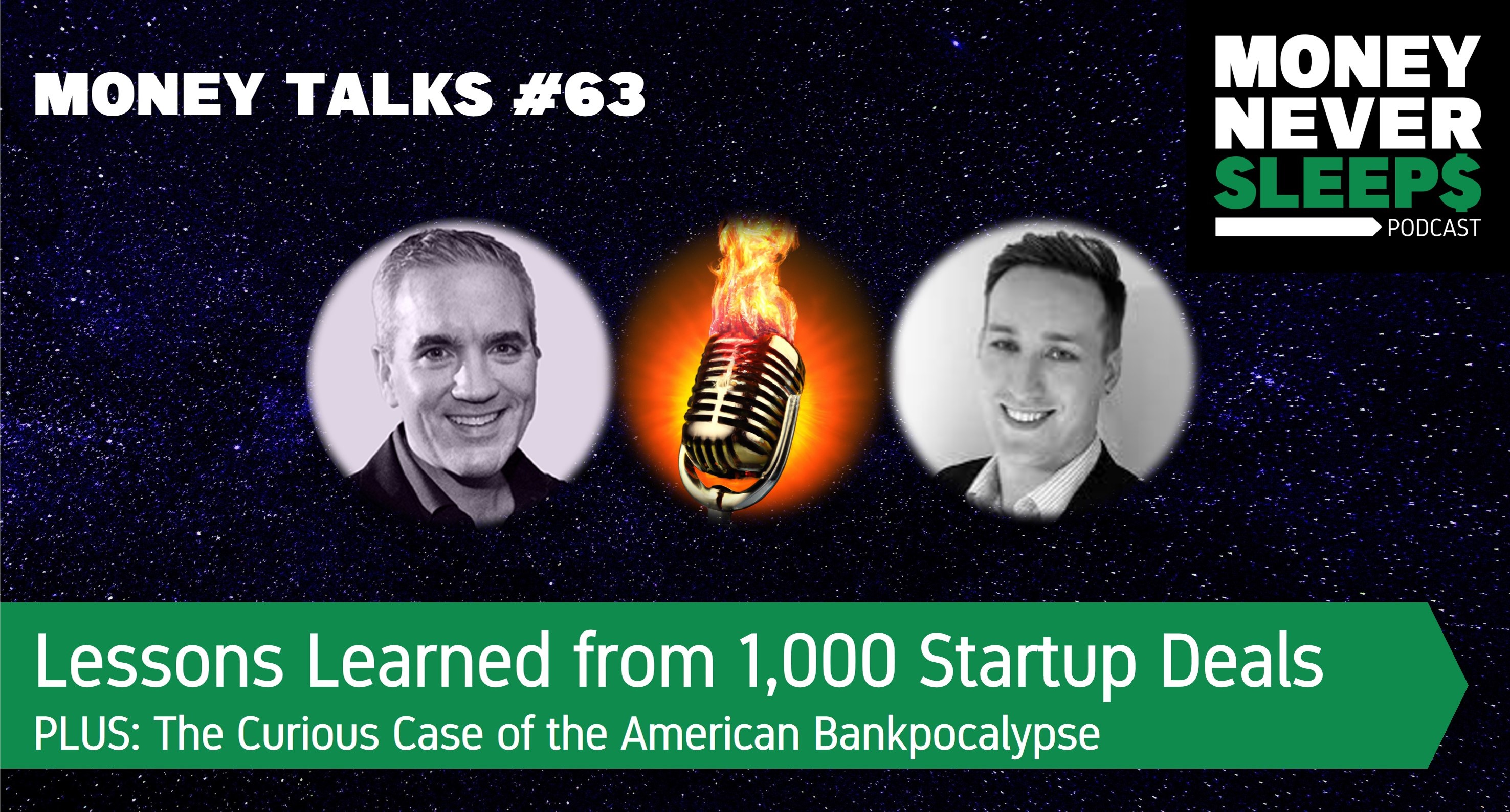
Eoin Fitzgerald and Pete Townsend take a quick look at the triumvirate of bank failures in the US with Silvergate, Silicon Valley Bank, and Signature Bank before Eoin asks Pete about his lessons learned from seeing over 1,000 deals in the last 18 months, so they riff on easy-to-remember mental models, investing in lines not dots, building relationships with founders, how those relationships evolve post-investment, and the founder having the most credible voice in the room.
STORIES COVERED:
When it Rains it Pours (Liang Wu, Life in Color blog, 13-Mar-23)
Signals: "SVB, Signature, & Silvergate"-gate (Nik Milanovich, This Week in Fintech, 14-Mar-23)
Should I Keep My Money in Bitcoin or a Bank? (Daniel Kuhn, CoinDesk, 14-Mar-23)
HIGHLIGHTS:
1 - Have a framework - something that you know cold and can work into a conversation with founders, and repetition is really the only way to build the framework into a true mental model. Pete uses the Techstars framework of ‘team, market, traction, idea’.
2 - Lines not dots - reaching an investment decision takes multiple interactions, multiple dots that connect to form a timeline. That timeline either reaches a peak and plateaus at a deal or drops off quickly and then crashes and burns. You need to increase the depth and breadth of those lines by bringing in people you trust to talk to founders you’re interested in and gather more insights.
3 - After the investment - shifting the narrative post-investment is critical, especially when the founder is raising their first round. You need to teach founders not just how to fish, but also how to find the right pond. That bank balance you funded as an investor will erode quickly if the founder doesn’t make it to their next round.
4 - The Founder’s voice - the founder has the most credible voice in the room, and they need to find their voice. After your own investment, you can do all of the coaching you want, but you can’t pitch for the founder. All you can do is make thoughtful introductions and hope they put their best foot forward to raise their round.
LINKS:
Sam Hinkie on Invest Like the Best episode 204 and episode 88
Leave a review and subscribe on Apple Podcasts | Spotify
Check out our MoneyNeverSleeps website and email us at info@moneyneversleeps.ie
Follow us on Twitter: MoneyNeverSleeps | Eoin Fitzgerald | Pete Townsend
--- Support this podcast: https://anchor.fm/moneyneversleeps/support
0:10 Hey there, I'm Pete Townsend, and this is money, never sleeps. We look inside the minds of entrepreneurs, and at the crossover of startups, Enterprise Finance, technology and Life. As we know it in this episode owned Fitzgerald, and I take a quick look at the triumvirate of bank failures, in the US with Silver Gate, Silicon Valley Bank and Signature Bank 40 and asked me about my lessons learned from seeing over 1,000 deals in the last year and a bit through techstars. So, we're if on easy to remember mental models investing in lines, not dots building relationships with Founders, how those relationships evolve, post investment, and the founder, having the most credible voice in the room. All right here on money. Never sleeps. Owen Fitzgerald.
0:57 That's me. How you doing pal? They do a sure. I'm not too bad and this lovely Wednesday morning with a. Look at my window. Yeah. Well I've already been outside once and I won't go outside again until probably about six o'clock time. Did the schoolroom? That'll be it know until I do the school run. Yeah yeah you know I did my walk and what II had again I'm listening a lot lately to the on the brink podcast with Nick Carter and Matt Walsh from Castle Island Ventures. Well, as what, three breakdowns with Eric golden, what three breakdowns, spin-off of invest like the best, right? So, Patrick o'shaughnessy's started doing, 083 Praises.
1:38 Breakdowns of familiar with ya, in order the web to respect your brake pads really, really good stuff. And I got a primer on stable coins this morning and I always like the primer episodes even though it's something that I may be familiar with already because you just get all that reinforce and you get that deeper deeper look after things and making lots of ins between stable coins and the eMoney regime and Mica in EU. So I was just kind of drooling over that stuff which was a lot of fun. That's my, how my own psychic mind works. I find I flick between a few depending I that's a lot of. It depends on the guest sometimes. Yeah, it does. You know like the property showed and I've got invest like the best but some of them I don't. If I don't know the guests enough, I'll be like I'll probably skip that one or I'll just go. If I'll go back to one of the ones that I really like and just listen to it again.
2:27 Yep. Yep. And you start see the circuit of different guest appearing on the same, you know, theme of podcasts and then the hosts of one positive end of the book. Yeah, yeah, exactly. And the host of one podcast appearing as guests on someone else's and they kind of trade back and forth on that. So it's like the this guy, Rob Hamilton, he's involved somehow with ordinals which is this nft project on top of the Bitcoin Network, which is, which is funny. It was Matt Walsh from Castle Island. Ventures was talking about it on the brink. Podcast and he's like, here's proof that Bitcoin isn't just some sleepy old project and I'm like for those in crypto to be able to say Bitcoin is just some sleepy old project but here the rest of the world talking about that they're like Bitcoin sleepy. What do you mean?
3:11 What do you mean? Looks like it's wide awake, I don't know what it's doing, it's all over the place anyway that's my that's my fun before the bait. Listen it terms of talking about things that are all over the place. Jesus the banking situation the u.s. right now is maniacally, I hate I hate. And we record and like, we put it out on a Friday and then some breaking news story, which is really relevant comes out like the same day and I'm like a for God sake. Yep. And we've just been talking about something else, like, two days beforehand and I know some story. I know I talk to Simon Taylor about this specifically, from fatigue brain food. He, and I caught up a couple weeks ago and he's I said the same thing. He's like, Pete, you just gotta let it go. He's like, you got to have a weekend. He's like, if you put stuff out, and then you finish it. And then the world changes.
3:57 It's just he covered next week, right? So yeah, here we are. And I like that. So here we are and probably just enough ink has been spilled at this point on, I know particular. And when I mentioned to you last night, I'm like, you know, you're right and so I didn't want to go through this in detail, but just for folks that may not have been paying attention. That first we had Silver Gate Bank, go a couple weeks ago and then we saw wasn't a couple weeks those 10 days ago. Flea. And then we had Silicon Valley Bank that went on Friday. When I say went, I mean, it's shut. There was a bank run that resulted in, okay, we gotta close the doors here and the FDIC in the u.s. steps in and does just that. And then signature bank, then also went over the weekend. And these Bank runs are really unique in that, it depending upon the Depositor, you have certain obligations if it's an obligation to yourself as an individual will find. But if it's an obligation that you have to investors, if you're a venture capital fund or an obligation, you have to shareholders if you're a startup and your employees and your partner's, then you can get into all different types of conflicting situations with what to do during a bank run. And ideally and I think it was I heard someone say this morning and forget which podcast to quote, but humans still behave with this innate core behavior, that existed Ten Thousand Years Is ago and you can't change.
5:25 And that means look out for number one, right? So, you know, there's been a bunch of ink spilled like you said about this over the past number of days. I am going to put in the show notes just three good summaries from people that we know or at least two of the three we know and have had on the show. So the angle, you did a good recap on the life and color blog, and he was on the show last week, the week before, and he did Called when it rains. It pours also Nick Milankovitch who we had on the show last year from this week in fintech. Did another good one called signals as Phoebe signature and Silver Gate gate. Right? Like Watergate and then Daniel Coon from coin desk. Should I keep my money in Bitcoin or a bank? And that was the interesting note that I got, from a couple people over the weekend like is crypto going to come out of this looking all shiny and we're crypto operates on this, you know, this model of Your keys, your crypto, you know, if you secure it yourself, it's yours.
6:28 If you hold it, if there's a hack of your exchange and you are holding crypto on an exchange, obviously that's a problem but that's not you holding it in your own wallet. That's you holding. Yeah you know assets on an exchange. So and this was when the person you know one of the messages I got from somebody said just that they were unaware that us DC had D pegged to the stable coin USD. See there was three billion in assets held at Silicon Valley Bank could be of the 40 billion of reserves behind behind the stable coin and that was over the weekend at the pegged. And then by Sunday night it was it was nearly back. So I said that was the only blip really for crypto out of all of this other than I think it's Elizabeth Warren in the US who is you know, championing the the fall of these banks that are involved in crypto and saying I told you so I told you crypto was bad. It's like ah, come on.
7:23 Yeah, get over yourself. You know. So you know I it's a story that will continue to develop people. Say, never let a good crisis pass you by. I think there's going to be a lot of changes perhaps at the VC level that comes out of this. Yeah. But I thought what I found interesting was sort of two things. First of all, like I think it was great, obviously in the UK that HSBC stepped in or ask. To step in pushed to step. Yeah, whatever look, that was good for the Marcus is what three? And a half thousand to more clients there in the UK. Do you know what is v b? So I looked over it, you know, you as well as you, you know, a good fuel, the team kind of across Ireland, UK the same way. I would say that was great for the business and for those kind of companies working with them and ultimately it work out very well for HSBC.
8:16 I mean, they got it for 1 pound and two billion liquidity, liquidity or whatever. So. Yep. I think it'll work out very well. They're very strong companies. Used to come up against spb all the time in Barkley's. They still look after the technology manufacturing telecoms clients and Seb was in everything. Yeah, yeah. Because they knew how to lend to them, you know, to ask business. So that was their Niche and they did it really well. So the likes of HSBC will do very well at a lot of say, in the long term you're a piece I think was, you know, there was a the immediate kind of high-profile contagion possibility in the u.s. especially in your VCS and companies and other Banks and stuff but actually To me the bit that they weren't going to quantify was, you know, the impact on people and I think like, you know, svv were lending against Equity against shareholding. First startup, Founders and stuff. They were the only show in town for that, you know, that's people's mortgages, that people's loans, they're caught their living, you know, their payroll or salaries, everything, and I don't know if it was necessarily something I could quantify, but that would have been a massive kind of knock on effect.
9:18 I would definitely definitely. I mean the the one that was, you know, rumored to be going next was First Republic Bank, but then that is drop what? 60% in other Equity drop 60 percent on Monday and then it shot right back up. I think the following day yesterday. So once it was clear that the the FED could perhaps be stepping in there as well. So hopefully you know that's like a that's a bank run. A verdict. You can't stop these Bank runs. It's nuts. No it looked like on paper. It looked like are you excited a commentary in order? Didn't nobody wanted to bail out the rich billionaires and the VCS and all that but actually it was the You know, once the domino effect of the people on the ground, in the startups, I saw tweets from a couple of startups where they might have closed around recently and all that money was sitting in Silicon Valley, but yeah, you couldn't taste offerings and I thought so but again, you know, because they were so good. What they did they were the only one able to do us which meant that she was such a massive concentration risk. When VCS are getting funded by them and then they're getting their portfolio companies to work with them, and everything was just a circular route back to Seb. Yeah, and that was the point.
10:23 Of one of the points from on the brink. Yeah. Was that particularly? And, and this is more due to the crypto side, but the concentration of activity at banks in crypto friendly Banks, is that by the FED saying to some of the bigger banks that sorry, you know, you can't Bank crypto that that then pushes all of the crypto players to concentrate in Banks smaller Banks, where they will be banked. And that is Risk and the fat is had to step in to bail out particularly Signature Bank. So the policy needs to change their at the top as well and I think it's just this stuff.
11:04 Is your inadvertently creating the concentration risk. You are you policy arm? You are and I think we just need it's going to take you know we talked last week about the web three gender gap in changing Society, one year at a time and you know top-down and bottom-up. I think you know changing the view Towards whether it's Society or individuals or politicians or businesses viewing that, listen digital scarcity is a good thing. This is actually a technology that you cannot put back in the box. So let's let's come up with some policies around it and I'll keep saying it the EU or steps ahead with with mica. But, and that's it. I'm Mika will change things and make a will allow Banks to play in that space.
11:46 Exactly. As it'll be a bit clearer and radiation. Yeah, it won't be fit for everybody, but, you know, the majority will be accepted then in some ship of order. No, what's needed? And that'll open up the market a lot more than it will. It will. I know, I could talk all day on this topic but that's probably, that's probably all we need to say on that. Yeah, it's like leave a couple of links. I'll send you for the show notes. Mark, Rubenstein net interest is a newsletter. I subscribe to it. Excellent. He writes really well on banking Financial Services. He put together a really good piece on SV, B and the downfall and evidence. I would stick that in the show notes as well. Very good, very good. Yeah, like Forrest Gump says, that's all I have to say about that. But speaking of podcasts earlier, and actually would have been a far better Segway if we'd gone into that in the middle.
12:30 Yeah, no, I was one of the ones I listened to regularly is invest, like, the best Patrick O'Shaughnessy, but like that one, I go back to a lot. He has two episodes with Sam hinkie who used to be the GM for our, the assistant GM for Houston Rockets. Yep. And then the GM for the Philadelphia 76ers and I suppose is one of the pioneers of analytics in basketball. Daryl Morey was his boss at the Rockets. He was these like the main man who was at Mount Rushmore as they call us there to be just those two guys on. Oh yeah. And he's out now doing his own. He has 87 Capital its own investment fund, but he has two great episodes. And the last one, actually, the more recent one, will put both of my show notes. He was Patrick O'Shaughnessy, was interviewing him obviously, he was asking him about, you know, any kind of contrarian views he has in relation to venture or things that he would have taken from, you know, his basketball learnings, and applied to kind of venture. And one thing that struck me was he's like, he doesn't believe in This idea of making kind of a quick decision on somebody, you know, all within the first 10 minutes. He decided, I like this founder.
13:28 I don't like this founder. It was kind of struck me because some see between me and you like, we look at a lot of stuff on the course of a year. Over the course of the last number of years and like that it's easy to jump to a kind of instant judgment or no, I don't like this. I'm not sure, I like this founder. But he was teased talking about, like not what he called breadcrumbs. Not only multiple kind of meetings but like looking us put stuff people put out online or You know, he even as far back with the companies investing in, he goes back, and looks at what tsys, they did in college and stuff like this. So his is probably to the extreme, but it got me thinking that we might have a chat in particular about your learnings over the last because you've gone through two cohorts now in terms of applications.
14:09 Yeah. And of the your work with Legos, that's probably a thousand or more at least in the last war zones that I've looked at deals that I've gone through my eyes that's just on tech. And and I remember back a few years ago with other partners, Trying to get funds off the ground and some of the investors. The fund investors that I was talking to was that we're saying listen where you going to get the deal flow from? I'm like I don't worry, I'll get it right. But I think the criticality of high-volume deal flow is now baked into my mind in that you need to put yourself in a position. You need to be out there and talking about what you're doing in order to get deal flow in order to get people. To say, yes, I want, I would like you to invest in what I'm doing and That, that volume that I've seen, you know, that point about Sam hinkie and building relationships and not investing after the first meeting so critical. That the term, that the line, that, that I keep saying is investors invest in lines, not dots, right? And if you think of that line that goes up, you need that line to be an increased font or an increased weight and need to find ways to increase the depth.
15:22 And Breath of that line. And so these multiple interaction points that you have. I was saying to a Founder yesterday. I said, listen, we're in a situation where we just spoke with you for the first time, two weeks ago. Usually in this type of setting we're talking to people for 6-8 weeks ago and we're having numerous interactions. We're getting to know each other and what tends to happen is that you can like someone right away or perhaps you don't but if you really like their their their This and there's a framework for this. Then you're going to talk to them again regardless of whether you like them or not, right? Because people don't always warm up to people right away and also you need to be a student of your own subconscious bias, right?
16:11 And say, like we talked about last week. Did I like them? Because they remind me of me? Or did I not like them because they don't remind me of me? Or did I not like them? Because they do remind me of Of me and I see some of my own faults in them, right? So you got to give these things time to develop. But anyway, when I say invest in lines, not dots having those multiple interaction points, what tends to happen is that you build up over time and you either plateau and you get to the point. Where, okay, we're seeing eye to eye. We both want to do this. You want me to invest in you, I want to invest in you, let's do this or you get to the point where it's going up and up, and up, and up. And you can have the similar Exact Track between two. Deals one that you say yes, on one that you say no on and what I'm just crashes and burns because something happens because you like, oh I didn't know that or they figure out that maybe it's not right for them and if all species, but if we had pulled the trigger, you know, three weeks before that, just on the basis of the first couple positive interactions. That deal would have fallen apart, right? So I mean that that's the first thing really is just that these things need to be done with time and if in a if a start-up founder ever gets frustrated, because if you see is taking their time, then you kind of do want them to take their time. Yeah.
17:34 Because whilst the fundamentally, it's a transaction. Like it is a long-term relationship. So it can't be transactional. Now, even though it is a transaction that Or trying to do, ultimately. Yeah, it needs to be a need to be based on building that relationship and you need to have a framework as well. And seeing the high volume of deal flows, does train your brain to think about your framework, right off the top of your head, and you need to have the ability to do that. The one that I follow is the one, and when you're investing precede, it's all about team, right? And that it's the four things. I look for our team Market traction.
18:18 Product or idea. What are each one of those, right? And when you're having a conversation with, someone generally, those conversations start out there, very, very product heavy, and you need to have the discipline in order. Even if you love the product, you need to move into the team. Tell me about how its constructed tell me about the market, your experience in that market. Tell me about how you're doing so far with getting people interested in what you're doing and you need to have that type of balanced approach. And if you're just making decisions based upon hype of a technology or a product, and you're not going into depth on the team there you're, you know, you're not going to get anywhere with that because because I think, I think you can make a quick decision on the opportunity because you might have looked at 10 in a similar Market.
19:06 Yeah. He's like, yes, this one, this one gets it. This one has the opportunity, you know, that's an easy art, it's an easier decision to make quickly. Yeah, yesterday obviously, it's the team under the phone or piece takes longer. Yeah. But you know, I, I've been at this age where I've got, I'm trying to make a hard decision between three that are all doing kind of the same thing. And I'm making my decisions based upon the team, how much traction they have, and how well, they know the market. So some of these tells write these signals that I look for when I'm talking to a team. Zoom is great for this, right? You could see eyes rolling when one founder of speaking and The one doesn't like what they're saying.
19:47 You can hear them talking over each other. Zoom is just so helpful with this because you're looking at both faces at the same time or three phases at the same time, right? You're also looking for Mentor, ability, will this person Listen to Good Advice? Will this person know, a bad advice is and are they flexible? Are they self aware? Do they have that humility to know that they don't have everything and they're not always going to be, right? And there are ways to, you know, just two types of questions that you ask around that. and there are there questions, you might post to somebody that you'll like this one where if you have a doubt that the founding team has strong commercial ability to execute and to sell You got a test for that and I put one founder on the hot seat and said sell me this Messi Jersey, right?
20:40 I had it my other, this pain, exactly. I had my son's Lionel Messi Jersey and he is the founder did a great job because he was asking me questions about, you know, trying to build a relationship with me. He was trying to build a relationship with me and asking me. It was a fan of messy. What football teams did I did, I watch, did I? Did I watch the World Cup? What did I think? Blah blah blah. All this type of stuff. Before we moved in for the cell, I'm like, okay this founder has some good commercial sensibility, around them. Another one, I had some doubt on and I said all right. Can we find your Killer Instinct here? Can we find your kind of overt outward sales chutzpah?
21:23 And he's like, well it's not very British, right? And I said, well let's think of somebody who's a Founder that you admire and he said Tom Bloomfield from Manzo and I'm like, yes. Tom has his understated technique of influencing people and getting them on board. But we know from, at least, I know or at least and Bowden represented it this way that, you know, Tom isn't exactly a quiet shy understated guy, right. He knows what he wants and he's going for it. Just the way that he comes across as more in line with his own personality, right? So you know, there's There's different ways to look for this. And then also with the team itself and especially when you've got, you know, because we're making a purposeful attempt that we want to bring more female Founders into this accelerator program and that when you see how the male and female of a team interact, and, you know, there was one and I don't want to get into too much detail because I Don't Wanna Give it away, but there was one that was like, last year, man, that was just it when I say, man, And I mean, man, in the way that he talked to his fellow founder, who was a female and it was like, we're not going there, we are not going there. So, you know, you're all tired to test for those kind of some of those kind of traits early on, I find like, you know, trying to figure out someone's kind of like that their Killer Instinct mainly or their ability to lead because obviously to turn a position things in a
22:55 particular way. But in trying to identify if the founder, you know, Has the either the skill set or, you know, the perseverance to kind of make it work. Yeah, yeah. And I mean, that's where that's where the market is. So, critically important as well. Does that founder have deep first-hand experience in that market? Do they know the market? Not only do they know the market, but do they know the channel? They're going down. If they're going down a B2B channel, do they have B2B experience. You're going down B, to C. Do they have B to C experience if they're going B to B to C, man? That's really hard. So do they have experience with that? And these are all questions you can ask. You can look at people's LinkedIn profiles, go only to a certain extent, you've got to ask the question, you've got to bring in other people to help you vet them. You've got to even, you know, I know one investor that just randomly will call people that, you know, say oh hey I saw your LinkedIn profile.
23:48 You might have worked with so-and-so in the past. Can you tell me about that? And sometimes you get some some information sometimes. You know, I hang up right. But like that you need more a some hanky calls, a breadcrumbs or data points, you do because like that you're, you know, you're lying is not open to the right. It's not a straight line. It's not so lots of dots leading in a particular direction. Yeah. Or pieces that, you know, help you make that decision. Yeah, yeah. Oh absolutely critical. And it's like that line that's going up it up. Having other investors mentors. That I know. Well, talk to these Founders just to get that different It is so critical and you may catch someone. I good day. You may get someone on a bad day, then they have another conversation and it can flip.
24:32 Also, you need to be very aware when you're investing globally and the impact the getting people at a bad our right? You may have a terrible conversation with someone because it's 2:00 in the morning and that was the only time slot that you could do and because they're thinking about, well this I really want to, you know, I want to work with this investor. They may agree to do something at 2:30 in the morning and, you know, people are night owls, sometimes, maybe they're not and And you, you know, or you get them for a first great conversation, the middle of day, and then, you know, in the middle of the night, things just fall to pieces and we'll give them a chance to talk to him again on their normal hours. But, you know, you can always get people at a bad hour. And that's one thing you got to be very careful of when you're investing globally and just be mindful and respectful of what time it is in other time zones, right? Always got to do that time.
25:19 It is. It's, are you guys going to say how do you find? Because I suppose we're both. But you know, I'm obviously not of not, I'm investing but not as a VC, and then your were were not to traditional investors. And obviously techstars do things, a particular way, how do you find our how we found that based on with both of us being students at a game for want of a better description? You know, we read and absorb a huge amount of stuff from the more traditional VC world and then trying to fit that into our own kind of particular investing or our businesses investing kind of philosophy. Yeah, yeah, it's been interesting. And this is, you know, I mean, techstars, the techstars way is team team, team Market traction idea, right? And that is ingrained into my head. Now, you know, it's to me, it's Team market traction idea and I can have a conversation around that and the ability to do that. Like I said, only comes from repetition. And so thank you to human GE the investment principle on the texts are swept through program with me who could continually pow Pounds us into my head.
26:25 These four things we need to look for. We need to test for, right? So you need to have that framework. And I remember in the prepping for demo Day last year, though that it changes. So would you make your admission investment decision? When you're doing precede, you can use those four criteria but then when you're testing, how well that they're presenting themselves for investment from others. You need to go back to your 10, right? And I'm not going to Rattle all of them off because I'm not going to get them all. Let's see if I can. Okay, vision problem solution Market that you're selling into.
27:12 your go-to-market plan, your team, your traction, your competition, your Oh, I just had it. Wrote roadmap, your roadmap. I don't eat. And I only say that because I have some here in front of me, you sent me out of order on my screen and the ask, right? And you need, you need to have all ten of those. So, when I was doing last year, the demo day preparation with, and having people pitch over and over and over again, until they have it down cold. I was testing for all 10 of those things. Now, we don't do the Askin, the techstars pitch because that's investors solicitation.
27:54 But, you know, that, Close up afterwards but the you know so it comes down to nine and that's when you shift gears a bit. So when you when you got to bring somebody in you're doing it based upon these four key criteria but then when you're going to actually help socialize this deal to other investors. You need to hit a lot more criteria, right? Because they're going to be tested on a lot more at, you know a seed stage or you know getting that first round done. Then it would have been when I'm investing precede, right? And I was saying this To someone yesterday that I always feel like if you want to master your level you need to master the level one step before you. And that's Angel right?
28:35 Angel Investing and that's why I'm such a student of folks like Jason calacanis read. His book did his Angel course online and you know I would like to even get further in depth, are you know, humor gar said to me? Well Pete think about that, but also think about series a right? What is it? That we need to help Founders Master themselves. Based upon how series a invest, right? And how you know, true seed stage investors invest as well. And actually that's that's an interesting point because it's going to one of the things I was going to ask was, you know, It flips, especially obviously with the techstars model uses very intense period of work with these companies of the evaluate them in detail.
29:16 Then you work with them very closely but then there must be a big shift in the nature of the relationship. Even on the other side there is and that was what I was picking out my you know by few Lessons Learned here. There is that point of that shift that okay. You get your lines not dots and you know like we talked about, so have your framework critical, you know, and whatever that is, whatever that works, you something. It needs to be baked into your mind that you can do that. You can reach to and use over and over again in the course of a conversation Colt, have the multiple interaction points lines, not dots. Absolutely critical. Then you kind of get into the fold with somebody after you've made that investment decision. The thing about running an accelerator program, is that you've got those 13 weeks after you've made the Investment decision to really get them moving and get them moving faster.
30:07 IE the term accelerator right? But there is that shift you're getting to know each other. You're trying to figure it out. You're always trying to be in a position of not saying hey tell me what you're doing today or give me an update on the business over the last week, but what can I help you with today? How can I help unlock some value? How can I help make an introduction? What is the main thing that you're worried about today, that I might be able to help you with today? Send me your email. Please. And I'll read that on how everything's going. But let's concentrate our focus on helping to get you moving in the right direction, on what you're struggling with today, right? Which is the sometimes the hardest thing to do because you're always looking for more contacts, always looking for more information but that shift from. All right, we're we made the decision, the money's in the bank.
31:00 We're moving forward with this, we need to get you and then Bridge, you Logically and learning wise to getting that first round going. And it's, you know, it's a whole different mentality and shifting into how Pete like we talked about last week, how people think about raising money from VCS? And this investor pipeline mythology methodology that I teach. And with again, a shout-out to Jenny Fielding whose method, it is that I've just fallen in love with the method, not Jenny and what Jenny is a rockstar. I'll give her that and but it's it's a process that you go through and you need to do deep, deep deep research. The biggest thing is, if you're getting tons of nose from investors, sometimes.
31:43 That's right. It's, you know that you should be getting a no other times. It's that you've researched the wrong. You are not attacking the right list. You're not hammering that right list to make sure you can get intros to all those people. I'm going to help with those intros and techstars going to help with those intros. But you need to do the work to identify who are the right investors for you. You always need to be the mindset that investing in my business. Should be a freaking pleasure for investors. This is the best deal they're ever going to have. Now, you don't say that and you don't carry your yourself that way because that's incredibly arrogant, and you're going to upset a lot of people, but you need to be looking at the investor landscape.
32:27 As if you're this, you're, you're a crazy salesperson targeting customers who are the customers. You really, really want to have that is going to be strategic for you. They can help you to get other customers. We're going to be the investors are going to, you're going to build a great, strong relationship with this going to help you get other investors and help you with a whole bunch of different things in your business. That's Mindset, you need to have. So when you start thinking about building your investor pipeline, it needs to be done on the basis of who the ones that I think, I'm really going to build a great relationship with that. I'm really going to like they're going to like me, We perhaps have something in common, you got to do a ton of research around that and that's that's no small piece of work and you just got to start attacking that.
33:08 And that is, that is the shift and that is the shift from we've made an investment to how do we actually get others to invest in this business as well? And It's a two-way street because you can teach some what you really want to be able to teach someone to fish, you know and and that you're not going to hand anything to anybody on a silver platter other than a warm intro, right? If the person that's still the founder that's asking for an introduction has proven to me that yeah this is an investor that they really want. Here's why? Because then I can go to that investor with tons more conviction. You know, and that because I'm not going to introduce a deal to a VC that I know that VC is not interested in that kind of deal, whether that it's a stage, no matter how.
33:58 Well, I know Mike Brennan from French Capital, I'm not going to introduce precede stage deals to him because he does not invest proceed. And now no matter how much of a nice guy, Mike is and how much I like him. And, and that he and I have known each other for years. I'm just not going to do that because it's it's a waste of his time. It's a waste of my time. It's a waste of the founders time doing the research and getting excited about the fact that I know Mike. Right. So, you know, it's Daddy that is such a big massive part of it. You know. I think going along with that that you definitely have to be supportive. And that's part of why I love doing this is that I love working with Founders.
34:39 Right. I love working with early-stage Founders and I love the upside as well. Right. Which is which is critically important. So there's I'm incentivize to be supportive and I'm a naturally helpful. Person. So that is good as well, but you gotta let them stumble. You got to let them make their mistakes because it's the only way that people learn this through making the mistakes themselves. If you know, and you can't go on every pitch with them. You can't should probably shouldn't go as an investor. It's an early stage investor, you can't because it's the founders voice is the most credible voice in the room. You know, you need to let them do it and in terms of even your own mindset. I know I find find a challenging at times when you're working with companies of different stages and in terms of even adopting your Own role and your own kind of mindset you because of the your knee deep and probably close to announcing your latest cohort and get not kicked off at the same time working with last year's cohort to have made different progress at different stages.
35:36 So you're trying to you're managing two different or like two portfolios companies effectively in different stages. Oh yeah, absolutely. And you've got, you know, and I'm saying to all of them. The first nine, I said your logos are up on my wall. I'm looking at your logos all all day everyday. There's going to be another 12 that are going to be joining that wall. Okay. In the next few weeks, get your request in now, you know because while it's still fresh that if you know, because a lot of companies that came out of the crypto struggle last year that were initially going to raise via a token sale that that market disappeared dried up so they had to they had to Pivot their strategy, not pivot their business completely but pivot. Strategy.
36:25 And so now a lot of them have just come back to the fundraising campaign. Now because the market starting to come back a little bit or you know, this banking problem is hopefully just speed bump. Now it's important to point out that when we went down the path of sourcing Founders last year for the program, that the crypto markets when it word is much different shape than they are. Now, what we've been able to identify is Founders that are like, well listen, you know, we're still in this. No matter what's happening with crypto, we're still here building because there's so much to be done in web three. And so, you know, we're getting Founders at little bit of a later stage now, just because of how fast the market was moving last year, things have slowed down a bit. People are thinking longer and harder about actually doing this so but you know, it's It's definitely a different situation and now I'm going, you know, we'll be up at 21. Portfolio companies and, you know, have five from previous from before techstars.
37:28 So, you know, getting up to the stage of Jesus, looking after 26 companies. Yep. Listen, I'd have a whole list of things that I had written down. As I go, we must chat about that and we must I must ask the go go for it. Even though I was going to say that like there's so much we can we should really bring it on to a second call. Yeah. And you know, be good is to do this with another investor. You know, an inch and a few and I know we have a couple of lined up someone probably coming Ash in a more traditional VC role but maybe not, but a traditional background because, you know, lots of people from lots of different backgrounds end up investing. It's always interesting to see what they take, what they take from their previous life into it. Yeah, yeah.
38:09 And just to bring it back, it's deal flow. It's all deal flow. I remember sitting down with a VC in 2019, and with one of the last VC projects, I tried to get off the ground and that investor said, to me, Pete, you're not going to get the deal flow with this strategy. You will not get that deal flow for the geography. You're looking to do. I said yeah. And and it's so true and getting deal flow is not just about market dynamics and where people are, and where they're starting up, but it's about your presence in the market. You can't just sit back on your laurels and way for people to come to you. You got to go out and find people. You got to go out and get them, and that's an end. You know it's not a tap that you can just turn on. You need to do a lot of work in order to get yourself in a position.
38:56 Where if you go out you start speaking to the world that people listen. And you get that audience in people like okay. Well, yeah that you know having a podcast helps right? So but yeah no I and and you know I always love to talk to other investors about this because you just can learn so much from a simple conversation. That's it. You know you can learn so much. And like we said last week, that that one chat or that blog post from Finn Murphy from, you know, A few years ago that just crystallized that for me of every investment you make, needs to be done on the basis, that it will be a home run, that you will get 100 x as an investor. You'll get 100 times your investment back because you might out of every 30 investment to make you might get to. If you're lucky one, that would be that home run, that would return your fund.
39:52 So we will have to watch this place to see, which one of your 26 is the Home Run. Absolutely, absolutely. Hopefully all that, they ought sake. Starting to be in your favor, the more you do. Well, do you know that's the thing with it with you know, one out of what is it? Nasty five percent of startups fail and you know, by putting them through a program of the first 13 weeks and building that relationship and building that trust can, hopefully get things to a position where you have your lowering those odds. You're lowering those odds of failure, you're increasing the odds of success. And that's what that's just what I try to do. What we can do. Yep. Burn it. All right. Well, let's see who we can get on to have a further chat about this. Yeah, sounds good.
40:35 And you enjoy those emails coming in and we'll talk to you next week. That does it for this week folks, you can learn more about the stories. We covered the show notes on our website money, never sleeps, that IE, if you like what you heard, please leave us a rating, and, or review on Apple podcast or Spotify. Is it helps others find the show? Thanks to Kona Brophy from creates out, for mixing. And editing this episode Kona is an excellent medium and to get in touch with when you're thinking about launching your own podcast. As for me I'm an early stage, startup investor focused on were fin techniques crypto. A crypto meets web 3 and I lead the textures. Web three accelerator. There are plenty of links in the show notes on money. Never sleeps data on how to get in touch with us. Us. So don't hesitate to reach out finally till next time.
41:18 Thanks for listening. See you Us. So don't hesitate to reach out finally till next time. Thanks for listening. See you