Spotify

 Apple Podcasts

 Amazon Music

 Overcast

 Castro

 PocketCasts

 Castbox

 RadioPublic

 RSS Feed
296: The Unstoppable Founder | Allard Luchsinger from Techstars
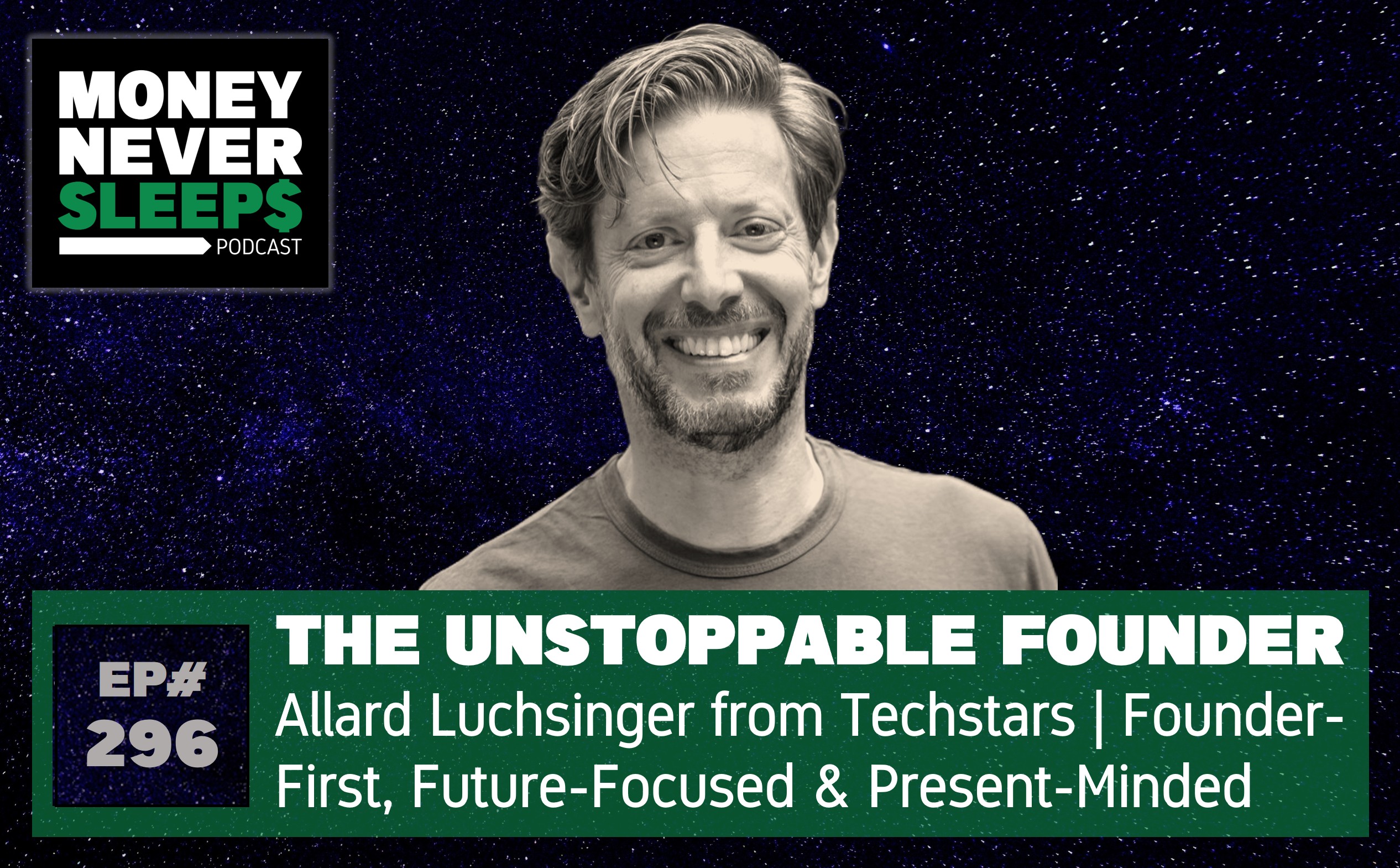
This week, I sat down with my longtime Techstars colleague and friend Allard Luchsinger, Managing Director of the ABN AMRO + Techstars Future of Finance Accelerator in Amsterdam.
Allard and I have been on each other’s investment committees for years, so this conversation hits a bit differently. We’ve traded notes across dozens of startups, and we’ve seen each other call the shots on what makes an unstoppable founder. That theme became the golden thread through this episode.
We get into Allard’s journey from building startups during the dot-com era, to co-founding a zero-commission trading platform years before Robinhood, to leading one of Europe’s most respected fintech accelerators. We also dig into:
-
His experience investing in African fintech and why mobile-first changed everything
-
The early signals from AI and how they mirror fintech’s formative years
-
The conviction you need to invest at pre-seed when all you have is a deck, a founder, and a feeling
-
The power of mindfulness, presence, and early-morning meditation
-
Why stablecoins and tokenized assets are quietly rebuilding the financial rails from the inside out
This one’s full of hard-earned wisdom from someone who knows both sides of the founder–investor equation, and delivers it all with a calm clarity that hits home.
LINKS:
Connect with Allard Luchsinger on LinkedIn
ABN AMRO + Techstars Future of Finance Accelerator: Website | LinkedIn
Leave a review & subscribe on: Apple Podcasts | Spotify | MoneyNeverSleeps (website)
Email us: info@norioventures.com
Pete Townsend: X/Twitter | LinkedIn
MoneyNeverSleeps: X/Twitter | LinkedIn | Newsletter
0:05 Money never sleeps, pal. Hey there, I'm Pete Townsend and This is Money Never Sleeps. We look inside the minds of entrepreneurs and at the crossover of startups, enterprise, finance, technology and life as we know it. This week I'm joined by my long time Techstars colleague and friend Allard Luxinga, Managing Director of the ABN Amro and Techstars Future of Finance Accelerator in Amsterdam. Allard and I have been on each other's investment committees for years, so this one's a bit different. We know each other well, we've traded notes across dozens of startups, and we've seen each other call the shot on what makes an unstoppable founder money. Never sleeps. Well, in this episode, we go deep on Allard's journey from building startups in the early Internet days to running one of Europe's most respected fintech accelerators. We talk founder conviction, investing in Europe, investing in Africa, the parallels between AI today and the early days of fintech, and how mindfulness and meditation can give both founders and investors a competitive edge. This one is full of hard won insight, but delivered with Allard's signature clarity and calm. And it's a conversation I think a lot of us in this game will find helpful.
1:18 So let's get into it with Allard Luchsinger. All right here on Money Never Sleeps. Listen, Allard, you've been part of the venture industry now for the past 15 years and in the ecosystem in a number of different ways. Maybe start with how you found your way into this, into venture and and why you're doing it. I was a founder. I started my first what we then called Internet business in in 99 and it was AB to B marketplace for the trade in new passenger cars. And we were three guys and we didn't know anything about cars, but it was the Internet and we had three years of working experience. So we knew everything and we were going to revolutionize the global car trading industry.
2:07 That was the goal. And we did extremely well for a period. So it was an amazing ride and it was like the full Internet bubble ride. And then in the end we died pretty spectacularly. They imploded, which is probably my biggest learning. I was the CEO. We bought it until for like 50 people and we raised €30 million, which is all money at that time. And then like in one day, weird day, the whole business model fell apart and that happened. Yeah. So we in the end we found product market fit by like basically our platform facilitating the trade between continental European car dealers, specifically from the Netherlands, whole bolt cars with the steering wheel on the wrong side, as we would say and then send them over exported them to the UK.
2:58 And that was a tax arbitrage, which is weird enough at that time, 35% arbitrage, you had all these huge, not car supermarkets with these cars boiling from another Europe in the UK. And we facilitated that trade. And that was like, we, we, we did 4000 cars on our platform And I this was the thing. And then the UK # dropped by 10% against the euro in a week. And our buyers in the UK just stopped picking up the phone, stopped picking up the cars. And so we had all the Mama Bob dealers in an eligible 200 cars with the steering on the wrong side, parking them in neighborhoods because they couldn't. So and then their buyers just wouldn't pick up the the cars anymore and we thought we had contracts, but it turned out like these contracts meant nothing. So within a week turned out that our whole business model was basically totally, I go the basic mistake in our business model and structural wrong and we lost all our buyers and all our sellers and that was it.
4:01 We basically then I fired half of the people tried to kind of keep on going with that, but we never really recovered everything went very badly and we closed down a year from then. So I did the what we then call B to C thing back to consulting, back to banking. You might remember that and and then started another company a few years later, which is a fintech company and and now I actually had some experience doing startups and two guys that I didn't know we got we got introduced, started his company and they needed a third Co founder who actually knew something about building a company. So we started this this company, which is basically the Robin Hood model 0 Commission trading in 2005 with one other guy from Amsterdam, we left for US to build a business. He didn't know anything about online brokers in the US, but we thought, hey, you know, why not?
4:52 How hard can it be? Turned out to be very hard, of course, but you know, we kept on going at it. We actually couldn't make that 0 Commission model work because customer acquisition costs were just too high. We didn't have that new platform that Robin Hood had later, which was the iPhone, but ended up building a quite a sizable company. And the largest investor in that company was actually a family office out of the Netherlands. And during the financial crisis, which hit us like full on a year into the business, like, you know, first, first business, it was the talk combo bursting that hit us. Timing is everything right, but this time our family office investor turned out to be like super loyal and committed to the business and really helps us through that difficult phase and allowed us to keep on building that business.
5:38 And at some point we left the operational management of the company. We were then 120 people, all of them from the US and all of them knowing much more about all and brokers probably than we did. And so at some point my Co friend and I left operational management, went on the board and then this investor asked me to build a fintech focused VC with him. But that got me into venture. That was in 2011. And this is a time that like when he asked me to do this, like, hey, I've got this thesis, which is basically financial services and the Internet and you know, it's going to be a big thing. And of course, you know, with the company we built, Secco, that was his first investment in that, but he really believed in it. And so I said yes to that and built this VC firm called Philosophy Fintech Ventures and we invested mainly in Europe and in Africa laid seed Series A which would now more be I seed almost presumed and seed right.
6:36 And we had a great run of that. We knew the for 10 years and became a fund. We took outside investors in and at some point that they do really didn't work for him. I became a partner in that and after 10 years we broke up a friendly breakup after 16 years in the fintech space. I actually didn't know what I want to wanted to continue there what I wanted to raise a fund. I didn't take a sabbatical and was happily in my sabbatical during COVID. And then at some point text article and they're like, Hey, we're looking for someone with fintech founder experience, Fintech investor experience in Amsterdam available. And you know, if possible some affinity with AB and Emerald Bank, which I had all of affinity with because I, my first startup, I actually partnered with them and as a consultant at my very first job, I, I worked with them very extensively. I think there's one guy in the world that fits that profile and you have all the phone.
7:31 That's me. So I, I didn't see yesterday immediately. Yeah, because I was working on some other projects and I knew that was like a very low probability project that we were going to acquire this funds platform. And I gave it like 25% that I will work. But I, I told Texas, I need to see this through and they told me why it doesn't work out, you know, check back in. And because of COVID, they postponed the program for half a year because didn't want to do another one like fully remote. And so there was still time for me to get on board for that program in 2022. So this is how I started with Tech Stars. And there was a this Fintech accelerator program with Barclays that ran in London for about 10 years and that had come to an end. And the at that time MD in London moved over to Amsterdam to start the program with ABN Amro and basically took all the assets and the mentors and the programming and amazingly continued that Fintech with the European Fintech program in Amsterdam.
8:31 And I followed him, him up. This was the first in person program. And we're now going for our fifth year, my 4th year running this, this Fintech accelerator, Texas Fintech accelerator out of Amsterdam. All right. And something you said they're back a couple minutes ago struck A chord. And I saw this in your LinkedIn profile, Allard, even though we've known each other for years, I went back to obviously look at your LinkedIn profile to find a couple of things. And the Africa connection, there was something that was important to me because I'd been on the board of an Irish fintech for six years and they just had an exit. But part of their big GO that they they have partnerships with and that they sell in is in Western Africa, and there's always been a bit of a affinity that I've had for that part of the world in terms of its appetite for fintech.
9:23 With your focus on European fintech, what lessons did you learn out of looking at African fintech that you think enriched your view of the European Space? So I'm the only thing very passionate about fintech in Africa. I my first connection to that was that after I came back from San Francisco and we came back to the Netherlands, I go in touch with a friend of mine who lived in and we had a fund out of out of Kenya and they were making an investment in this company called Settlement. And they were looking for a board member, someone who actually knew about startups and knew about fintech. And so they ended up with me and I joined their board, actually just before I joined a philosophy. And then it took two years for them. We, we did the Series A with, with Cello and then became an investor.
10:14 And I stayed on that board for about 10 years or nine years. Also the principle of our fun really liked Africa and the, and, and it got very enthusiastic about it. So we made two more pretty significant investments in Africa, one in Nigeria and one in South Africa. Oh, Fintech, of course. And, and so I spent about 50% of my time actually, you know, in Africa Fintech over that 10 year period. And I always say there's, there's basically 1 thesis for Africa Fintech. I mean, it's made me simplifying it. And that is that there is like a billion people in Africa. And when we started 750 million of them, we're not connected to the formal financial system. And basically the thesis is let's connect the speed. And that's a massive business case, but it's also, of course, a massive impact case because like there's hardly anything you can, you can better do for people that are not connected that to, to connect them into the, to the financial system and you're giving them access to payments, to loans, to all of that.
11:21 And the power of like fintech in Africa is being mobile. It has changed everything. There wasn't the possibility for basically real fintech or financial inclusion in Africa before fintech was there. The mobile phone changed everything and allow kind of every person even with a very simple I hold Nokia phone pure SMS based to be connected into the ecosystem. And so it really told me the impact that finance serves to have on people's lives. And that's one and how it really can be fortunate good in the world. Also bad, by the way, because the moment you can do this, you get predatory lending and there's a balance that is sometimes hard.
12:03 But also, you know, the power of that platform and the powers of platforms in general, like what mobile could do for a whole continent is like it transformed the way people could live there. So that has never been so clear to me, as you know, has become incredibly clear to me because of the experience there. And you see now with a new platform being AI like that probably will have like a similar kind of effect on the whole world as in this new platform could change everything. So the power of that became incredibly clear You. Know you just hit on something here. Do you think that opportunity of realizing that, you know when you started that there's a huge opportunity for financial services on the Internet or Fintech, that looking now back at Europe and seeing how few people are connected to AI and seeing the big opportunity for financial services on AI on the Internet, Is there a parallel there? So the basics are different in that way. That's like we have specifically in Europe, most people are connected one way or the other to Internet. And like even much more than for example, in the US, most people have bank accounts and are connected, right? And I think that one of the interesting things about AI is that many of us will have the gut feel that everything will change and everything will be different. But it's very hard to see how exactly that will happen. And I wish I could tell you differently, but if I like, I've never been so uncertain and
13:34 unsure about the future of what all we do as I am now. And to be honest, I think actually nobody has the answer right to what AI will really mean for startups, how we build businesses, for financial services in general, how we build fintechs. And I'm it's interesting. I mean, we are now sourcing for recruiting for our next cohort And we see, you know, of course, like 80% of the companies that ply are building something with AI at his core. And it still feels that we're building, we're kind of doing the same. We're still building the same things that that were very replacing thing is like, hey, I, I used to be a headphones analyst and now I'm buying an AI that can do 80% of the job I did right.
14:26 There's lots of that. While, you know, when the Internet started, I nobody would have could have first seen social networks in the way they work like, or you were in the way that worked. And I don't think we're at that phase yet in fintech that you see all these models that would have been just impossible. There were not nobody was thinking of and now coming to the fore and will be the largest companies probably that will exist in in 10 years time, you know, as the Google and the and the Facebooks and rigors of the world. And I do believe that AI has in all its breath will have way more impact. Even then, for example, the coming off the Internet itself, which was already like probably one of the largest things happening in our lifestyle, right?
15:09 Yeah, it's interesting because I'm sitting here thinking, well, isn't it just an engineering problem if someone says they want to use AI to build a model on how a startup raises money and then put AI agents in place to go raise that money from other AI agents, right. Or do that for a venture fund itself. Or do that for how a bank controls its capital preserve ratio, whether they're a big traditional legacy incumbent bank or they are one of the neo banks. And is there a SAS platform that could be built around that? All that stuff. And just thinking about, well, if we want to send a spaceship to Mars, we got to build a spaceship. And we have to do that thinking about all the eventualities of what could happen. And we're going to we're going to build it, we're going to do it and we're going to spend send a spaceship to Mars. Are you seeing any big thinking like that to saying let's completely change where we are in financial services with AI? I'm not seeing much of that yet to be honest. I think people working all stuff, Yeah. And I, I need to be very honest on this, right? I asked myself if Google would have come to me in 1998, would I have invested in it?
16:18 But I've just saw, you know, another search engine. I'm even unsure of that. Like, would I recognize it if someone would really work on, like, the next real big thing? So now we have AI agent for everything and Fintech is hardly ever on the absolute forefront ALS innovation. And the reason is that like the smart people in the room, they like they know that with financial services, you have this regulatory thing, right? So the low hanging fruit is often not building something very complex in financial courses because very soon it will hit the regulator and the regulator will just say no. So you know, you better take your super innovation to another segment and then later on it will come to Fintech. And I'm I experienced that two years ago when like it was clear that like Gen.
17:10 AI would actually transform everything in your heart. Chetty PT came, I had come out in November and then in the year following, I had very few like literally out of hundreds of applications, like 2 Gen. AI applications, which was half a year later. This is my hypothesis where the hypothesis is that, well, it could be like the most advanced teams are not looking for an accelerator. That could be one thing. But the second thing is that the mainstream innovation, right, they're not, you know, they're people are not thinking let's do financial services first because specifically with this stuff and I'm repeating myself, but the regulation is such an important part of it. I do think that some of the most advanced thinking I I'm not seeing yet they and I also think that often think that goes going to be the second order, but that it will come and that it will change everything and that it will change everything in ways that we can't imagine. I have no doubt about that.
18:05 So we thought that a bit and I know you were there of, you know of crypto web 3 blockchain like 10 years ago and then it kind of never happened in the way we saw that would happen in the speed and it was harder to find like real use cases. Now that all is changing as we speak and over the past few years, but I think the AI thought is a different and you can see it already. It will truly change. Everything is such a structure in such a foundational way and fast. What's turn the tide is that people stop saying, hey, I'm a blockchain business or I'm a crypto business. It's that they're going in to solve a problem and that it just happens to be the technology they're using is is blockchain and tech that's been used to power crypto businesses in general.
18:53 That started to get people more interested. And alongside that, there's always just the passage of time, right, and the maturity of businesses and the maturity of technology and the maturity of those who are implementing technology in businesses. And I think with AI, I think we'll see a similar trajectory. And that, OK, it's not hey, we're AI powered capital reserve ratio. It's that, hey, we're a SAS business that makes it easier for banks to automate this part of their business. It just happens to be powered by AI. And it gets to that point where when AI is actually, you know, we're a few years longer than the tooth at that point by that stage. But on that point of kind of trading ideas on things, Allard, you know, you and I have been on each other screening committees over the years with your program, with my program at Techstars.
19:46 And but there's one thing that we've never quite gotten into each other's heads on, which is that the kind of conviction that you need with these early stage founders to pull the trigger and to make that investment especially. When this is in emerging tech where the signals can just be so opaque, what is it that you've kind of leaned on in order to get that conviction that you need in terms of your past experience in the tool set that you've built up around investing? But me, we're a few years in philosophy and we, I started that business with very, very experienced entrepreneur or being extremely successful IPO his oil and gas firm twice, which is good for your, for your personal balance sheet. And we decided that he was not a very experienced venture investor.
20:36 And I'd been, I'm being operator, I'd have been a founder. So I wasn't very experienced investor. So we're looking back, it's like what works and what didn't work. And it was then basically that we came up with this thing called the unstoppable founder thesis. And it was basically, if we look at our portfolio and which companies were doing well, which we're not doing so well, It was when we compromised on founder quality or like with reasoning like, OK, this founder is great and we he needs some support. Like he can't really sell. He needs some support or she needs some support there. Or, you know, probably this is not the long term CEO, but it could that never works. So the ensemble founder thesis was you need to invest in people that will build this business with or without you. They don't actually need you to build their business because if you don't give them the money or to support, they'll find the money of the sports or well, so the whole idea that you're like massively important in the lives of the trying to find people that you're massively important to to become successful, like sort of way to find the people that are so driven that they will build this business whatever happens, right. So and that became in simple founder thinking that this is not new, of course.
21:50 I mean it is something that like, I'm not saying that there's something you need and this is still. And this was like we were late seat Series A And so. So we have much more to look at. Like these work adjacent companies, they had revenue and they had customers. There were stuff to look at in our case at the screening communities and in our application. But there's nothing, I guess often like 2 people and a deck and then there's your storytelling and there's their passion and you know, there's an idea. But let's be honest. I mean, at text, as we say, we have fixed criteria, team, team, team. And that is market size traction idea. And this looked for nothing that we put in that way, right?
22:31 Because literally the idea is lost. And I, I found that you can change people's and like, if, if the idea is not good enough early in the program, they will actually realize there's enough mentor meetings that will tell them that. And when they meet 60 mentors that they will actually realize it. You can work with that all that they can pivot. But if the founders don't have that, that like that instable in US. And also maybe that's founder market fit or final products fit. If that's not there, that can all be fixed. So I've doubled down on this like, or in the early stages reading logically, there's even more on that. And I think there's even not that much more.
23:14 So my biggest worry always is like to go too much on a thesis for like infant. That's what's the thesis. Well, this year, you know, we have a stable coin infrastructure thesis. I, I, if I find a amazing founder that's going after the credit space, right, which might like building a balance sheet heavy business, which might not be the the hovest thing in town at the moment. We are so early, like cycles go up and down and like credit will be in vogue and out of vogue. And but if you have an amazing founder building, then they will be able to build a big firm in that segment if it where the markets works with you or works against you at that point. So that's that's basically my strongest conviction. And when I get others, others screening community like your this try where you're trying to look for now, of course, it's hard to do in one meeting.
24:05 And there's, you know, just signals that you need. That's my long winded answer to your. For your question, no, it's, it's, it's funny like last year, I think it was in sometime late summer, I started hearing the word founder mode, right? Like someone in founder mode and it was last year and I forget what I was calling it. You can see that you can almost smell it from a founder, right. When they have that unstable that that beast mode that they go into and you see it and it's funny because it can be in the people that you least expect that are prim and proper, always kind of like one at the top level, very sophisticated.
24:47 But like when you break it down, they're just hungry animals and they'll just go for it. When you take that approach Allard and to be founder 1st and founder focused as we all have to be in tech stars, obviously, and as anyone in early stage investing and precede investing needs to be that. How does that all wrap in then to the program you're running with ABN Amro to kind of curate that unstoppable founder thesis and turn that into real results during the course of a three month program? Or so my biggest learning has been as an investor and I kind of got into investing. No, he's moving because I've been a founder.
25:27 But the as an investor needs to be super humble. I mean, if you've been an operator and ACEO and you've been used to kind of being the balls you're used to I knowing what needs to happen and then tell people what needs to happen and then like they'll make it happen and then think good things happen all right or bad things happen. But it's that's what you do. So in investing, you need to be super humble. You need to assume you are not right. The founders are living this their whole life and they are going to pick the one to the right. So running an accelerator as well. We don't do a cookie cutter program. Every single company that comes to us, every set of founders that come to us, have a very, very different way what it means for them to accelerate.
26:11 I don't have one single answer for them. I actually don't have the answers for them. What we do is we try to put founders in the position to be the best possible selves and present them with a big banquet of options they can go after, which is a banker that they probably could get like it's very harsh for them to get anywhere else. That's the real value, right? You, you present them to meet a whole bunch of people that are incredibly relevant to them and their business. We have that base of mentors because we have a feeder program and we've been doing this for a while and people love to hang out with founders. And, and these are people that like we can guarantee that every company that comes into our into our accelerator meets four to seven people that will be transformative to their business and, and is really and are willing to work with them. And how do we know this?
27:05 This is just experience over the years that always happens. And then we have like Amy and Emerald bank or actually turn out to be super open to really experiment and pilot and work with these farmers. Not all of them need to do a deal with a bank like Amy and Emerald, right? It gives you a good portion of them. And of course, we also select for that is like, hey, that could be such a great match. And if that deal happens, it's incredibly transformative for the start and very valuable for AB number as well. So that actually is, is a path that we that we provide. But the most important thing coming back to what we said is that never believe that you have the answer for company. Never believe that they will go through like our started program and then good things happen.
27:49 No, Every company goes through their own program. Tech's already been doing this for a long time. So there is a way to kind of make this super relevant for any company that gets into the program. And then it is for us. And this is also where my journey let me in, which I think is, by the way, the most interesting thing about my job now is how do you make this I, constable founder the best possible version of him or herself, right? So that they can really shine. Now, how can you take away barriers and propose options and this all without like and trying as hard as you can not to tell them what to actually do? That's often not a very winning study. Now that not doesn't always work. And of course, because you've got so much experience behind you, you, you, sometimes you, you know, you do provide for some answers hopefully.
28:41 And, and, but the biggest thing is put them in their power because the power is in them already. That's why they're in the program. And it's just like how to take away the barriers and turbo charge them with connections. And how do you, in terms of helping them find their way, how do you restrain yourself from giving outright guidance and advice versus enabling them to find their path? Yeah, So, and this is, it is a very interesting question because I never get that totally right. It's it's hard to get right. Like there is I, I, at one point I, I trained to be coach. And so a coach asks questions and as a coach, you are actually not allowed to give answers, which in the end, if you've been in the industry for say, 30 years and you've done all this is also not fair. So that's why a mentor is a little bit different. A mentor asks a whole bunch of questions, but in the end is allowed to actually also share.
29:43 So the insight that might look like an answer. So I tried to do that, I tried to 1st ask a whole bunch of questions and let them come with to their own solutions. And then at some point you add your experience to it and help them form their own mind. But the technique of actually helping them to formulate the answers to the challenges they have by bringing in like some of the high contacts maybe and experiences you have that I think that is where where the magic happens. If you can do that now. So this all goes out of the way where you just like keep on giving answers because you're holding them wrong. And when you only ask questions, you also, I think many of the founders really would also like to to hear some of the answers, right? They're like, you know it.
30:31 Why did you tell me? Oh yeah, someone, I had someone do that to me recently. We're having a chat and it was a problem that I had a decision I was facing and was talking to a friend who's a coach and he was doing a coaching session and doing all questions. And then halfway through he's like, Pete, time out, right? We got to end this coaching session. What you're talking to me about right now, clearly the second thing you're talking about, I see your face light up when you're talking about that. So do that, right? So that he jumped right out of coaching mode and right into directive mentor mode, which was pretty cool. So yeah, sometimes you do have to do that when you see it happening, you know. But I think it's that process of leading them to that point that gives them the conviction to then all you do, you're not telling them what to do, you're just pushing them over the edge, right? I know that from your leadership in meditation that gives you a great view into kind of sometimes maybe, I don't know, you tell me, does that give you a great view into the mental nature of founders and perhaps to look for those things that you can help push them a little bit over the edge sometimes? Yeah, in a way.
31:35 So yeah, I, I, I started this journey all mindfulness meditation. Actually it's sort of as many with yoga and that very power yoga. I go yoga and then slowly and you get kind of, you start to get the essence of that all a little bit. And I did a yoga teacher training at some point in the sabbatical. And this was right after we came out of the US. We, when I got on the board of Secho, we took the family for a year on Bali and I'm game at yoga. You get a lot of meditation with that. And I started to feel the power of that meditation practice to actually go inward and find silence and stop kind of thinking about the past in the future and trying to be in the present and what it does to you.
32:24 If you if you keep up that practice and you become you create like awareness of what's here and now. Another awareness allows you also to not to be in better control of your, of your responses. The weird thing is people meditate. You tried to get some depth and silence and I thought some thoughts and thoughts and people thought there's not a great meditation session because always thinking, but, but many people don't realize is that it's actually the practice of getting to into souls and then recognizing that you're back into a fantasy world of the past and future. And then bringing back and then going back and going back to the breath, for example, going back homework. And that trains this muscle and that's the awareness muscle, which at some point in your life starts to it.
33:09 It starts you start to realize that, for example, hey, you always didn't because of something, you know, you kind of irritate you, you get grumpy, right? And then I could be grumpy for an hour for not really in great meeting. I wasn't really lashing out to people, but like, or I'm grumpy and you're grumpy to your family a little bit and nobody knows. And like the awareness created for meditation. Now you still get grumpy, but then after like half a minute you're like, oh, I'm grumpy and you can snap out. So that and I think so that the more you practice mindfulness practice like meditation be maybe the primary one, the more you train that muscle of awareness and that starts to roll into also recognizing things and other people. I noticed I'm I'm more able to be in the present with what is really here now I'm not only thinking about what I'm going to react to and on all that, because now I get catch myself easier going.
34:04 I'm actually not thinking about when I want to answer. I'm not really listening. So trying to do that, which makes you more receptive to what people are actually saying and actually really hearing what people are saying and being able to be there with them when you know, kind of they tell you something. And I think that has a had a lot of significant effect of how I lead and also how people perceive in that. Like people feel it and you're they feel it when you're really there and when you're really listening and, or when you're like actually with your thoughts halfway somewhere else or trying to think of what you're going to say or all that. So yeah, I do think that has been very, very useful, probably my most useful life skill and much useful training over the past say 20 years.
34:55 And also in the warm to be very old, which most excites me to deepen. Like I feel that there's so much more to find there. It feels very productive because the effects of the training actually they come out in the real world, your relationships with your family and your and your, your friends and the people you work now also there's it's often like 2 tips forward, one step back, you know, 2 steps back. It's all the same. Like there is never like this. It's very known. Perfect. I know where you're going and I've been doing meditation now for the last few years, but very lightly and just discipline that I have to try to do it most days and that bring you back and focusing on the present and the little techniques and I do it all through the headphone stuff.
35:42 That discipline that you get through meditation of bringing yourself back to focus on the present. And you've just taught me this now, Allard, So thank you. It's transferable to how you're speaking with founders and how you're trying to help them because you will notice things that cause them to tune out a bit if you start going in a certain direction. But you want them tuned in, You want them focused. So it's bringing yourself back off of whatever path you're going down with your guidance with whatever and bringing it back to focus on the founder and to ensure you've got that buy in, you've got that purchase really that that traction with the founders mindset between your mindset and their mindset. And that is deep.
36:31 And you can only get that really through meditation. I think. So that I think that's the advice to other investors out there is practice meditation. Well, I, I think it's and it's and it's, it's easier said than done. So for everyone who wants to start meditating, my tip is do it early in the morning. Like take 15 minutes before you would normally get up because that's the only like you normally get up 7 get up at 6:45 because that is the time that you actually have the moment you go like, Hey, I'm going to do it like after breakfast or off of this or off of that or during the day becomes very hard because to, to keep it up. Now, one of the things, as with everything, is the consistency of your practice.
37:15 It really, really helps. So every day a little bit is the way to do it. So I and I take that into our accelerator. So we do some mindfulness training for those who want it. And then three times a week I meditate with them in the morning. Very early on, just after my own practice, I open a Zoom call and we practice for about 10 minutes and we do like 7 minutes of meditation and three minutes where I share a song, a little bit of wisdom and then ready for the day, even if it's for a few minutes like ground and find the size inside yourself and not let your mind kind of walk away with you. Is is extremely valuable. It is. It is. It's good discipline and being able to recognize these unstoppable founders and being able to have these mental approaches yourself to be able to see those things and to help guide them once they're in and help them. It help empower them to find their own path like we've been talking about that they're still going to be regardless of how founder focused we are, they're still going to be verticals. There's still going to be things interesting in fintech that are happening that you think are going to be important to where these founders then go over the course of the next 12 to 18 to 24 months.
38:27 And even on, you know, beyond that are the things that you're pointing to right now that you think are very interesting in fintech that you think are going to be important for founders to embrace in terms of, you know, some of these blurred lines between different verticals right now? So it is and you said the blurred lines with the vertical. I mean that's really a good way. So, so Fintech, the interesting with Fintech is if you get payments like the market cap of the of payments is global GDP, like digital payment, it's the biggest market in the world is that for payments lending is probably 50% of GDP, right is driven by loans going somewhere.
39:10 So and those things were kind of they were like mobilized by financial institutions. But what we see of course more and more is that every company can be a fintech. If you have a marketplace, then you embed the lending into that and you have, you know, payments capability into that. So slowly, I think that's one of the interesting things that we've seen over the past like say five years, is that every company becoming a Fintech is one of the big things by embedding finance into everything, which is and all the founders that we're talking to right now, they're like hardly anyone that's still trying to build something super generic, right? That's removed only fintech from that. So that's like everything becoming the fintech. And this is such an open door, but like if you're not thinking about how AI will will change your business role and I'm there with them, right.
40:00 We don't know yet. But if that is not like at the core of your thinking going forward, yeah, you're probably going to be in make trouble very soon. Now I'm also working with all founders in and I know you do as well, Pete, is that like in the earlier stage? This is a super, super hard journey and people think it will get easier if they get into this very difficult first phase, but it actually doesn't like the largest company larger the problem. So and. Trying to keep mentally sane and stable in actually going after that journey. I think it's also something that we in our programs really, really work on with the founders like build the also the mental resilience and the stability to be able to keep up with the fact this very difficult and tough journey of them. Totally.
40:48 I was talking to an investor the other day who was had the good grounding in fintech, but lacked any appreciation of going even further than that into purely natively digital, right in that where you're looking at on chain finance. And I talked to him about stablecoins, just as an example, and tried to keep it simple and use some of the Chris Dixon language, which is, you know, digital payments without gatekeepers or digital payments without intermediaries. And he viewed the whole market as being, well, you can use a stable coin to do a payment, or you can use crypto, these Bitcoin, Ethereum to do a payment.
41:30 He's like that. That's it, right, Pete? I said, no, you are looking at the entire market for payments here. And that kind of was the eye opener for him that really said, oh, listen, can you tell me more about this? Has that entered into the lexicon of everyday type of conversations that you're hearing about this space from your vantage point? The tough part with that also in fintech is that people have been saying it for now 12 years and it hasn't happened. And now it's really happening and probably a lot of people when we'll catch on in time, right? Yeah. And one of the reasons for that, of course, has been in the like in the developed nations, I mean, brackets, we just don't have a massive payment problem specifically now we have Apple Pay, right?
42:21 That works really, really well. If you are a consumer like I can, every country has its own way really easily by transferring money. And I can allow you have things like tiki, which everybody uses and or you have ideal. And there's all these like payments have become really simple. And if you're in a country like the Netherlands, like for consumers is free, like you never have any friction. So, and even with mobile payments, like I remember in the first years of me being a VC and fintech, everybody wanted to show me their mobile payment, But I've got the best app from all the payments. And somewhere just kept saying, listen, you come to me with 5000 merchants and 20,000 users and show them that they have repeat usage and we'll talk because I don't really need to, don't need to see your app. And nobody made it.
43:09 Of course, it was Apple Pay in the end that kind of that broke the mobile payment thing. And and one of the reasons is that like to have an improvement in payment that needs to be so much better, not Apple payables, right? You just do to click with your phone and kind of that that broke that. So that has been the difficult part about like really revolutionary payments and bringing them home change is that the promise is not hard enough. And then on the other hand, the, the scalability of the, the protocols was small, big enough, right or reliable enough to actually get all that massive volume on chain. Now those things are, are changing right now and stable coins are of course a big driver of it. And I think we've just scratched the surface. And I and I I feel that it might not be even impactful for, for specifically called Jordan.
44:01 That is what all happened in the back end. And then in the end, like consumers don't even know that they're actually paying some change stable coin reels, right? Because like, because you were in in non emerging markets or are not really interested in finding new ways to pay and they're OK with the ways to pay as long as it's deep and it's financed and it's going. So it will be an infrastructure play that that will, you know, at some point and will take time because this is regulated, this is finance, this is tough, this is very complex. It will change the whole infrastructure of of payments. It can't be any other way because it's so, so archaic the way we we actually do Payless at the moment, specifically called border, which is of course the first one to go, but also in, in a more local national ecosystem.
44:47 Yeah. I mean, stable coins are, I see it is kind of the great unlock and that's something that, like you said, you know, it's something simple and straightforward from a consumer perspective. A lot of folks won't need to use it, but a lot of folks do. And that the emerging market thesis around stablecoins is very strong. Stripe, for example, with their bridge acquisition now opening up stable coin payments in 120 countries where it's just easier to send remittances using stablecoins than it is going through all these different hoops in the legacy infrastructure. But where I see this great unlock is that, you know, what it can then interact with and what it can then interact with is digital securities or tokenized assets. And those tokenized assets then not being tokenized just for the sake of tokenizing an asset and putting it on chain, but then actually allowing it to be reused for different things.
45:35 So being able to reuse a tokenized money market fund for collateral on an, you know, on a derivatives exchange. And so I, it's almost like, you know, Stripe starting to unlock digital payments by doing 8 lines of code, something very simple. Now, Allard, you've been in this ecosystem for over 15 years. For longer than that, when you include your startup experience, you know, and your time as a founder, what is the most important yet non obvious lesson that you've learned over the years? Well, it needs basically two things. Won't timing anything is like almost close and impossible. A timing is one of the most it is actually possible to kind of have a look into the future and have some insights on it that could come true. But then also timing them is one of the furthest things in investing.
46:29 And I have totally lost my trust in myself being anything good at timing right. But the interesting thing is with building Zeco, which was basically Robin Hood, right? Same visible. I've been wrong twice. One, I build a company that didn't become Robin Hood, right? We sold the thrill of money, but it was not Robin Hood, which was the plan. And then I spent five years of my life telling everyone that wanted to hear the Robin Hood would never work because I tried it and it turned out again, timing was everything, platform was anything. So I see that's everywhere. It's the same with the crypto web free space. People have been saying it for 10 years and then everybody lost conviction that it would actually many people conviction would ever happen.
47:11 And now all of a sudden, like we see it really happening and some people never lost the faith, but I think almost everyone was off on timing. And the other one and I, I, we spoke about it too much and mainly already. But the one thing is that like you could have all the great stories about business models about like anything, but there is nothing that can replace a founder with a passion that is in the end, that's what it's all about. And it's very easy for us in the very early stages to say so. But to be honest, still in Series A for investing, it's the founders with with that and stop calling us that, that actually will create the winners. And I think many people that have been invested for, for for some time notice, but it feels very anti intuitive. I have people that like friends of mine that made little money building great businesses and then they become an Angel investor and they invested people with great ideas. And then they're like, well, the founder, it made me not the best founder, but I've been an operator. I can fix that.
48:11 Oh no. I'm. There to help because now I need and that never works right so for to really realize it's really all about these people that do it. That's really what you need to and then your whole model needs to be how to support these people, right? The people like the the no, you don't have to really support the business that much. You have to support the people what they need. There might be business needs, of course, but that's so that's maybe maybe the two things that. I love it, I love it. Perfect place to round this out and I round out each interview with that I do Allard with this final question that I ask of everyone. What is one thing that people would not expect to know about you? I actually, when I don't do texarns, I really love to go and warm silent retreats, meditation retreats.
48:59 And last year I did a month on a retreat. You know, that kind of so intrigues me. What happens then? Yeah, if you would find my passion at the moment is to in more and more on this adventure of, you know, of finding what's there if you if you really allow the the silence and the present to be there. So that might be not so obvious if you read my LinkedIn. Yeah, but listen, you know, we've been given two years and one mouth for a reason, right? And that that is why and and Allard, this is, you know, true to this day when I have some of the most difficult problems with a big decision that needs to be made. That's why I give you a ring, right? And that you're excellent at listening and helping people to find their way.
49:45 So thank you. Thank you, Pete. I will leave it there and thank you for this chat and I look forward to our next one. Very good. Thanks, Pete. That does it for this week folks and thanks to Allard for opening up his mind to help us figure out why he does what he does. If you like what you heard, please leave us a rating and or review on Spotify, Apple or on Money Never Sleeps dot IE slash rate. Thanks to Conan Brophy from create sound for mixing and editing this episode. Conan is an excellent media man I work with on your own podcast. As for me, I'm an early stage startup investor in the next version of the Internet and I lead the Techstars Web 3 accelerator. There are plenty of links in the show notes on money never sleeps that IE on how to get in touch. So don't hesitate to reach out.
50:30 Finally, till next time, thanks for listening. See ya, money. Never sleeps well.