Spotify

 Apple Podcasts

 Amazon Music

 Overcast

 Castro

 PocketCasts

 Castbox

 RadioPublic

 RSS Feed
What Becomes Code? AI Agents and the Tokenized Fund | Alejandro Gutierrez | Superteam Ireland [EP. 328]
Key Takeaways
- Alejandro Gutierrez returns to MoneyNeverSleeps to debate whether tokenized funds represent a brand-new asset class or simply existing funds operating on modern rails.
- Major financial players like BlackRock and Ondo are driving the shift toward putting model portfolios onchain, making traditional assets machine-readable.
- Over 60% of tokenized stock trading volume on Solana occurs outside of traditional US market hours, highlighting the growing influence of automated agents.
- Integrating AI agents into fund operations forces a critical evaluation of which processes can become code and which must remain human-anchored.
- Discussions from Solana Suits in London reveal that institutional adoption of blockchain infrastructure and tokenized funds is actively accelerating.
What Becomes Code? AI Agents and the Tokenized Fund
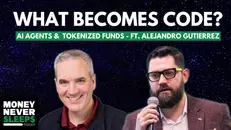
Pete Townsend is joined by Alejandro Gutierrez, the person behind Superteam Ireland and the most frequent voice on MoneyNeverSleeps, for a conversation about where tokenization is actually taking investment funds, and what happens to everyone who services them.
Two parallel universes
Pete opens with a feeling a lot of people in the industry will recognise: tokenization is live, growing and well past the pilot stage, yet TradFi is integrating at its own pace alongside it rather than being replaced by it. Borrowing Matt Walsh's challenge from On the Brink, he asks Alejandro whether tokenized funds are a new kind of asset that can do things existing funds can't, or the same fund on new rails. Alejandro's answer is a bit of both for now, with the change coming progressively, and new onchain assets on the way that we don't even know about yet.
Making assets machine-readable
Pete brings in Ribbit Capital's framing of tokenization as a way to make an asset machine-readable and secure, and follows the thread to its next stop: once an asset is machine-readable, AI can work with it. That's the backdrop to BlackRock and Ondo putting model portfolios onchain, the pre-built allocations wealth managers use to place clients by risk profile, though Pete is careful to point out that the Ondo side holds synthetic exposure rather than true equities.
Six ways to tokenize a share
The two compare tokenized equities today with stablecoins six or seven years ago, when algorithmic designs like Terra's UST sat alongside everything else before the market consolidated. Pete runs through the models in play, from DTCC and Nasdaq putting the same share in a new format, to issuer-sponsored shares like Galaxy's on Superstate, Coinbase's custodial one-to-one tokens on Base, notes and certificates from Robinhood and xStocks, Ondo's synthetic wrappers and equity perps. Alejandro suspects it may take a regulator, rather than a Terra-style collapse, to force consolidation.
What becomes code
The heart of the episode is the operating model. Alejandro sees holding and settlement at the custodian as largely proven candidates for code, with legal segregation and key management staying human anchored, and OTC settlement risk automatable while liquidity remains a different story. Pete pushes further, suggesting you take the org chart between a fund manager, administrator, custodian, prime broker and auditor and ask whether each process could be an AI agent with coded guardrails, working together the way people do today.
Markets that never close
Alejandro makes the case that distribution is the biggest prize for firms like BlackRock, pointing to Solana data showing more than 60% of tokenized stock trading happening outside US market hours. Pete's view is that humans are filling those hours for now, but they'll become the playing field for agents rebalancing stacked onchain ETFs around the clock.
Institutions are in the room
They close on Alejandro's read from Solana & Suits in London, where he says the days of crypto begging institutions for attention are over, alongside the Allfunds-backed Project Harmonia on Solana, tokenized money market fund share classes approved by the Central Bank of Ireland, and Solana Breakpoint 2026 coming to London from 15 to 17 November.
Connect with Alejandro
LinkedIn: https://www.linkedin.com/in/alejandro-gutierrez-98979b43/
X: https://x.com/A_gutierro
More on Superteam Ireland
Website: https://ie.superteam.fun/
LinkedIn: https://www.linkedin.com/company/superteam-ireland/
X: https://x.com/SuperteamIE
Referenced in this episode
CoinDesk: BlackRock offers a glimpse of how tokenization may change your investment portfolio
Ondo Intelligent Portfolios (with BlackRock)
On the Brink with Castle Island (Matt Walsh)
Ribbit Capital on tokenization
Lex Sokolin: The rise of robot money
DTCC tokenization service
SEC approves Nasdaq tokenized securities trading
Galaxy tokenized shares via Superstate Opening Bell
Coinbase tokenized stocks on Base
Robinhood Stock Tokens
xStocks
65% of Solana tokenized stock trading outside US hours
Project Harmonia (Allfunds on Solana)
Central Bank of Ireland approves tokenized money market fund share classes
Solana Breakpoint 2026, London, 15-17 November
Watch or listen:
YouTube: https://youtu.be/2vSKw9wdNtY
Spotify: https://open.spotify.com/episode/402ghFsiG8cs0jeTfOmwoQ
Apple Podcasts: https://podcasts.apple.com/ie/podcast/moneyneversleeps/id1455819294
Chapters
0:00 Cold open
0:25 Intro
1:03 Two parallel universes
1:27 New asset or same fund on new rails?
2:46 Making assets machine-readable
3:26 BlackRock, Ondo and onchain model portfolios
4:14 Tokenized equities' stablecoin moment
5:06 Six ways to tokenize a share
6:49 What becomes code, what stays human
8:02 Collateral and the agentic fund
9:43 Composability and distribution
10:45 After hours belongs to agents
12:05 Solana Suits: institutions are in
13:40 Breakpoint 2026 in London
14:24 Wrap up
Sharp riffs, big ideas and real insights from smart people, all in under 15 minutes. Hosted by early-stage investor Pete Townsend with the people rebuilding money, markets, and the internet from the ground up.
Frequently Asked Questions
Who is Alejandro Gutierrez?
Alejandro Gutierrez is the Leader of Superteam Ireland who joined the MoneyNeverSleeps podcast to discuss tokenized funds, AI agents, and onchain finance.
Are tokenized funds a new asset class or new rails?
The episode explores the central debate of whether tokenized funds create an entirely new kind of asset or simply put traditional funds onto faster, modern rails.
How are AI agents changing fund operating models?
AI agents are redefining fund org charts by challenging teams to determine which operational processes can be automated into code and which require human oversight.
[00:00:00] Alejandro Gutierrez: Something that we are seeing more and more, right,
[00:00:02] Alejandro Gutierrez: In the X stocks and Solana, like around 60 something percent of all the trade happens outside US trading time.
[00:00:10] Alejandro Gutierrez: And that happens just because there is a bigger distribution, right? That before was not there
[00:00:15] Pete Townsend: At the early days, it's mostly humans that are trading after hours and on weekends.
[00:00:21] Alejandro Gutierrez: That will
[00:00:22] Pete Townsend: it'll be the brand-new playing field for agents,
[00:00:25] Pete Townsend: This is Money Never Sleeps: sharp riffs, big ideas, and real insights from smart people. I'm Pete Townsend, GP at Norio Ventures. Let's go.
[00:00:37] Pete Townsend: So this week I've got Alejandro Gutierrez back with me, the person behind Superteam Ireland and the most frequent voice on the show. Today, we've got an angle on tokenization, surprise, surprise, off the back of BlackRock and Ondo putting whole portfolios onchain and a few other things that are going on in the ecosystem.
[00:00:58] Pete Townsend: Alejandro, welcome back to Money Never Sleeps.
[00:01:01] Alejandro Gutierrez: Thank you very much, Pete. Really excited to be here
[00:01:03] Pete Townsend: Awesome. Now listen, where I'm kind of going with this is that we're at a point where some of the financial markets feel like we've got a bit of a parallel universe going on with tokenization. This is what we've been talking about for years, you and me, that this is happening.
[00:01:17] Pete Townsend: But then also we still have TradFi, and TradFi is integrating and moving onchain, but it feels like there's just two different things going on right now.
[00:01:27] Pete Townsend: And I was listening to Matt Walsh on the, On the Brink podcast the other day, and he was saying what he's waiting for is "show me a new kind of financial asset, something that can do something, that existing financial assets can't do", right? So my question for you is, with tokenized funds and tokenization in general, are we building a new kind of asset that can do things that existing funds can't?
[00:01:57] Pete Townsend: Or is this the same fund on new rails?
[00:01:59] Alejandro Gutierrez: I think it's a little bit of both at this stage, and I believe that it needs to be a progressive change from one to another. I don't think we can expect actually traditional financial system just to deprecate older systems and then just move into onchain rails. I don't think that's the way it works, unfortunately.
[00:02:19] Alejandro Gutierrez: I believe there are going to be new assets that will come in onchain that we don't even know yet. I think AI is just opening all sorts of different opportunities, and we are seeing that tokenization is probably the most viable way to do some of those assets, right?
[00:02:32] Alejandro Gutierrez: I don't think tokenization is just about putting existing financial products on a new infrastructure. I think it's just beyond that. But this is just an strategic, like a step towards that ultimate objective,
[00:02:46] Pete Townsend: Yeah. Yeah. I was listening to Simon Taylor talk about this. He was quoting a Ribbit Capital paper from last year that they wrote about tokenization is a way to make a thing machine-readable and also enables it to be secure, right? So that's effectively what we're doing, is taking these offline, off-chain things and making them machine-readable, and that opens up a whole 'nother kettle of fish when it comes to if something is machine-readable, you start thinking about AI, you start thinking about robots, you start thinking about robot portfolios, right?
[00:03:21] Pete Townsend: Robot money, as Lex Sokolin calls it. I'm quoting way too many podcasters here today.
[00:03:26] Pete Townsend: The story that CoinDesk came out with that where they're talking about BlackRock and Ondo, was really on they are taking portfolios, what are called model portfolios, and they're putting them onchain.
[00:03:36] Pete Townsend: And model portfolios are things that wealth managers build so that they can just direct their clients into pre-cooked allocations depending upon their risk profiles. And so BlackRock and Ondo are building those together, but the Ondo side of it aren't true equities that are being put onchain.
[00:03:57] Pete Townsend: They're synthetic versions of that. So we- we've got a lot of different versions happening at the same time
[00:04:04] Alejandro Gutierrez: You can do so many different versions on what this token represents, right? Like at the moment, most of them, as you say, are synthetic. I think at some point that will change.
[00:04:14] Pete Townsend: I try to equate it to stablecoins, right? Six or seven years ago, we had different versions of stablecoins. We had things like algorithmic stablecoins, Terra LUNA, UST, remember all that. And things were at an early kind of,
[00:04:32] Alejandro Gutierrez: A lot
[00:04:32] Alejandro Gutierrez: of experimentation, right?
[00:04:34] Pete Townsend: yeah, a lot of experimentation. Now they've consolidated. And so I feel like we're at the same point with tokenized equities right now, that there's a lot of different versions happening, and I wonder if it's gonna take a Terra LUNA type event for people to sit up and say, "Actually, we're gonna do them, most of them, one standard way."
[00:04:55] Alejandro Gutierrez: Or maybe a regulator to come and just put a lock into it and how this should be happening. There's not a alternative that will give us just consolidation, right?
[00:05:06] Pete Townsend: Yeah. Yeah. So, I mean, just to run through some of them, we've got the same share running on a new format, and that would be like what DTCC and Nasdaq are about to go live with or in different states of going live with. You've got what we call issuer-sponsored native. That is where, like Galaxy, they issued a tranche of their equity, a class of their equity on Superstate, on the platform.
[00:05:34] Pete Townsend: And Superstate Opening Bell is that product. Then you've got custodial one-to-one with a pass-through, and that's what Coinbase are doing on Base, where Coinbase actually hold custody of the asset and then have a digital version of that trading onchain.
[00:05:50] Pete Townsend: Then you've got notes and certificates with Robinhood and xStocks, and where it's actual almost a derivative type asset of the equity. And then you've got synthetic wrappers, which is what we're seeing on Ondo. And then the, one of the most interesting ones for me is equity perps. I think that is just, that is perhaps the new asset class or one of the new asset classes, similar to CFDs, where you're just giving the holder exposure.
[00:06:20] Pete Townsend: It's not ownership of this specific asset, it's just you're getting exposure. And this is one of the things that Matt Walsh said on, On the Brink podcast as well, like last year. He's like, "I really don't see any other need for a trader that just wants to get exposure to equities. I don't see a need for them to do anything other than equity perps or perpetual futures."
[00:06:40] Alejandro Gutierrez: Funny enough, this is one of the biggest narratives in the crypto space at the moment as well, right. It's probably the only native one that is still growing at a decent pace.
[00:06:49] Pete Townsend: And if we look at how we move to a fully tokenized model for, say, just funds and the equities that they hold, I think there's opportunities here with AI for a fair chunk of this model that can become code. If we think about the overall model here, what do you think will become code, and what do you think might remain human anchored?
[00:07:13] Alejandro Gutierrez: That's a good point because, like I, I believe that it should be always like some sort of balance until we fully transition, we are fully comfortable with the technology. I don't think we are there yet.
[00:07:25] Alejandro Gutierrez: Probably from the custodian point of view, like what I believe that could be code could be like the holding and the settlement.
[00:07:33] Alejandro Gutierrez: I think that's, that's almost proven, and we probably are comfortable with it.
[00:07:38] Alejandro Gutierrez: What stays more of a human anchor point would be something like legal segregations key management or components like that, right? From the OTC desk, maybe it would be more like into the settlement risk.
[00:07:51] Alejandro Gutierrez: That is something that can be automated. There are a lot of platforms that are doing it at the moment. But then when we're talking about the liquidity, that's a different story, right?
[00:08:02] Pete Townsend: And when you talk about this being a new kind of financial asset, is it a new kind of financial asset, or is it a financial asset that can just do more things?
[00:08:10] Pete Townsend: Like being able to reuse an equity token for collateral that you move at the drop of a hat to be able to get margin. And that, I think, is one of the big opportunities here. And if you're to think about how that impacts the operating model for an investment fund that would be holding those assets that you could use as collateral, that's something that's gonna take some thinking.
[00:08:38] Pete Townsend: That's something that's gonna need some new controls and procedures. And why would you try to build a new thing on top of something that is fully digital and automated with a human process? No. Just do that agentically. And when I start talking to people about agents being part of a fund operating model, they get all scary thinking of Agent Smith from The Matrix, right?
[00:09:02] Pete Townsend: But this is, you can code guardrails into an agent, what the agent does or doesn't do. Let's look at
[00:09:08] Pete Townsend: the org chart an org chart of the operating model between a fund manager and an administrator, a custodian, a prime broker, an auditor, all of the other players, and say, "Could we actually identify each one of those processes as an agent, as an AI agent.
[00:09:25] Pete Townsend: and have them working together in concert in the way that humans do today?" And I think there's, I think there's some opportunities there to rethink the whole model, not just, "Hey, we're doing additional things with this asset, so we need new processes." No, it's, we are actually going to rethink the model and do it a smarter.
[00:09:43] Alejandro Gutierrez: I fully agree with that. I think it's fine to just build on top of what we have for a certain period of time, but at some point, we need to just rethink exactly how those processes are integrated into our new financial plumbing. And it's a reality that agents are going to be part of that new financial plumbing, right?
[00:10:00] Alejandro Gutierrez: It is something that we, we don't discuss much, but it could be like okay, how these assets are going to be compatible between different platforms. Composability should be part of this conversation as well, right?
[00:10:12] Alejandro Gutierrez: Modularity, all these components that we have been just talking and we're still like, waiting to see, right?
[00:10:19] Alejandro Gutierrez: And then, like something that we have been saying many, many times, and it's the fact that, okay, this is going to just open doors for distribution.
[00:10:28] Alejandro Gutierrez: And I think if you ask me, that's probably the biggest advantage that this model brings to, to BlackRock. That suddenly they are just distributing this to multiple people 24/7. And I know there's a lot of people saying like 24/7, is there something people that wants to buy this type of asset 24/7?
[00:10:45] Alejandro Gutierrez: And funny enough, something that we are seeing more and more, right, is in the X stocks and Solana, like around 60 something percent of all the trade happens outside US trading time.
[00:10:59] Pete Townsend: Okay.
[00:11:00] Alejandro Gutierrez: And I think it's, yeah, it's huge. And then around 17% or something like that happens on the weekends. So it's telling us like 100%.
[00:11:10] Alejandro Gutierrez: And that happens just because there is a bigger distribution, right? That before was not there
[00:11:16] Pete Townsend: Yeah. And, at the early days, it's mostly humans that are trading after hours and on weekends.
[00:11:23] Alejandro Gutierrez: That will
[00:11:25] Pete Townsend: it will change, it'll be the brand-new playing field for agents,
[00:11:29] Pete Townsend: To rebalance portfolios to say, "Actually, you know what? We're going to stick together this onchain ETF that is investing in European equities, and we're going to put that on top of another ETF that's investing in US equities and another one investing on top of Asian equities," depending upon your view of the market or depending upon your wealth manager's view of the market.
[00:11:55] Pete Townsend: And you've got this automatic rebalancing portfolio that just runs 24/7, and that will give you a nice little bit of extra return on top of this.
[00:12:05] Pete Townsend: I know that you were in London during the week and that you had some interesting reflections from your time in London. Were, was it the Solana Suits event that you were at?
[00:12:19] Alejandro Gutierrez: I was in there for Solana
[00:12:20] Alejandro Gutierrez: Suits.
[00:12:21] Pete Townsend: What happened there?
[00:12:22] Alejandro Gutierrez: The days of crypto or blockchain-based solutions begging for the attention of institution is, they're over.
[00:12:32] Alejandro Gutierrez: So everybody that was a well-recognized and established financial institution was in that room.
[00:12:38] Alejandro Gutierrez: And the conversations now have passed it from the, "Okay, this is possible," to, "Okay, now it's happening, and we are working on it and we are going to be launching our own products," right?
[00:12:49] Alejandro Gutierrez: The Solana ecosystem has a big push now into RWAs and tokenization and I think that's a big narrative that is taking as well the ecosystem and seeing what is happening probably in Harmonia and Allfunds.
[00:13:01] Alejandro Gutierrez: The blockchain and the crypto space is ready just to take that, that charge, which is something that we have been waiting for more than five years now.
[00:13:10] Pete Townsend: And have we, we been waiting or have we been pushing?
[00:13:13] Alejandro Gutierrez: Well, a bit of both. Well, there has been a lot of pushing with optimistical waiting behind because there's just so much push that you have to do until the person on the other side reciprocates. And now that, that is there. So yeah, the, the push was worth it. Let's call it that way, Pete.
[00:13:33] Alejandro Gutierrez: Even here in Ireland, right? Like even in Ireland, having those three money market funds approved by the Central Bank of Ireland, it's just fantastic.
[00:13:40] Pete Townsend: Yeah, hopefully there'll be more to come of that. And there's also, speaking of Solana and Suits, that the new website that I saw last month for Solana Breakpoint 2026 in London next month, that looked like quite institutional in positioning.
[00:14:02] Alejandro Gutierrez: Yeah, it's just about tokenization more or less. And I think having London as the city that is hosting it makes perfect sense, 'cause big chunk of all that industry moves around those streets in London.
[00:14:16] Pete Townsend: Looking forward to that. That's November 15th, 16th, 17th, I think.
[00:14:20] Alejandro Gutierrez: Correct. Yeah
[00:14:21] Alejandro Gutierrez: more to come. Exciting times, that's for sure
[00:14:24] Pete Townsend: Definitely. Definitely. Well, listen, thank you, Alejandro. Great to have you back on the show. Really appreciate it, and I know I'll be seeing you soon anyway
[00:14:32] Alejandro Gutierrez: Thank you very much, Pete. Pleasure as always.
[00:14:35] Pete Townsend: Wonderful. And to all of you out there, thanks for watching and listening, and don't forget to follow or subscribe wherever you get your podcasts. If you're enjoying the show, please leave us a review. It helps others to find the show, and it means a heck of a lot to me. Till next time. See ya.