Spotify

 Apple Podcasts

 Amazon Music

 Overcast

 Castro

 PocketCasts

 Castbox

 RadioPublic

 RSS Feed
298: Techstars Web3 Demo Day 2025: Live from NY Tech Week
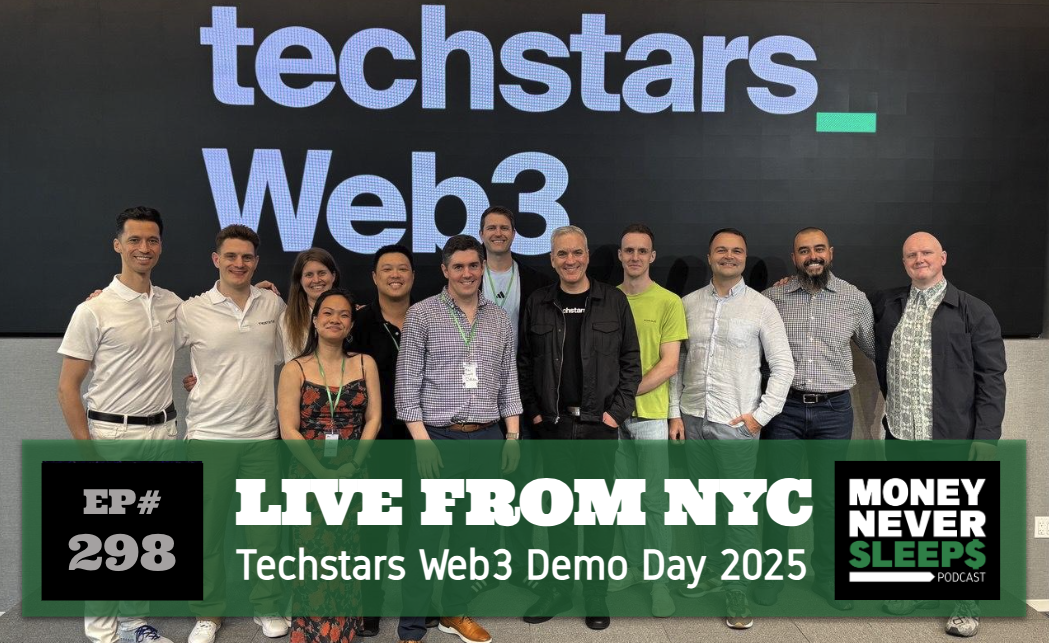
Welcome inside the venue for the Techstars Web3 Demo Day 2025, recorded live at Civic Hall in NYC during NY Tech Week, where we brought 5 incredible web3 startups to the stage for a standing-room-only crowd of founders, investors, and builders.
These aren’t founders chasing hype - they’re building with traction, with purpose, and with an eye on the next version of the internet.
Along the way, you’ll hear:
- A powerful fireside chat with Clarisse Hagege, founder and CEO of Dfns, on her journey from TradFi to web3 and the reality of timing your raise
- Startups introduced by their mentors and customers, not just the usual emcee banter
- Closing thoughts on what Techstars Web3 has meant to me and to Hugh McGirr, my partner in building this since 2021
You’ll hear from:
-
🧠 Autonom – web3’s first full-context real-world assets oracle (Co-Founder & CEO Brian Lenertz)
-
🛡️ DABL – the essential risk layer for onchain hedging (Co-Founder & CEO Mike Maguire)
-
🔐 Nera Systems – privacy-enhancing tech for secure data sharing in AI workflows (Founder & CEO Rami Akeela)
-
🌱 nodes.garden – one-click platform for running testnet nodes and earning token rewards (Co-Founder & CEO Ilya Lebedev)
-
🔍 TRUSTBYTES – bringing predictive intelligence to institutional wallets(Co-Founder & CEO Jeremy Prasetyo)
Whether you’re a founder, investor, or web3 builder—this one captures the energy, the ambition, and the conviction of what’s next.
🎥 Watch the full video on YouTube: Techstars Web3 Demo Day 2025
LINKS:
Leave a review & subscribe on: Apple Podcasts | Spotify | MoneyNeverSleeps (website)
Email us: info@norioventures.com
Pete Townsend: X/Twitter | LinkedIn
MoneyNeverSleeps: X/Twitter | LinkedIn | Newsletter
0:05 Money never sleeps, pal. Hey there, I'm Pete Townsend, and This is Money Never Sleeps. This week we're doing something a little different. I'm bringing you inside the energy of the Techstars Web 3 Demo Day 2025, recorded live at Civic Hall in New York City during New York Tech Week a few weeks ago. You'll hear from the founders of five incredible Web 3 startups from our latest accelerator class. These are builders who are tackling real problems with real traction. Along the way, you'll also hear from mentors, partners and investors who've been in the trenches with them. Plus, a short fireside chat with Clarissa Gage, CEO and Founder of Defence, on her own founder journey in the reality of raising capital at the frontier of finance.
0:50 What made this day even more meaningful for me, and for Hugh Mcgurr, my longtime partner in running the Techstars Web 3 Accelerator, is that it marks the end of a very special chapter. Money. Never sleeps. Pal, more on that soon, but for now, just know that what we built together with this community is something I'll carry forward with huge gratitude. So let's get into it with Techstars Web 3 Demo Day 2025. All right here on Money Never Sleeps. Thank you, folks. My name is Pete Townsend. I am the Managing Director of Techstars Web 3 Accelerator alongside my partner, our Techstars Investment Principal, Hugh Mcgurr.
1:39 We've been running this since 2021. This is our 4th class that we've done and we're very excited to be here today to tell you a little bit about what's going on with the program and what we've done with them. But also the most important thing is that we've got five of them pitching to all of you here today. OK, so a little bit about Tech stars. We are the world's most active PRECEDE investor and our tagline is that we are better for founders and that is the big group that we serve as founders around the world. We look for founders in places where others don't. We try to help them succeed. We have 3 1/2 thousand active portfolio companies from over the years that we've invested in since 2007 and all time we have the funding that they've raised since they've finished the programs and moved on and gone through their successive funding rounds of $29.5 billion.
2:34 We have 21 accelerator companies that are valued at 1 billion or more, whether they're unicorns or Decca corns and 127 billion in all time graduate market cap. It's the value that these companies have created. So big numbers, very active accelerator. We invest in founders for the long term and we give them the push that they need to get into the market and get over the hump and start selling to customers and to users and to raise money. Looking at Techstars Web Three, we've been investing in Web three since 2015. We were early take a Web 2 primarily accelerator way back before the Web three term was created and start investing in some crypto companies, start investing in blockchain companies. Then in 20/20/21, people started talking about Web three. We created the Web 3 program particularly that Hugh and I have been running, investing just into Web three companies and projects.
3:28 Over the years we've done 280 plus investments in Web 3 or Web 3 adjacent companies or projects and they have gone on to raise over 2 billion in funding since they have left the program. 10 billion in market cap that we have from our Web three investment companies. Big one that a lot of people will recognize as chain analysis. We bring people back into the program after they graduate, after they leave the program. We had Jonathan Levin, the CEO of Chain Analysis, giving all of our founders a story about the history of chain Alysus and his role in that or the past 10 years. And that was Monday night when we all got together here in New York. We also have our weave led by Sam Williams. They went through our Tech Stars Berlin program in 2018.
4:10 We also have defense and Clarissa Gage, CEO and Co founder is here with us today and we'll hear from her in a little bit. Finally, other big name that you may or may not recognize as Natick's, they're mapping the world in 3D from the dashboard of your car or your Tesla camera. Very impressive group of founders. And we have the very impressive group of founders that you will meet today. So our class of 2025 thirteen week virtual program, many tech stars programs are in person, but with Web three, we respect the global and virtual nature of Web 3. And we don't ask people to move all over the world for the program. We do ask them to come to see us though. And this picture behind me is Saint Patrick's Tower in Dublin, where I live live in Ireland.
4:51 I'm originally from Boston and Saint Patrick's Tower is right across the street from the Guinness Brewery. And so Dublin is a great place to build relationships and we bring everybody there for the first week. We then go virtual for five weeks and we bring everyone to London for a week to immerse them into the London startup ecosystem, which is really beneficial for them. And then finally here in New York City for New York Tech week after we did another five weeks virtual. So here we are today with you, the capper of the program for Demo Day. During the program they had, in addition to all the other things we do with them, they had 500 plus Metro meetings, six companies or projects times 90, plus mentors, plus a few more on top of that. And that allows them to pitch their story, tell them about their business, engage with these mentors on a weekly basis as their lead mentors or just this new group or community, this new network that we give to them.
5:38 At this stage, all six of them have real traction and real customers to point to. And that is the big thing that we try to get to with this program. So what is web three? Most people in the room don't need me to answer that question for you, do I? OK. But the way we look at it is twofold. Sam Williams from our Weave calls it the protocolization of composable web services. What Chris Dixon from A16Z said now he wrote a book to try to introduce Web two people into Web 3 and crypto. So he's put it a bit simpler and said, listen, this is enabling digital services without gatekeepers. Take stable coins. You can fit that definition into there enabling digital payments without gatekeepers or intermediaries, right? So that explanation works in reality for us. When people ask me about it, when my family and friends that don't know anything about Web three asked me about that, I'd just say, listen, it's the next version of the Internet. What do we look for?
6:29 What do we invest in? People say there's too much infrastructure out there, that people are building too much infrastructure in Web three. Well, you know what? There's still some gaps to fill. Usability, security, accessibility, the USA of crypto blockchain and we need that balance to be right and it should not be a trade off. We need to be able to do all three and we still have some infrastructure to build to get there. Tokenized economies is a bit of a shout out to Balaji Srinivasan came up with this idea called the D Phi matrix. Imagine any asset in the world mapped against any asset in the world. This could be Bitcoin to ETH. This could be a sliver of the Mona Lisa up against gold futures, right? We have a long way to go to get there. But this is where any asset is tradable against any asset because we are trading in tokenized economies. We are re engineering financial rails here. That is the big lift.
7:19 That is the big ask, but it needs to be done with incentives and with purpose. We can't just say we're going to tokenize an asset for the sake of tokenizing it. Fun, right? No, there needs to be something beyond that. For example, tokenizing money market funds needs to be reusable as collateral so that we can trade on a 24/7 basis on these re engineered financial rails. Consumerization needs to drive mass adoption of blockchain to the tipping point where we have more people on this planet using blockchain whether they know it or not versus those that do not. Finally, ownership and attribution. Blockchain needs AI and AI needs blockchain. We need to know who owns what, we need to know who created what and be able to prove that we look for AI to accelerate our path of Web 3 adoption.
8:06 So the six companies and projects that we have as part of our Techstars Web Three class of 2025, I could give you a little bit of a snippet on each one, but I'm going to let them do that for you. OK. But we have Autonom and Brian Leonards will be pitching today First off the bat. Then we have Dabble. Mike McGuire will be pitching. Nearest systems is Rami Akila, the CEO and founder who will be pitching today. Nodes Garden. We have Ilya Lebedev, who is recorded because any digital nomads in the room raise your hand. Yeah, hard to get a visa. OK, You can't prove that you have something to go back to in the country where you came from, So he wasn't able to get here this week, unfortunately, but he has an excellent pitch that we will show you on screen. And then Trust Bites led by Jeremy Presetio, 0X Bridge led by Satyam Agrawal.
9:01 Unfortunately, he's going through a family bereavement right now and he will be back hopefully in December, and we'll bring him into another Tech Stars Demo Day so he gets his full Tech Stars experience. So it's these five that are there with us today, and we'll be pitching to you. So what I'd like to do is introduce Clarice Hage, who's going to come up here with me, and we're going to have a little bit of a chat about fundraising. It gives me great joy to bring Clarice up on stage with me here today. So thank you, Clarice. Thank you. So Clarice and I met in March, April of 2021 before I joined Techstars and I was a mentor for the Techstars ABN Amro Future of Finance program and Clarice and her Co founder Chris had just started on that program and I was their mentor and we stayed in touch after. The program.
9:56 Yeah. There was no web tree cohort before that, absolutely. And when we launched the program back in 2021, Clarice was one of the first people that I got back in touch with to say, hey, would you like to come mentor on my program, right. So she's been mentoring now for the past four years with us as we can been incredibly helpful. So Clarice, why don't we just get started and you probably just tell us a bit about you and about defense and about what you're working on right now? Sure, yeah, Hello everyone. It's, it's a, it's a pleasure to be here and to come back here to the Dexter's environment. It's, it was a, a very important step for us now, and I'll come back to that. But you know, when you are not a founder coming from the Silicon Valley, you're looking for, you know, any sort of credibility, Mark, right. And texters was extremely instrumental in putting us into a place where we're seen, where we're trusted and we could, you know, start growing from there.
10:52 But so before actually launching defence and even going through through texters, I spent about 10 years in banking. So I had a very, I would say traditional career when you graduate from a Business School, except that I was not fit for banking. And that was very clear because I moved every year and a half. I tried all the division you can ever think of in a bank. I went to equity research, wealth management, I was chief of staff for the CEOI structured export products, I was a corporate investment banker. All that in nine years, right? So definitely I was, I was trying to find my place in that space. And, and something that was very interesting is that when I, I was actually working on export and and trade product, we started talking about blockchain technology to see how it could improve the processes we have, we had in place.
11:40 And I think for me, that's the time it was back in 2013, So very early. It was the time where I, I looked at this technology thinking this is super interesting. And then I had the chance because you know, all that is very much made of chance all the time. The people you meet, the people that are coming and educating you about the sector, about a new technology. And so I had a chance to have a friend showing me at the time, the white paper of IOTA. I wished it was a theory. I'm frankly, I would have been welfare to but but it was it was when I think, you know, we all have, you know, everybody building, investing in web tree. I think we all have a war moment. And that was, that was pretty much where my brain exploded and I realized, all right, we're not, we're not going back from that. And the way I see blockchain, and so it's very, I'm going to try to limit the definition of obviously it's very limited. But for me at that time, it was very much of A stack upgrade, right?
12:38 Blockchain was a technology that was absolutely needed for banks to just enter the next decades and the past at which we were starting exchanging financial insurance and financial transactions. So since then, I, you know, always was very close from the space. I actually started building startup in 2016, which was a remittance application between the US and Mexico. And at the time you couldn't build anything. It was very hard to even, you know, leverage smart contract. So we put that aside, never leave my never left my job for that. And 2819 it's, it's sort of like was a, a moment where I had the opportunity to actually help a startup that was incubated by the bank.
13:22 I realized during that summer that there was no infrastructure solution that was fit for use cases that were not by side crypto trading, right? You had many dashboard to buy, you know, crypto, but you didn't have an infrastructure solution that could enable institutions, fintech to start building applications. And when I realized that, to me it was a no brainer when you're convinced that this technology is going to power all financial transaction within the next 15 to 20 years because it's a long process. This seems to be the kind of, you know, most basic piece of infrastructure to build. So let my job build defense. And this is what defense is today, right? It's API first wallet infrastructure that enables any fintechs, any financial institution, any banks that want to start building application, which will leverage flexion technology to make those transactions safe to streamline the way you actually interact with the blockchain.
14:17 It's very much a back end solution for crypto for anybody building once again application. So today we we work on several segments. The main segments we cover are going to be custody, right? So we do a lot of custody infrastructure with players like Zodiac, Custody International and others. On the payment side, we work behind players like Bridge. We got acquired by Stripes. So we do a lot of cross-border payments. Last month we had the 1.7 billion of volume and I would say 70% of that is stable coin payments. So we're very much growing with that new wave of adoption. And then after we service as well tokenization use case and and and more trading use cases. That's a long answer.
14:58 Very good. No, thank you, Clarice. It's really helpful. You've over the past four years have raised $30 million in capital. What do you think worked well? It was a journey, right? I would say that every single raise is very different, right? Raising your proceeds is very different than raising your seat, than raising your Series A and you feel like you know, every time you go after one you, you get it. And then you're arriving to a new challenge where you meet very different type of investors that are expecting very different things. When we starting raising a precede round, frankly, I think we were both lucky and the right place because it was right after or during texters lucky because actually the 1st 200 K we raised was when the Bitcoin was at 5K.
15:43 So nobody knew or wanted to invest in blockchain in web tree. This was not interesting. Those push 200 key were painful to raise. Really painful. You would send a deck about your product and spend 25 minutes with an investor trying to convince him that blockchain was something right? So forget about even explaining what your product was about. And so once that was done and we actually at the same time got accelerated by texters once again, we got that credibility. People were willing to take a call, which, you know, make it made a ton of difference because, as I was saying, and I think not to point, not to point anything against investors, but you know, when you're investing, you're trying to de risk your investment, right. So you're going to look at, you know, founders that are repeat founders.
16:29 Obviously, you know, it makes your due diligence easier. You're going to look at, you know, schools that you know have been have good network and where you know your founder is going to be able to very quickly sell its product, etcetera. If you out of these tracks, then it's just a bit harder, right to, to get exporter to be seen and to and to get even a, a meeting with, with anyone. And so Techstars was super important for that right kind of credibility stamp and also just opening, getting access to a wide range of investors. I'm smiling because I'm thinking about actually right in the middle before Techstars and when we struggled raising that 1st 200 K, we actually treated investors like, like you would massively cold outreach for clients, which, you know, doesn't really work, which which is things that I've actually, you know, learned the hard way. Yes, you have a lot of things, you have a lot of people that open your, your emails.
17:27 And so if you, if you're good at it, if you e-mail back and forth, but once again, investors want to de risk their investments. So if you're not introduced in a way, you know, that is also creating some some credibility and de risking factor, then it's it's a hard one. But yes, so then right before we started textures, then Bitcoin went from 5K to 40 Ki think at the time, and it was an interesting conversation that everybody wanted to have. And so that's was, you know, we booked the precede and the seed round where potentially did you know, the easiest money we've ever raised just because we were at the right time at the right moments. And so this is where I want to come back on, you know, to luck. Luck is also super important.
18:13 So you obviously need to do the best you can do and you need to make sure that execution, execution is stellar and that you take all the best you can to build a successful business. But at the end of the day, there's always a, a part that you don't control. And that's that part that like of, you know, being at the right place, you know, on the right topic, which was very easy to understand for investors that had never invested in crypto before and at the right time made, yeah, those precedency rounds very easy. But two things I would say here, I think the first one is that first check, right? I would say to all founders as per check you get or that first seed round, you know, you should definitely maximize the the amount of cash you can get, right, Because then after you know, you never know, market can change, market can turn around. Doesn't mean you need to burn it fast, but you need to make sure you maximize that shake because that's the only time in your founders existence where you can actually raise on a deck. We've barely no, barely right.
19:13 You you people want some proof, right, some proof of, you know, as is your product useful and is anybody like, do you have at least one person that wants to to buy it? So there's a bit of proof, but they are very limiting, right? Which with this money you we'll be able to peeve up if you need to peeve up. But that's first take is to me extremely important. Being surrounded by the right investors that will accompany you on the second on the second step is also super important. And this is where, once again, you know, I would always say take as much money as you can. Another thing that we've learned the hard way is, is just the, the valuation, right? When you're at the hype of a cycle, people give you valuation you didn't even know you could get right. When I received my first term sheet, I was like, oh, wow. So I didn't negotiate my first term sheet because it was already something that being in business for nine months with defense, I, I didn't think that we we could reach to this type of of valuation.
20:08 But if you actually spend too much time in negotiating, you know, trying to maximize that value, then it's it's a hard one to step up from, right? So to me, that's first round is a lot of value. Take as much as you can, control your valuation. Don't do it yourself too much because you want to make sure that you want to keep going, right? You want to ensure that you're invested and you're still interested in your business. Because at some point, if your investors own everything, then you know, it's a hard 1. So you need to work for something. But so yes, I would say those are very much, you know, how was it was easy at some point series. It was very hard for many reason, but also because we're starting raising in a downturn right on the market. The usual suspect of our category were investing only in early stage.
20:54 There's barely no growth stage in crypto. That's something that you know, should always know that, you know, Series 8, Series B is, is scarce and crypto. We hope that the current trends are going to open up some opportunity in that traditional investors in the growth stage are going to come back to the web tree world. And so that was a very, yeah, very different journey. Very good, very good, good words of advice. Raise what you can, be ambitious, realistic, but also evaluation. You got to be careful on that. Any words of advice to investors who are about to meet some founders here today or those that are thinking about investing in this space? Well, they, they, they know their job quite well. But no, I would say when I was surprised of when I, when I started raising money is that once again, as an investor, you want to make sure you get as much money for as little risk you can, right?
21:44 And so contrary to what you could think, yes, investors decrease, but in a very controlled way, right. And so I would say to me, if you really want to find innovation and if you want to get out of the mainstream assets, you can find trying to take a bit more risk, especially on an early stage startup is, is to me super important. And this is where you're, you're going to get anywhere your, your highest return and it goes by, you know, once again, opening up to that I've never built before, right? Because it's not because it's your first time that you're necessarily going to going to fail, right? You know, we, we went through phases where investors were very much operating by trends. And I think it's, you know, be untrendy, try to be untrendy. You'll be surprised, right?
22:29 Definitely. All right. Well, listen, Clarice, thank you. Really appreciate you sharing your thoughts, your insights very helpful. So thank you, Clarice Agach. Thank you. Yeah, you can. Get that? OK. So on with the show and wonderful to have Clarice here with us. So thank you again. And we're going to start with the pitches now, OK. But we're doing something a little bit differently. Last year, I got up and in between each pitch, I tried to provide some type of Comic Relief, but I'm not going to subject anybody to that this year. And what we're doing is that we're bringing on someone who is important to the business of each one of the startups that are pitching here today, whether it be a customer or mentor or I advise for someone to do an introduction.
23:14 So what I'd like to do first is to ask Andrea Volansky from KENTA Labs to come on to introduce our first pitch. Andrea, hey. Everyone. So I'm Andrea Volansky. I'm with KENTA Labs. At KENTA, we address white space opportunities in fintech that can be best sold with blockchain. Our first product is a decks is a perpetual trading decks for real world assets. We will go live in the Q4 of this year and we have our first client who is annual volume of about $100 million. When we were searching the pricing oracles, we know several really great providers out there, but the kind of like specifics of the real world, those specifics, that context was not reflected in the prices.
24:16 For instance, the stock split or dividend payments, the only one provided was doing this right and it was autonom to bring this on chain. You need to factor in a very rich context that is relevant to the prices of those assets. With that, let's welcome them on stage. Brian, it is my big pleasure. Hi everyone, hope you're all enjoying New York Tech Week. So my name is Brian, I'm the CEO of Autonom, and today I'm here to looks like there's some kind of an issue here. Just kidding.
25:06 However, this same type of type of issue, not being able to transmit and receive the necessary data, is exactly what happens when you try to use real world assets like equities in defy using the existing infrastructure. Last year there was $15 billion worth of real world assets tokenized on chain, but there was no borrowing and lending available. And of the $2.7 trillion in perpetuals that were traded, there was effectively no real world assets. Perpetuals, for those who don't know, are a type of futures contract with no expiration. It was pioneered in Web 3 and people really love them. But the infrastructure to price assets like equities and commodities doesn't exist for perpetuals.
25:51 Current infrastructure provides what's called real time price. That's the price right now as it is. So what happens? There's a stock split. These guys will tell you the price was $100 on Friday and $10 on Monday and that's it. What does it look like on chain? Looks like a 90% stop, 90% drop in price over the weekend from 1200 to $120.00. And you can even see some of the providers just took an average of the two. Like it doesn't even make sense. And what does this look like in the real world liquidation. Everyone who was long in video over the weekend, their positions are liquidated on Monday. The legacy infrastructure just wasn't built for this. But we were since day one.
26:40 That you might ask, OK, stock splits. How often does this really happen? Do we need infrastructure just for this? Can I do it myself? Maybe, But it's more than just stock splits. Every dividend that gets paid out needs to have a similar type of adjustment. All the mergers, all the acquisitions, all the other weird stuff that Triadfi does that your web three guys never heard of. They need adjustments thousands per year just for the S&P 500 and you need to do it all perfectly if you want to open the floodgates to real world assets for your on chain application. Our Tam is huge. That's how it usually goes with financial services. But our realistic obtainable market is about the perp volume of 2024, which is $2.7 trillion.
27:29 Our first customer Adrina is the third largest perp DEX on Solana and we've already begun Co marketing efforts with them ahead of our Q3 launch. Beyond that we have another 10 integrations pending and with our volume based pricing model we have a first year projected revenue of 6,000,000. I built the first OE V product at API 3, which was a way for Oracle's to capture MEV revenue. And before that I worked at Wintermute where I managed their RFQ system and built their liquidation engine. Rhianne has a background in corporate finance as well as operations and defy marketing. I handle all the tech, she does everything else.
28:12 And that's John, our head of legal, kind of a necessary evil. We're not just patching the gaps of today. We are building the rails for tomorrow's financial future. Thank you. Hi everybody, First off, I want to say thank you for your time and and thank you for letting me be part of such an amazing community. I'm on Marciada. I've spent the last 15 years deeply embedded in AI and, and crypto as well. You know, more importantly, I'm obsessed with removing friction for founders so that they can build faster and better. For me, today isn't about the pitches, it's about the potential. And the two guys that I'm working with, they had that in troves How I Met them.
28:58 Well, you might know that the gentleman that introduced us, his name is Pete Townsend. Him and his team, they've been betting on Frontier Tech and Frontier founders more than anyone else, and it's truly an inspiration to be a part of it. He told me you got to meet these guys and boy am I glad that I'm glad I listened. It was life changing. What stood out. Yeah, they can definitely build tech. They can ship products. But what they're able to do is actually take complexity in one hand and clarity in the other and deliver it in a solid package. They do this in a humble fashion. They're focused on solving problems that other people don't want to touch or even acknowledge. And these are real problems, whether they're Web 2, web three, tried 5D5, whatever, you know, acronyms, letters or word soup you want to use today.
29:44 Crypto lending is a mess. It's either too risky and rigid, meaning people are either, you know, lending out too much and getting destroyed or cutting down the LTV and and losing customers. How do you fix that? Dabble flips the script. They're creating basically risk management on chain where you can have automated hedging and provide the ability to actually intelligently and responsibly scale as a lender or even as a user. And these aren't just ideas. These are actually in motion with real pilot clients. And we're back testing next Gen. solutions as we speak. So there's applications that maybe start in crypto, but they certainly don't end here. This isn't AD 5 fantasy. This is real infrastructure.
30:25 It's infrastructure that can make a market and it actually can impact and protect billions, if not trillions. So without further ado, I'd love to introduce Mike McGuire and his Co founder Jay Chow and dabble. Thank you. Thank you. Thanks. Appreciate it. Hey everyone, I'm Mike, Co founder and CEO of Dabble. What is the most important holiday in February? Valentine's Day? President's Day? Well, if you thought either of those, I hate to tell you, you're wrong. Groundhog Day 2025 while Punxsutawney Phil saw a shadow, crypto fell off a Cliff, Bitcoin down 8%, Ethereum down over 23%, and all this within about 24 hours. So that Monday morning I headed into the office to resign to pursue dabble full time and I ended up witnessing this carnage unfold first hand.
31:27 Borrowers received margin calls on Sunday. Went to bed that night anticipating they'd post margin Monday morning, but in reality, they woke to learn they've been auto liquidated and lost all their collateral overnight. Needless to say, they were not happy. Through March, nearly 1 billion in crypto loans had been liquidated. This is a brutal dilemma for crypto lenders. Do they lend conservatively at 2550 cents on the dollar, severely limiting their revenue? Or do they lend aggressively, watch clients disappear during market volatility? But here's what's interesting. This problem is only expanding. As assets move on chain, many institutions will face similar challenges.
32:08 Does anyone here remember Silicon Valley Bank? A cautionary tale on how even safe assets can bring down the house if left unhedged. But Dabble solves this with our automated risk management platform. A client can upload their loan book or portfolio via our API, where our smart engine will then determine the optimal hedge to be placed based on that client's risk preferences. Our execution system will then go out and execute the hedges on chain or off chain, take those positions with a loan book, real time monitoring 24/7, adjusting dynamically only if and when necessary. So now a lender can lend and earn the revenue aggressively while maintaining A conservative risk profile. We take the complicated process of hedging and make it simple and seamless with our intuitive interface. What used to be a gut wrenching 15% market drop overnight can now net to just two to 3%.
33:04 The crypto lending market currently stands at about 36 1/2 billion and is on pace to hit 250 billion by the year 2030. But that's still just the starting line for us because we're building for the larger $3 trillion global corporate hedging market, starting with crypto asset hedging today, expanding to RWS and the larger corporate hedging market as institutional adoption accelerates. Same platform, multiple asset classes, more traditional risk advisors like Chatham Financial, they manage over 1 trillion and annualized hedge volume annually. But as a former client myself, I was frustrated with how overly manual the processes were. And while other competitors like Derivas Lab do improve upon this slightly, they still don't operate anywhere near crypto. More crypto native firms like Chaos Labs, they focus more on protocol and defy risk, where Dabble uniquely combines the institutional risk focus with on chain infrastructure, 24/7 monitoring and automation.
34:01 Since Techstars, we've successfully built our V1 product and back testing tool, so clients or potential clients can see exactly how much value Dabble can add. With our AI first approach, we've been able to move quickly and we're currently live with a $10 million crypto lender and already seen an effective 25% risk reduction accelerating our progress beyond just crypto assets. We'll be going live with a $100 million RWA client later this month. We're looking to add 2 to three more clients to fill out our beta program and expect to be revenue generating by the end of Q3 this year. Dabble operates on a scalable subscription model with monthly minimums based on hedge volume. We'll also be offering a margin financing feature to make it even easier for clients to hedge and we'll be charging 1 to 3% financing fee on that.
34:46 Our team brings deep expertise in the space. My Co founder and CTOJ and I met in 2021 where we were on the founding team at Pangaea and built an automated FX hedging platform. Jay brings over a decade of deep technical expertise in both crypto and fintech. And As for myself, before Dabble, I built and ran the hedging program at figure we solve a 400 million in monthly volumes. And prior to building with Jay at Pangea, I was in structured finance at HSBC and securitized products trading at Bank of America Merrill Lynch. Groundhog Day 2026, Phil might see a shadow again, but the loop is now forever broken. Thank you.
35:33 Hi, my name is Benny Hamill and I'm the founder of the Hamill Network, a consultancy which helps companies launch new businesses, scale them fast and hopefully exit for high valuations. I work with a lot of CPG companies and for those CPG companies, the insights that they generate from their data is often the difference between success and failure. When they're launching new products, the analysis and those insights come from third party analytic companies and AI platforms. And that's where the dilemma arises.
36:14 How can I be sure that the data that I am sharing with those parties is going to remain secure and private while it's being shared and processed? That's where Nero Systems come in. And I've been very fortunate to be a mentor to Rami and his team as unseen. The universal application of their solution to keep data private for any enterprise that needs to share with a third party. I've been so impressed with the Nero team. They have really deep experience of creating cloud based enterprise wide solutions.
36:55 They also have a really breadth of knowledge across many categories, from CPG and healthcare to data warehousing, and they have unique expertise in creating privacy technologies. When I worked at the Coca-Cola Company, one of the biggest issues that we had was sharing our Nielsen data with third parties. Nielsen were very, very concerned that this data that they owned would become into the public domain. Nero Systems have now developed a solution around that using there's a full stack AI focused solution. So now I'd like to introduce you to Rama Akila, the CEO of Nero Systems. All right.
37:42 Thank. You. Thank you, Maddie. Hello everyone. My name is Rami. I'm the founder and CEO of Near Arm Systems. Let me start with a staggering reality. In 2024, the total cost of data breaches in the US alone reached an eye watering $15.4 billion. And this isn't just a number, it's a wake up call. It demonstrates the financial devastation that all companies must endure across industries. But this isn't just about money. Trust is shattered, repetitions are destroyed, and companies find themselves with an urgent challenge to harness the power of AI while protecting their sensitive data.
38:27 Now AI, for it to be effective, it needs access to sensitive data and this creates vulnerabilities at all stages, at rest, in transit and especially in use, which leads to opportunity costs. Companies, they hesitate to utilize cloud services due to privacy concerns. They struggle to collaborate with third party partners and they mess out on monetizing valuable insights. But what if they could do all of that securely? And that's precisely what NERA has to offer. NERA is a privacy enhancing technologies platform, or PETS, that allows organizations to securely process, analyze and share sensitive data. Here's how it works.
39:12 Unencrypted data or models are processed through our software securely, which leads to a private output. Now this can happen on Prem, on the cloud, or at a partner site. The result? The data is never exposed and is kept private throughout the entire life cycle of the data. What differentiates us from our competitors in the PETS domain is our performance and ease of deployment. We have built the full stack solution that integrates seamlessly into existing tools and workflows. We are up to 100 times faster and up to 10,000 times more efficient in terms of storage. We're already making traction in key markets. In infrastructure, we are collaborating with Google Cloud to deploy our solution into their stack. We have an LOI with AI mine systems, green CSP which is building solar powered micro data centers and we're launching 2 pilots with them.
40:08 In the consumer product domain, we are launching. We are engaging with Sarcana, a leading CPG analytics company and launching a pilot with a dairy analytics company. And in healthcare, we're engaging with organizations that handle sensitive research and patients data. We're confident we can capture this market valued at $500 million this year. Given our unique value propositions and partnerships that Tam for Pets is projected to grow from $400 billion in 2025 to $1.3 trillion by 2032. Our business model consists of two key revenue streams.
40:49 The first one is about encryption services, which we charge for on a per TB per year basis and the second is secure processing, which we charge for on a per operation basis. What connects us here at NERA is our passion for data privacy. I bring you over 2020 years of experience in hardware, software, code design, focusing on privacy systems. Our CPO Ed brings over 30 years of experience in enterprise computing and Sam brings in a special expertise in cybersecurity and privacy. Work with us at Nero to truly defy privacy limits to harness the future of intelligent data.
41:29 Thank you. Hello. Hello, Hello. How are you guys? All right, let's do it. Yeah, we're here to have fun. So I'm Art Malkov, former head of marketing for Iotex Pala Market Silica. So you might have heard of some of those projects. And I always look out for what are really projects that stand out. And Notes Garden run by Ilia Lebedev is one of those projects. So what are we people who are non-technical want? We want notes. We can never run them, but what if we could? So for me their mission, the vision, what nodes garner does really show that. You know how many nodes do you really want? The answer is as many as you can, right? As many nodes.
42:20 But most people are not technical. So what if you could, as non-technical person run nodes? And for me it was a real eye opener when I met the team. I saw how much potential there are, how much demand and how much opportunities and vision the team has. And therefore, without further ado, I would like to introduce Olia Lebedev from Nose Garden. Hi everyone, I'm Ilia, founder of Nose Garden. Really wish I could be with you in person, but let's have some fun anyway. I want to play a little game. Please raise your hand if you have ever bought crypto. Now keep a trace if you have ever tried running a blockchain node.
43:08 Now keep a trace if you have ever tried running a node in test net. Yeah, I don't see so many hands left, and that is a missed opportunity. In 2024 alone, over 15 billion in token value was distributed via air drops in test Nets, mostly to early contributors and not operators. Running just one node could have earned you up to 100K, and there were hundreds of smaller air drops too. So why don't more people do it? Because test net nodes are brutal. Unstable networks, confusing guides, terminal errors. Most people just give up before they even start. And that's why we build Nos Garden, a one click platform for deploying and managing test net nodes.
43:52 Test Nets are booming. New L2, S, DP, insurance, AI chains launch every week. All of them are powered by nodes. Yet running a node is fragmented and painful for users. It means hours of Discord threads, GitHub repos, searching on Telegram, Twitter, using broken scripts for projects. It's hard to attract early node operators and build memental. Both sites need help, and we are solving it. Test Nets are messy. We make them simple. Users can deploy nodes across dozens of networks, no technical skills required. We help users to discover opportunities and maximize rewards. And we'll help projects to get early traction by typing into a real user base.
44:36 And it's working. We are already getting inbound requests from projects that want to be listed. We launched in June last year and went full time only three months ago. We did over 70K revenue last month, growing at an average of 80% month over month. We have over 1800 active paying customers right now and over 6000 total sign ups. And we have done this with just product, community and hustle, spending only a few $1000 on marketing in total. Our growth so far has been almost entirely organic through Telegram and Twitter. We are scaling it with referral system, localized content and influencer partnerships. Our users bring in more users and acquisition cost is extremely low.
45:22 We're also creating educational content to help our users learn, grow and stick with us. They're starting in a fast growing and underserved niche test Nets where over 15 billion in token rewards were distributed last year. Today, we support dozens of blockchains, daypins, AI networks at the top of the funnel and as I transition to mainnet, we are in the best spot to follow them. This is a market we could capture worth over 250 billion and growing fast. Long term, we plan to build a cloud compute layer on the more than 900 billion cloud infrastructure market. Some other players like Mints Air and Rapid Node offer test net nodes, but we are ahead.
46:04 We support the largest amount of networks, offer the best pricing and automate all user required actions. Unlike our competitors, we have a simple subscription model. Users pay from 5 to 50 monthly fee per node with no hidden fees or commissions. Most users run multiple nodes and treat it like a portfolio. We have a strong founding team. I have eight years of experience in software engineering and crypto mining, so I deeply understand the technical and economic layers of web free. Peter, our CTO, has more than eight years of experience as DevOps and reliability engineer. Ross, our Chief Video officer, previously worked with global brands and now leads partnerships and network growth.
46:47 Today we built infrastructure and community. Soon we'll combine them into something entirely new. A user powered compute layer. No centralized cloud can replicate infrastructure grown by people like a garden, a nose garden. When a startup founder kicks off its first meeting with you by saying, we've just made a pivot, there's always a little voice in the back of your mind thinking, OK, is it the first pivot or are we on the spinning wheel here? And then you meant A-Team like trust bites.
47:27 Trust bites, they embody, probably do the best. The startup paradox. They are the most ready, not ready team that I've met since I I started mentoring textures. And honestly, it's a powerful place to be because building the startup is like building your house, right? You don't start unless you have a solid blueprint and you actually have a deep understanding of the field you actually starting building on. And Trust Bites gets that at its core, Trust Bites, it's 3 individuals that are extremely, extremely experienced in the space, right? They've been in Webtree for the past few years.
48:10 Every single of them is a serial entrepreneur and a a serial founder. What I've been super impressed with over the past few weeks that I've been building with this team is the level of discipline that they operate with. It is truly exceptional. So when a start up typically ask me to meet with one of our sea level, I tend to say no because frankly they have limiting time and we can't afford to be, you know, a ground, a playground for new, new projects. But when our CPO came back to me and say, I've met with the Trust Bites team, I love their product and I want to start building with them, I was not surprised, but I was definitely impressed. I'm super excited about the announcement that you're going to make today.
48:55 And I'm very, very excited about the fact that we're going to start building together. Jeremy, without further delay, where are you? You're here. Please welcome, Trustbites. Thank. You. Hi, I'm Jeremy Pozzettio, CEO and Co founder of Trustbites New York. Monday morning, 9:15 AM we are in the boardroom. The coffee is hot, the inbox is full. The head of product is gathering the team to discuss client share The head of product of an institutional model provider. Here the first issue they dive in centralized exchange.
49:37 We didn't miss any withdrawals. We missed compliance. The operations team didn't know what I have to do. How shall we explain that? The markets moved fast, the wallet didn't. The funds moved above the allowed limits, then a corporate treasury. We need to rebalance before it's too late. They didn't want alerts after it happened, they want proactive rebalancing. 2. Clients. Two types of pain, one core issue.
50:17 Reactive systems in a proactive world. Sadly, this is the truth for many crypto institutions today. Their words are static, their operations are reactive, and their funds are stuck back to the room. The team locks up. The head of product writes 2 words onto the whiteboard. Predictive intelligence. This is what Trustbytes is all about. What security shouldn't be replaced, it should be amplified, making your wallets smarter, faster and forward-looking. Trustbytes adds the intelligence layer to any institutional wallet with context aware forecasting, proactive rebalancing and dynamic policies. And all that while also being easily integrated into your current institutional wallet.
51:13 Because this isn't just about better wallet management. This is about intelligence driven capital optimization, automated, optimized, always on. We've entered tech starts with a security product and then pivoted at the beginning of the program. 10 weeks and 81 prospect interviews later, we are proud to announce the first contract signed with a top institutional model provider. Thank you so much for your trust Clarice and with her team. We are building our two initial use cases, hard code rebalancing and yield optimization.
51:54 If you look at the landscape, we cross multi venue capabilities with predictive ones and mainly compete with the internal solutions here. However they are mostly static threshold systems. Then there are providers like Talos that offer post trade analytics and you can put some of the building blocks together yourself and Okta focus on treasury management and of course a few other wallet providers. However, none of this is proactive or dynamic and here is the blue ocean for trust fights. We turn current secure infrastructure into proactive financial instruments and unlike others who built to pull their clients into their ecosystem only we do the opposite and give clients the complete view over all venues that is desperately needed with predictive intelligence.
52:53 We've done a bottom up calculation and today there are a little bit over 30,000 wallet based businesses putting us into a market of roughly 10 1/2 billion dollars. And this is expected to grow in the next 5 years to 76,000 businesses creating a market opportunity of nearly $27 billion. And this is part of an even larger market with treasury operations and accounting. Our business model is traditional software as a service and here we align to the pricing structures of the wallet providers so they can sell this through a partnership approach as modular add on services and we also sell directly. Our founding team combines 25 years of machine learning and data science expertise. Our CTO, for example, Carrie has built the data team at Centwave from being the 1st engineer herself to over 40 people. Our CEO Jonas has built a licensed crypto field on an off ramp out of Switzerland and I LED enterprise cells in the Closings to multiple 9 figures.
54:01 Today we are bringing intelligence to institutional wallets. So let's discuss because tomorrow we will be the predictive intelligence powering every wallet based business. Thank you. Thank you, Jeremy, You see how he did that? He walked down into the crowd very gracefully and then stepped backwards and without even looking stepped back up onto the stage. He's a ballroom dancing champion. So that's one. He literally is. He literally is. OK, So well done, Jeremy. Well done to all the founders. OK, I'm going to bring us home, close things out in a couple of minutes. OK, so First off, a few thank yous. Thank you to all of our mentors.
54:50 Mentors are the lifeblood of any Tech Stars program and we have a number of our mentors in the room today and wanted to say thank you to all of them. We can't do this program without you. It allows us to scale what we do, and it's a lot of people that we bring into the program who we trust and trust innately to help these founders and give first without the expectation of anything coming in return. So thank you to all the mentors. Really appreciate everything that you do for the founders, OK? I also want to thank our Techstars global network partners. You'll see some brands up there that you definitely recognize, probably all of them that you recognize. They're very important to the way that we run Techstars programs because they provide a lot of support. And at the earliest stages, this kind of support that our global network partners provide is so critical. So really want to just express our appreciation to our global network partners.
55:42 So thank you. Also a thank you. This is our team, you and me since 2021. That a thank you. I I'm not going to do a Snoop Dogg and thank me. I'm going to thank Hugh. OK, so because I refer to Hugh as the greatest hire I've ever made in my career, but realistically, he was a gift dropped in my lap by Techstars. So thank you to Techstars for bringing Hugh, Rob. But thank you, Hugh and the class of 2025, I wanted to express my thanks to all of you. This has been a fantastic class. OK, These are builders, not tourists, people that want to execute, that come in to execute. They're truly going above and beyond with what they've done over the last 13 weeks.
56:35 They are mission aligned. They have that big vision, but they are market ready. They know they need to get product into users hands and they're doing that. You saw that with the traction that each one of them have, they're also community centric operators. They realize the power of the network, realize the power of community and cultivating that. And they've taken every intro that we've given them and they've run with it. So thank you to the Class of 2025 for doing everything that we ask of you. And there's more to come because this is Techstars for Life, and we mean it when we say it. So you can't get rid of us, guys. All right, so with these six companies, very much looking forward to the next steps as we'll be going through with all of them, what these founders need, they need believers, they need backers, they need partners.
57:25 So if anything that any of them said today struck even the slightest chord of interest or curiosity from you and helping them in any way that you can, please seek them out and talk to them today. That's what they're here for. We're here to bring the whole community together and to spread the word and to make these types of connections. OK. This is, as I mentioned, our class of 2025 from our first week in Dublin where we're just building relationships and getting everyone together. About two miles down the river, 3 kilometers at the end of the river. It's a place called the, it's now called the Three Arena. But it was back to the Point Depot in 1989. And in 1989, there was someone, an Irish poet, a stage performer, musician.
58:06 He goes by the name Bono. He stood up on stage New Year's Eve knowing that they had just gone through years and years and years of playing the same music. And he said sometimes you just have to go away and dream it all up again. That was the beginning of what became Ockton Baby that they released in 1991. That changed the path of everything that they did, the group U2 did as musicians. Going forward, every summer, Hugh McGraw and I get together, We have a chat about what we're going to do next and whether we're going to go again. OK, you and I will have that chat and we will then let you know as soon as possible on what we're going to do next. But what I can tell you is definitely coming next. So we've got a Founder Catalyst program coming up, all right, being run with a layer 1 blockchain, and that is kicking off sooner than expected.
58:57 Audra Gibson just over here to my left. Audra, give everybody a wave. She'll be running that program. OK. So please, if you're interested to learn more about that program or interested in getting involved in any way, applications open this month. So that's it. All right, so that does it for this week, folks. And that's a wrap on Demo Day 2025 for Texos Web three. Huge thanks to the founders from Autonom Dabble, Neera Systems, Nodes Garden and Trust Bites for bringing the fire, and to Clarissa Gage for sharing her wisdom on founder grit, fundraising and pushing through when the odds are stacked. I want to give a massive thank you to all the mentors, investors, Techstars partners and Techstars team members who've been part of this web tree journey with us since 2021. But most importantly, thanks to the founders from the 40 start-ups we've backed.
59:50 This demo day marks something special, not just for the culmination of 13 weeks of relentless building, but a moment of reflection on what this community has become. As you and I turn the page to what's next, just know this. Techstars for Life isn't just a saying, it's a mindset and the ripple effects of this program are only getting started. Also, thanks to Conan Brophy from Create Sound for mixing and editing this episode. Conan is an excellent producer to work with on your own podcast. Also, an even bigger thanks to Conan for the gargantuan task he undertook and pulling together the video for this production as well. And I'll provide a link in the show notes to the Techstars Web 32025 Demo Day video on YouTube. Finally, till next time, thanks for listening.
1:00:31 See you.