Spotify

 Apple Podcasts

 Amazon Music

 Overcast

 Castro

 PocketCasts

 Castbox

 RadioPublic

 RSS Feed
Who's Watching the Agent? | Rob Viglione | Horizen Labs [EP. 310]
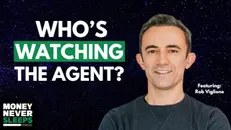
Who's watching the agent? That's the question at the heart of this episode — and it's one that's going to define the next decade of finance.
Your Schwab account is already making automated investment decisions for you. Now imagine that at 100x the speed, 24/7, across every asset class globally. No human supervision. No sleep. No off switch.
Who's watching the agent?
That's the question Rob Viglione has been thinking about longer than most. Before he was building cryptographic infrastructure for the agentic economy, he was in the US Air Force managing software agent programs that automated the tasking and dissemination of radar data. Then Afghanistan, supporting Special Operations Task Force intelligence efforts. Then a PhD in Finance. Then eight years building privacy infrastructure at the cutting edge of Web3.
Rob is Co-founder and CEO of Horizen Labs, the development studio behind zkVerify, Horizen, and ApeChain — and one of the longest-standing voices in Zero Knowledge Cryptography in the industry.
In this episode we get into the mechanics of what actually breaks when you put AI agents on financial rails that weren't designed for them. The scale alone is staggering — we're talking orders of magnitude beyond anything current infrastructure was built to handle. But the deeper problem is trust. Agents acting on your behalf, making decisions at speeds no human can supervise, on rails that are completely public. Your data, your strategy, your positions — all of it visible. All the time.
The answer Rob is building toward is Zero Knowledge Cryptography. The technology that lets an agent prove it did what it was supposed to do, without revealing how it did it. Accountability without exposure. Privacy without opacity. It sounds like having it both ways — but that's exactly what ZK makes possible.
We also get into the TradFi-DeFi question. Is traditional finance integrating with decentralized finance, or infiltrating it? Rob's honest answer is that it started as infiltration — but the destination is full integration. The minimum requirement for institutions to come onchain is strong privacy. The non-negotiable requirement from regulators is compliance. Zero Knowledge Cryptography is the stack that squares that circle.
And we close on the big question. Rob has seen autonomous systems in war zones. Now he's building trust infrastructure for the agentic economy. Is this the moment Zero Knowledge has been waiting for?
His answer is worth hearing.
Find Rob at horizenlabs.io and follow him on X at @robviglione
MoneyNeverSleeps is on YouTube: www.youtube.com/@moneyneversleeps1814
CHAPTERS:
00:00 Who's Watching the Agent?
01:30 The Stakes of Agentic Commerce
03:00 What Breaks When Agents Hit Financial Rails
05:00 Is TradFi Infiltrating or Integrating with DeFi?
07:30 Zero Knowledge Cryptography and Privacy on Public Rails
09:30 Baking Privacy into the Protocol
11:00 Is This ZK's Moment?
#MoneyNeverSleeps #ZeroKnowledge #AgenticEconomy #HorizenLabs #Crypto #Fintech #Web3 #Privacy #Tokenization #AI #Blockchain #ZKProofs
0:00 Who's watching the agent? We're entering a new world in a gentle commerce where we do not have guardrails yet and we have to race to build them. Every asset class will be tokenized one day soon, and agents will be operating in this entire domain autonomously. They'll be operating in systems that don't even exist today, and now your data is completely in the public domain all the time. This is Money Never Sleeps. Sharp riffs, big ideas and real insights from smart people. I'm Pete Townsend. Let's go money. Never sleeps. My guest today spent his career figuring out how machines make decisions in high stakes environments and what happens when those decisions go wrong. Now he's building the trust infrastructure for the agentic economy. Rob Viglione, Co founder and CEO at Horizon Labs. Welcome to Money Never Sleeps.
0:49 Happy to be here, Pete. Thank you for having me. Awesome. Just to set the scene, Rob, your Schwab account is already making automated investment decisions for you. Now imagine that at 100 XS speed 24/7 across every asset class globally. Who's watching the agent? Yeah. Right now we just count on Schwab and the other brokerage firms to handle the algorithmic trading properly. But the reality is as these things become agentic, where we have algorithms themselves that have authority, spending power, trading authority, that are making decisions on our behalf. This is where right now we're entering a new world in a gentle commerce where we do not have guardrails yet and we have to race to build them. When it's 24/7, this isn't for me and you, this is for the agents.
1:38 In that absence of human supervision, what are the stakes here? Everyone knows what the stakes are. The stakes are existential for your business, for society, some could say. But we're seeing enterprises spend billions of dollars on trying to put up guardrails and really try to do monitoring and compliance. Ford agents internally are doing already. What we're trying to do, you know, like in our segment of this industry is what we're building cryptographic guardrails so that we can actually control and you know it's not completely controlled monitor in real time exactly what agents are doing on our behalf. But what actually breaks when you put AI agents on financial rails that weren't designed for them? A lot, right. So the scale is just orders of magnitude. We could talk 100 X and some people are talking about a million times, kind of like payments volume could be occurring on these rails that just aren't designed for them.
2:26 These rails are designed for humans and human systems and institutions that have their own internal checks and guardrails. So you don't have the rogue trader, the rogue kind of invoice paid, you know, like someone picking an invoice and a company for a billion dollars when it was supposed to be $100,000. We have already a labyrinth of systems and checks in place that you are no longer valid. When we have agents that are doing things at scale, they're just unimaginable right now. And do you see more kind of instead of having additional intermediaries that you will have more agents that are performing the tasks that previously had been done by intermediaries A. 100% So like my company comes at this from what we call the Web three-part of the industry where we're dealing with agents that are designed to be in the public sphere and operating on chain with literally their own wallets.
3:13 But we also talked to like major institutions, enterprises and systems integrators that are building at a frantic pace, agents to kind of already turbocharge internal operations for companies. Like whether you're talking about Volkswagen or, you know, a variety of other enterprises, they're building part of agentic behavior into their business model so that they can collapse their operating costs, which ultimately means probably replacing human functions in the front. You don't want to give them the keys to the Kingdom, right? You don't want them to be completely unconstrained and just operating completely on the without guardrails. So like right now, this is a problem that companies are attacking in different ways. You have to see So's or security operations of firms that are just really getting in there and sandboxing things.
3:55 We do that internally at Horizon Labs and finance Ages that could be trading 24/7, 365 on any type of asset class that could be tokenized. And the hint on that is every asset class will be tokenized one day soon and Ages will be operating in this entire domain. They'll be operating autonomously and they'll be operating in systems that don't even exist today. You then turn agents on to these things where previously was humans pressing the trading button and now agents had the full authority with a budget and a wallet with funds that could disappear in an instant if you don't put in the proper guardrails. It's a human assist AI operated model that will probably work best. Yeah, absolutely. The agents need to have that accountability, and that accountability will come from these human guardrails.
4:40 One of the other sides of this is exposure and the world being able to see what you're doing. Because this is operating on blockchain rails now, there are vault based solutions for this. There are a number of other startups that are working on this. For the person whose agent is out there acting on their behalf, or for the organization whose agent is out there acting on their behalf, how do you avoid that portfolio strategy from becoming known and publicly exposed? Yeah, I think this is the, the, because this is the difference from, you know, the tribe flight to the future 5 stuff with D5 kind of as an intermediate stage in traditional finance, the firms keep their proprietary trading secrets, their secret sauce to their business and to their profitability secret. It's on the servers.
5:24 It's literally part of human capital and IT and infrastructure that resides within the firm. Now we're talking about operating on rails that basically are global computers, effectively, right, that are completely persistent, and now your data is completely in the public domain all the time. So now we need different technologies that can actually operate in that public sphere while retaining privacy and affording accountability. Like what? One major class of technology here that we specialize in is called 0 Knowledge Cryptography. And it's that class of cryptography that allows you to basically execute transactions or computation without revealing those parameters or the inner workings of it directly. Now this is a key breakthrough technology.
6:05 You combine this with other privacy Brazil technologies like trust execution environments, even fully homomorphic encryption, FHE, this stack, this sort of privacy and accountability stack, I think is absolutely going to be at the heart of this future Phi concept. I spoke with my pal Alejandro Gutierrez about this and the question I had for him when he started talking about privacy and how the institutional adoption of on chain rails is driving this demand for more privacy. I said is triad Phi integrating with D Phi or is Tri fi infiltrating D fi? What do you think? And additionally infiltrating and as a long term central point and decrypted guy, it feels that way.
6:49 But I think the reality is it's going to be an integration. And this is what I'm talking about. These worlds are going to combine because they just make sense. We had some period of time called 10 years from, you know, Satoshi not coming from a washing Bitcoin to in the advent of D5 where it could scale sufficiently. We can start talking about it and the Financial Times for instance. But we're friendly at a point where you add agentic behavior and AI in general. And when you're talking about persistent trading and operations on a world computer, it just makes sense. So the world is converging. I think that this infiltration is going to turn into a full blown integration. That's exactly where you know, the minimum requirement for traditional institutions to come on chain and start dealing with these tokenized assets, which they absolutely have to. They know it to be competitive, they have to and there's so much opportunity for them to do it.
7:38 They need strong privacy. Now at the same time then very strong compliance. And this is what is kind of shaped our industry over the last 100 years is this kind of ever evolving system of compliance and kind of oversight from our regulators is absolutely necessary and must as a hard requirement be baked into the system. Yeah, you. Just use the term baked in. And I think that's the key is that you have the privacy baked in at the protocol level rather than these additional utilities that sit on top of the whole stack that then are acting as a gatekeeper rather than protocol baked in privacy. When we talked about kind of protocol level privacy, I think like this industry, Bitcoin, Ethereum and the major rails of web three that I think are going to be this future financial rails. They evolved in this permission less environment where anyone in the world can run a node.
8:29 You can verify every transaction, you can see every transaction, you can broadcast a transaction without anyone sense from you a blocking you from doing so. When that intersection bumps up against the regulated world where you have legal jurisdictions like the United States that have things like Olfact restrictiveness and there's participants or countries and actors that are not allowed to participate in the US financial system. You know, this is the concept of like, well, can we actually bake that into the protocol itself or you do or do you need these overlays now as of right now, like while the debate is still happening and he'll probably still happen for some years. Like what we're doing as an example of Horizon Labs is we're actually baking in like an overlay to the base blockchain. Like this is coin basis blockchain ecosystem.
9:10 We're baking in a privacy layer there. And we're doing in a couple different ways. Like our approach is just pragmatic. We want to get out there to market like a good old tech entrepreneurs see how things work and generate demand and customers and everything kind of integrate as we go. But I think the real interesting question is what you hit on, which is like, can we actually at some point take these overlays to ecosystems and bake them into the cores of protocol? I think we're in this bridge moment of, hey, let's just get trad Fi on chain and we're going to need these layers, these utilities as we do that. Once we have everyone on chains, that's where we can then enable the protocol level to have these native inbuilt privacy considerations 100.
9:54 Percent for us is the business in the space like AUS company we know we have to just comply with a certain regulations, but not ever in the world is U.S. company. And like reality is like I don't know if we could bake in like an OAFAC restricted list into Ethereum's core protocol. Like I just don't know if that's ever possible. I doubt it. Overall, Rob, now you've seen autonomous systems in war zones, now you're building the trust infrastructure for the agentic economy, right? Is this the moment that zero knowledge has been waiting for, or is this the moment that zero knowledge proofs have been waiting for? Or is the market still not ready to have this conversation? I've been in ZK saying ZK was the thing in crypto when Z Cash launched and then we had a quick follow like other privacy coin project on Zen Cash back in 2017. So I've seen it all.
10:44 And the reality is the technology was extremely clunky back then. And our vision was always to bring ZK to the application domain, not just have it for private money transfer. But we were early and we could feel it and we saw the industry evolve from like ZK roll ups to then you have the DZK virtual machines that are out there now for general purpose computation. You have like is it get proof generation networks, you have the proof verification network or ZK verify. We now have a stack, like a modular stack for ZK. And now like even that one can say, OK, that's on the supply side. But now I think AI is driving the demand side of that equation. And this is the year where we're actually seeing the supply side and the demand side of the equation for ZK really take off exponentially. That's fantastic, Rob, what's the best way for people to get in touch and learn more about what you're building at Horizon Labs? Yeah, I mean Horizon Labs dot IO and you know the key there is this Horizon like Zen, the cryptocurrency, like the our first products that we lost in 2017. But that's the best way.
11:39 You can also follow me on Acts Ed Rob Vigliani. Fantastic. Thank you, Rob and folks, if you enjoyed this episode, please like subscribe, leave us a review. It really does help. And again, appreciate you coming out to the show. Rob, it's been great to talk to you about this. Thanks for. Having me, Pete.