Spotify

 Apple Podcasts

 Amazon Music

 Overcast

 Castro

 PocketCasts

 Castbox

 RadioPublic

 RSS Feed
What Do You Own? Tokenization’s Missing Half | Dr Ian Hunt [EP. 330]
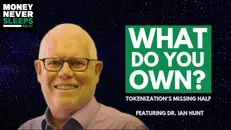
Pete Townsend is joined by Dr Ian Hunt, who spent around 40 years on the buy side working with firms from Barings and Flemings through to M&G and Fidelity. Ian was the design authority behind FundAdminChain, the first distributed ledger-based funds platform to go live in the UK, and he and Pete sat on the FAC advisory side together. His new paper with Steve Whyman, Replicating Legacy is Squandering the Promise of Tokenisation, argues that most of what the industry calls tokenization today is the old system on new rails.
Cash onchain, finally
Back at FAC, Ian used to say that everything changes once cash is onchain. When Fidelity International launched its tokenized share class on the platform in 2021, there was no usable digital cash to plug into, so the team built a private stablecoin to get atomic settlement and onchain cash management. Today there are hundreds of billions of dollars in stablecoins, and tokenized deposits have become a favourite of the Bank of England. Ian also clears up a common misunderstanding: atomic settlement doesn’t have to mean instant. What makes it atomic is that the asset and the cash move in the same environment, locked together, whenever settlement happens. Pete connects this to his conversation with Emma Landriault of JPMorgan Kinexys, who described digital cash as a layer cake.
What do you actually own?
The OKX and ICE joint venture wants to trade tokenized versions of major US stocks under the SEC’s innovation exemption, and most of the companies on its list have objected. Ian finds that curious. Structurally, the venue looks a lot like a nominee account or an unsponsored ADR: shares are immobilized with a custodian and tokens are issued against them, and nobody objects to those arrangements. Issuers can object here because the exemption invites them to, and what they’ve said is that they see no benefit in it for themselves.
The lost oneness of value
Pete puts Charlie Kerrigan’s one-liner to Ian: “Apple is solvent, the token issuer goes bust, you lose.” Ian agrees that this is the whole problem in a sentence. A tokenized share carries two exposures the shareholder doesn’t have, one to the custodian and one to the token issuer, and many would-be issuers don’t have the capital to back their obligations. So the risk and value of the token drift away from the risk and value of the underlying asset. Just as the Bank of England worries about the oneness of money, investors will worry about the oneness of investment value.
Own versus owed
The paper goes further than critique, building on the trading-desk frustrations Steve Whyman set out in The Love-Hate of Tokenization. In Ian’s words, “by changing the way you own something, you don’t change the thing.” Tokenizing an existing fund or share leaves the intermediaries, servicing and regulation exactly as they were. His alternative is to build finance from two primitive tokens. Title is for things that can’t be digital themselves, such as buildings or fine art. Entitlement is for future flows of value. Every financial asset is really a cluster of future entitlements, and entitlements can execute themselves through smart contracts.
Two things instead of a whole load of things
When every product is built from the same two primitives, one operating model can serve every asset class. Interoperability between chains gets far simpler too: instead of standardizing every asset class and product type, chains only have to agree on the structure and meaning of two tokens. New products also stop adding layers of complexity, which today, Ian says, takes three to five years to work through for each new asset class. Ian is now co-writing a composable investment specification with Steve Whyman, Charlie Kerrigan, Rich Fox of Schroders and Professor Sarah Green, covering the operating model, architecture, regulation and legal framework, to present to the FCA, the Bank of England, the BIS and AFME.
Connect with Ian on LinkedIn, read the paper on SSRN, and hear more from Ian on the paper in his Future of Finance interview.
Subscribe on Spotify
Subscribe on YouTube
Subscribe on Apple Podcasts
Chapters
0:00 Cold open
0:17 Intro: Ian Hunt and FundAdminChain
1:07 Cash on chain: the FAC private stablecoin
3:25 What stablecoins open up: atomic doesn’t mean instant
4:44 Stablecoins, tokenized deposits and the digital cash layer cake
5:55 OKX, ICE and why issuers are objecting
8:28 Apple is solvent, the token issuer goes bust
10:37 The paper with Steve Whyman: own vs owed
13:50 Title and entitlement, the two primitive tokens
15:01 Interoperability: agreeing on two things instead of many
16:24 Innovating without adding complexity
17:08 The composable spec, and who’s writing it
18:52 Wrap
[00:00:00] Ian Hunt: The word tokenize assumes that there's something there that you are tokenizing. It sounds neutral and unthreatening, but actually that is absolutely pregnant with meaning.
[00:00:11] Ian Hunt: By changing the way you own something, you don't change the thing. You just change the way you own it.
[00:00:17] Pete Townsend: This is MoneyNeverSleeps, sharp riffs, big ideas and real insights from smart people. I'm Pete Townsend, GP at Norio Ventures. Let's go.
[00:00:25] Pete Townsend: My guest today is Dr. Ian Hunt, a well-known authority on buy-side business process and technology with a strong reputation for innovation in the investment process, risk and derivatives.
[00:00:36] Pete Townsend: And I can attest to that 'cause he was a design authority behind FundAdminChain, the first distributed ledger-based funds platform to go live in the UK a few years back. And Ian and I were advisors on FAC together. So I've been absorbing his views on tokenized funds for a long time.
[00:00:53] Pete Townsend: His new paper with friend of the show, Steve Whyman, says most of what we call tokenization today is the old system on new rails.
[00:01:00] Pete Townsend: Ian, welcome to MoneyNeverSleeps.
[00:01:02] Ian Hunt: Thank you, Pete. Very good to be here. Very good to see you again
[00:01:06] Pete Townsend: Awesome.
[00:01:07] Pete Townsend: Now listen, back at FAC, we were always saying that everything changes once cash is onchain, and I heard those words come out of your mouth, I don't know, 100 times. Now that there are hundreds of billions of dollars in stablecoins and other forms of onchain cash that are in supply now and live onchain, is this a moment you were waiting for?
[00:01:29] Ian Hunt: Yeah, look, it makes a lot of difference. When we set up FundAdmin Chain and worked with with Fidelity to launch what it was a tokenized share class. We were aware that the benefits were limited. We were still dealing with a conventional fund structure. We needed to create a private stablecoin in order to have the benefits of cash on ledger because there simply weren't available forms of digital cash that we could just tap into. And that gave us the ability to have atomic settlement, and that gave us the ability to have effectively onchain cash management.
[00:02:07] Ian Hunt: The benefit of tokenization can go well beyond just changing the way you own things from shares or units to tokens.
[00:02:18] Ian Hunt: That gets you some limited benefits. It gets you the benefit of a self-maintaining register, where the movement of the tokens between owners effectively updates the register itself, so you don't need an externally maintained register. That's a good thing. And that eliminates some reconciliation requirements.
[00:02:41] Ian Hunt: It gives you potentially the ability to liberate the ownership of fund units, tokens, shares, call them what you like, from the kind of straitjacket of the transfer agent's register. This is exactly why now there's a fashion for tokenization of money market funds to enable them to be used as collateral because they were effectively immobilized in the TA's register and couldn't easily be used for other purposes.
[00:03:14] Ian Hunt: I think there are much more significant benefits if we go beyond treating tokens as just markers of ownership
[00:03:23] Pete Townsend: Yeah, absolutely.
[00:03:25] Pete Townsend: Now that stablecoins are live in the market to an even far greater extent than I think we could have imagined back in 2019, what does that now open up, not only in the specter of tokenized funds, but also tokenized equities as well?
[00:03:46] Ian Hunt: It's the same principle. If you're gonna reduce settlement risk, if you're gonna have settlement within exactly the same environment, the same technical environment for cash and for asset, and you're gonna do that in a digital environment, you have to have digital cash.
[00:04:06] Ian Hunt: People think atomic settlement is instant, and that's what it's for. But that's not the case. So atomic settlement can be something that was deferred for years. The atomicity is that you have the same technology, the same environment running the movement of asset and running the movement of cash.
[00:04:25] Ian Hunt: So they can be absolutely locked together, and they're locked together easily within the same environment. Whereas at the moment, the movement of asset is by delivery between custodian accounts and the movement of cash is movement between bank accounts in different technologies.
[00:04:44] Ian Hunt: So I think yes, the availability of stablecoins, and it's not just stablecoins, the availability of tokenized deposits, other forms of cash.
[00:04:55] Ian Hunt: I think at the time we were working on FundAdminChain, we expected CBDC to come much earlier than it has and to be a preferred means for central banks to issue digital cash. But stablecoins have come along in greater numbers than maybe we were anticipating at the time and with more respectability.
[00:05:18] Ian Hunt: And tokenized deposits have become the darling of the central banks or certainly of the Bank of England. And, you know, there is every prospect that there will be tokenized deposits as a form of digital cash alongside stablecoins as a common and respectable means of digital settlement.
[00:05:38] Pete Townsend: Yeah. I spoke with Emma Landriault from JPMorgan Kinexys about this a few months ago on the show, and she was referring to digital cash as a layer cake, and that you've got different instruments for different purposes, whether it be stablecoins, tokenized deposits, or other forms of digital cash.
[00:05:55] Pete Townsend: One of the other things, Ian, that you and I would talk about back in the day was what is it that you actually own? There's a live example of this right now on the tokenized equity side with OKX and ICE, the owner of the New York Stock Exchange being ICE, and they want to trade tokenized versions of big US stocks.
[00:06:13] Pete Townsend: But most of the companies on the list said, "No, thanks." Why do you think companies are objecting to the tokens in this particular venue with OKX and ICE when nobody objects to their shares selling in, for example, a nominee account?
[00:06:26] Ian Hunt: The door has been open to objections here because the SEC's waiver that has enabled ICE and OKX to set up this exchange allows the parties whose shares are tokenized to object, and they don't have to say why they're objecting.
[00:06:43] Ian Hunt: What we've heard is that the issuers are objecting because there's no advantage in it to them. And what's gonna be happening is potentially twenty-four/seven, but certainly more availability of trading outside the conventional hours of conventional markets for trading conventional shares.
[00:07:06] Ian Hunt: And that's not within or is seen as less within the control of the issuers. It is a curious situation because if you look at the structure within which tokenized assets are being potentially issued and traded in token form on a token exchange, it is very similar, as you say, to a nominee structure.
[00:07:33] Ian Hunt: It's very similar to an unsponsored ADR structure. So you have immobilization of whatever the set of shares or bonds or whatever that are going to be tokenized. Those are put in a specific custodian account essentially, and immobilized there. And that is then the reference asset for what is issued as in token form.
[00:07:59] Ian Hunt: Those tokens are then traded on the basis that there is a beneficial ownership relationship back to
[00:08:09] Ian Hunt: the assets that are in immobilized custody. That is pretty well exactly how a nominee account works. And nobody objects to that.
[00:08:20] Ian Hunt: But then there's nothing-- there is no equivalent of the wording in the SEC waiver that invites people to object to that. .
[00:08:28] Pete Townsend: Absolutely. And I think it's interesting to look at it from the issuer's perspective, and obviously they're the ones that have objected, but there's also the investor's perspective and what is it that they want and who is it that is trading assets in a tokenized venue, and what is it that's important to them?
[00:08:44] Pete Townsend: You talk about the, the governance rights that they have, the rights to things like proxies and dividends and so on, and looking at it from that perspective, Charlie Kerrigan put it in one line that "Apple is solvent, the token issuer goes bust, you lose."
[00:09:02] Pete Townsend: Is that the whole problem in a sentence from the investor perspective?
[00:09:05] Ian Hunt: Yes, it absolutely is. We've had various proposals in the market, before, for the tokenization and the token-based trading of already issued equities and bonds. These have fallen over, not because of objections from the issuers, but because of a lack of oneness of the analytics and the value of the tokens against the underlying.
[00:09:35] Ian Hunt: Those are two exposures: one to the custodian and one to the issuer, which you don't have if you own the share, if you own the underlying bond indenture or whatever.
[00:09:48] Ian Hunt: In a lot of cases, the people who have been putting themselves up as potential token issuers don't have that capital strength. So all of these things mean that both the risk and the value of the token are gonna be different from the risk and value of the underlying.
[00:10:08] Ian Hunt: So they're not gonna trade on a one-to-one basis. And that is a real issue. So we've lost the oneness of value. Just as the Bank of England is concerned about the oneness of money with any kind of dodginess in stablecoins, so investors will be worried about the oneness of investment value and investment risk if they take on a form of ownership which introduces new risk and new cost
[00:10:37] Pete Townsend: And I think this is one of the main things that you're addressing with the paper that you wrote recently with Steve Whyman. He was a recent guest on the show as well, and we called that episode The Love-Hate of Tokenization.
[00:10:48] Pete Townsend: The paper that you guys wrote says that every financial product is built from just two things: something you own and something you're owed later. Can you explain that to me the way that you would if I was new to this space?
[00:11:01] Ian Hunt: Yes, absolutely. The word tokenize assumes that there's something there that you are tokenizing. It sounds neutral and unthreatening, but actually that is absolutely pregnant with meaning.
[00:11:13] Ian Hunt: And The, the conventional view there is an untested and unstated assumption behind all of these things, which is that tokens are there as markers of ownership of something. And that is all, really. And as a result of that, then the limitations of benefit which we acknowledged with FundAdminChain apply generally and fully across the current tokenization initiatives. And that contrasts with what happens if in addition to tokens that represent ownership of something which cannot be digital, like a building.
[00:12:00] Ian Hunt: You know, a building is not a digital thing, it's a physical thing. Jewelry, fine art, things which are off chain necessarily. The best we can do to bring them onchain is to represent their title through a token, and we can then trade and move ownership by moving title in token form. If we extend that to set to the meaning of tokens to encompass future transfers of ownership, future obligations, future commitments to deliver value between participants onchain, then the world changes completely.
[00:12:43] Ian Hunt: Because instead of saying, "Okay, we've got this conventional fund or this conventional asset, and we're gonna stop marking its ownership with a share, and we're gonna start marking its ownership with a token," which leaves everything else about that asset unchanged. It's still got the same entities involved in its delivery and its asset servicing.
[00:13:07] Ian Hunt: It's still got the same structure. It's still got regulation attached at the asset level. It's still got roles mandated by regulation at the asset class level or the product level. So they haven't changed much. , By changing the way you own something, you don't change the thing. You just change the way you own it.
[00:13:31] Ian Hunt: If you look at extending our ambition for tokens to creating tokens that represent future entitlements from the perspective of the, the holder or future obligations of the issuer, then the world changes.
[00:13:50] Ian Hunt: All of our financial assets are themselves clusters of future commitments, clusters of future entitlement.
[00:13:59] Ian Hunt: The two primitive forms of token are just title, which applies to off-ledger reference assets and entitlements from which we construct financial assets and financial products on ledger.
[00:14:15] Ian Hunt: Instead of having a separate operating model, a separate set of regulations, a separate technology, separate law, separate roles for each asset class, and attaching all of those attributes at the asset class level, those attributes are now attached at the primitive token level. And every asset class, every financial asset class, every financial product can benefit from the same operating model and the same set of processes because those processes operate at the primitive token level not attached to the end asset class.
[00:15:01] Ian Hunt: And this is an absolutely radical change and brings in an order of magnitude more benefit than anything which a purely title, purely ownership-based token structure can deliver. And it also has benefits in something which everyone is concerned about, which is interoperation, interoperability between chains.
[00:15:22] Ian Hunt: Because at the moment, if you're gonna have interoperation between chains and you're gonna settle in one place and issue in another place and transact across chains, then those chains have to have the standardization that has to exist is at the end asset and end product level. So we have to have the same view across each chain that is interoperating. We have to have the same view of each asset class and product type and solution. And otherwise, we can't exchange between them and we can't interoperate between them. If we have tokens at the primitive level that assets and products are built out of, all that the chains have to agree is the structure and semantics of those underlying primitive tokens.
[00:16:15] Ian Hunt: So you end up agreeing about two things instead of a whole load of things. So that's a major advantage as well.
[00:16:24] Ian Hunt: If we start from the point of view that every asset, every product is a composition, it's composable from underlying commitments, underlying entitlements that are in self-executing token form, then we can innovate without adding complexity.
[00:16:43] Ian Hunt: We can innovate much more quickly. We innovate without needing to create new technology, without needing to create new operations, without needing to attach regulation at the end product, end solution, end asset level. So all of these benefits are orders of magnitude greater than just getting a self-maintaining register, and that's why this is important
[00:17:08] Pete Townsend: There's so much going on right now in this space, and Ian, I know you're right at the center of it and have been for a while. What's the best way for people to go read the paper and follow your work?
[00:17:21] Ian Hunt: Steve Whyman and I have written a couple of papers pointing out that there is a very severe limitation on the benefit of replicating legacy in a new technology.
[00:17:33] Ian Hunt: We're moving on now to a specification of that ecosystem and a specification of the operating model, the technology or the architecture, the regulation and the legal framework required to support a composable ecosystem. And we're doing that not just between Steve and me. We're doing that with Rich Fox, who's the head of UK public policy at Schroders; with Charlie Kerrigan, who you mentioned, who's a leading digital assets lawyer in London; and with Professor Sarah Green, who's the law commissioner who was behind the drafting of the existing digital assets laws.
[00:18:12] Ian Hunt: So we've got a major deliverable coming up which we'll be targeting at the people who are currently publishing, the institutions that are currently publishing policy in this space and who are asking what more ambitious and more advanced models of tokenization look like. So we're trying to answer that question, and we will be targeting this, presenting this to FCA, to the Bank of England, to BIS, to AFME, and to the digital markets champion, et cetera, and offering it as an articulation of an alternative ecosystem.
[00:18:52] Pete Townsend: And it's a huge opportunity one with a lot of work, but that's the only way to really grab ahold of these big opportunities, just dig in, right? So listen, thank you again for joining in. It's been great talking to you about this.
[00:19:05] Ian Hunt: Thanks, Pete. Really good to speak
[00:19:07] Pete Townsend: Wonderful.
[00:19:08] Pete Townsend: To all of you out there, thanks for watching and listening. Don't forget to follow or subscribe wherever you get your podcasts. And if you're enjoying the show, leave us a review while you're there. It helps others to find the show, and it means a heck of a lot to me. Till next time. See ya.