Spotify

 Apple Podcasts

 Amazon Music

 Overcast

 Castro

 PocketCasts

 Castbox

 RadioPublic

 RSS Feed
The Next Episode - MoneyNeverSleeps 300: One Story Ends, Another Begins
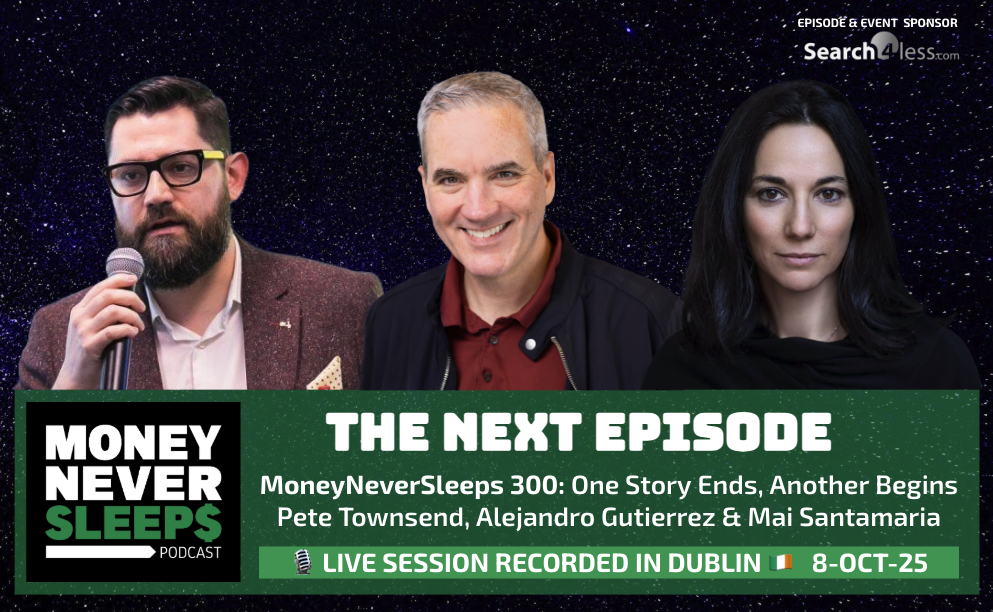
This one was special. Episode 300 of MoneyNeverSleeps was recorded live at the Podcast Studios at HeadStuff HQ in Dublin - the legendary former Westland Studios where artists like U2, Dropkick Murphys, and Hozier have recorded in the past - marking the end of an era for the show’s long-form interview format, and the beginning of a new chapter.
Seven years. Three hundred episodes. Hundreds of conversations with founders, operators, investors, regulators, technologists, and dreamers building what doesn’t exist yet.
This episode brought together some of the people who’ve been part of the journey from the early days - Mai Santamaria, Alejandro Gutierrez, Paul Smyth, Barry Darmody, and of course, Conan Brophy, the wizard behind the sound since day one. The room was packed with friends of the show, past guests, founders, and long-time supporters.
🪩 From Two Mics to 300 Episodes
-
2018–2020: Two mics and a backpack. Episodes recorded at Dogpatch Labs, BoI Startup Hub, Top Tier Recruitment, and WeWork.
-
2020 Turning Point: Covid forced the pod online and opened it to the world. MoneyTalks segments emerged, and guests like Mihai Alisie, Pascal Bouvier, and Graham Rodford expanded the horizon.
-
The Eoin Era: The chemistry between Pete and co-host Eoin Fitzgerald helped build a loyal following, culminating in milestone Episodes 100 and 200.
-
Post-Eoin Era: Rotating co-hosts (Mai, Alejandro, Laura Walsh, Paul Smyth) carried the show forward with fresh energy.
-
2020–2022: The golden era of fintech × crypto crossover.
-
Post-2023: Fragmentation and web3 fatigue hit - but niche content still resonated deeply with the core audience.
🧠 What the Data Told Us
-
Peak engagement during fintech × crypto crossover stories.
-
MoneyTalks segments tied to big macro narratives and bold predictions consistently outperformed.
-
Investor-driven episodes (Matthew Graham, Joey Krug) and big names (Sam Williams from Arweave) generated spikes.
-
Technical or policy-heavy episodes struggled to connect.
Frequent Co-Hosts: Alejandro (10), Paul (8), Laura (7), Mai (6).
Fan Favorites: Mihai Alisie, Sam Williams, Joey Krug, Matthew Graham, Elaine Deehan, Barry Darmody, Laura Walsh and Martin Cass.
🔮 2025 Predictions Recap & Reality Check
1. Tokenization Takes Center Stage ✅
Institutional adoption has made tokenization core infrastructure, not just innovation.
2. Stablecoins in E-commerce 🟡
Rails are being laid by Stripe, PayPal, Shopify. Consumer adoption is slower but B2B volumes and cross-border payments are driving momentum
3. Decentralized Identity 🟡
DID and verifiable credentials are progressing - still early, but foundations are strong.
4. Blockchain & Gaming 🟡
Indie studios lead, AAA is cautious. UX and regulation still hurdles.
5. AI Meets Blockchain ✅
AI agents are now embedded in DeFi, DAOs, and governance. A massive frontier is forming.
6. Regulatory Milestones ✅
FIT21 became the Clarity Act, the Genius Act passed, and MiCA is implemented. The global regulatory base layer is here.
7. Multichain Developers ✅
The single-protocol mindset is gone. Builders are going multichain by default.
8. US Bitcoin Reserve + Global Adoption 🟡
Narrative gaining traction, some state reserves emerging, but still early innings.
9. Memecoins & AI Agents ✅
Early but real — the next mania might be agent-driven.
🧑🤝🧑 Featured Voices
-
Mai Santamaria — on vulnerability, community, and the moments that made her laugh (and cringe).
-
Alejandro Gutierrez — on predictions, tokenization, and the evolution of the show.
-
Conan Brophy — the heartbeat of the pod since episode one.
-
Paul Smyth — long-time co-host and friend of the show.
-
Barry Darmody — local hero, Episode 130 guest, and sponsor of #300.
📝 Top Quotes
“It’s the end of an era and the start of a new one.” – Pete Townsend
“Authenticity and vulnerability make a great guest.” – Mai Santamaria
“You made people feel safe enough to tell their real stories.” – Alejandro Gutierrez
“Seven years of conversations I never thought I’d have — and now it’s part of who we are.” – Pete Townsend
🚀 What’s Next
MoneyNeverSleeps is evolving into a new, sharper, video-first format — shorter riffs, faster turnaround, and even more relevant takes on what’s shaping fintech, crypto, tokenization, AI, and the next wave of founders building onchain.
This isn’t goodbye. It’s the next episode.
🙏 Acknowledgments
-
Search4Less & Barry Darmody — sponsor for Episode 300
-
Conan Brophy & Gav Timlin — for seven years of production magic
-
Everyone who ever tuned in, shared an episode, or stepped up to the mic
🔗 LINKS
Leave a review & subscribe on: Apple Podcasts | Spotify | MoneyNeverSleeps (website)
Email us: info@norioventures.com
Pete Townsend: X/Twitter | LinkedIn
MoneyNeverSleeps: X/Twitter | LinkedIn | Newsletter
0:05 Money never sleeps, pal. Hey there, I'm Pete Townsend, and This is Money Never Sleeps. We look inside the minds of entrepreneurs and at the crossover of startups, enterprise, finance, technology and life as we know it this week. Well, this one's a bit different. We're coming to you live from the podcast studios that head stuff HQ in Dublin, the legendary former Westland studios where legends like U2 and Hozier once laid down tracks. And tonight we made our own history. This is episode 307 years, 300 episodes. Hundreds of conversations with founders, operators, investors, technologists and dreamers building what doesn't exist yet.
0:47 It's the end of an era and the start of a new one. We celebrated the journey with a live audience and two of the voices who helped carry the show forward, my Santa Maria and Alejandro Gutierrez. We visited our bold 2025 predictions, talked through how they've actually played out, and shared a look ahead to the next chapter from When He Never Sleeps, Sharper, faster and video first. This night was pure magic, a feel good moment of the year, a full circle reminder of how a scrappy little curiosity project between two mics became a global conversation. Big thanks to Search for Les and Barry Darmody for sponsoring this episode, to Conan Brophy for seven years of production magic, and to every single one of you who's ever tuned in, shared an episode, or stepped up to the mic.
1:31 So let's get into it live from Dublin with my Santa Maria Alejandro Gutierrez, and an incredible room of friends and founders. All right here on Money Never Sleeps. Money never sleeps, pal. Live from Dublin, This is Money never sleeps. Thank you everybody welcome to episode 300 of money never sleeps. It's been a long time coming, seven years, 299 episodes up until last month, and I'd like to welcome my Santa Maria and Alejandro Gutierrez to the podcast with me. So welcome to you both my.
2:12 Thanks, Pete. It's an absolute honor being here. Alejandro, thank you very much, Sir. Wonderful. So this is an important occasion. This is something that we've been building up to for a while. We are live here at the podcast studios at Head Stuff HQ here in Dublin. This is a former site of Westland Studios, OK. It's a location where bands like U2, Dropkick Murphy's Hozier, Christy Moore, a bunch of others either recorded or produce their music here. So we're in good company with a name like Pete Townsend, I feel like, OK. Or it's appropriate that we're here. Always a rock star in my own lunchtime. But, you know, hopefully we can we can make that true tonight. OK, so this was supposed to be the final episode, but a gentleman by the name of Conan Brophy, who has been our producer since 2018, he and I caught out back in June and we talked about doing something a little bit different. So I wanted to do the capper on this era because it has been a very important era.
3:12 Before we move on to the next format, give us some head space to be able to move forward to the next era and we'll talk about how we do that. Content is the engine that keeps Nario Ventures going. Nario Ventures, the name I of my business that I started in 2016 and during the Techstars years where I worked with Techstars from 2021 to 2025 and investing in 40 companies along with Hugh Mcgurr back there. He's just joined us now thanking Hugh. He was the investor principal with me with Techstars. It was absolutely critical keeping this, what we call a content flywheel going. So the more content you produce, the more people you reach, the more people that come to you in terms of recognizing what you're up to and perhaps generating some deal flow. That deal flow then generates more interesting people to talk to.
3:57 You produce more content, and the wheel goes around and around and around. And that's the whole idea. Now, I didn't do tech stars just to get that content flywheel going, but it was certainly one big benefit of it. OK, so I'd like to thank a few people before we get started Search for less. So Barry Darmody is here. He's the CEO of search for less Barry's good friend known him for over for 25 years now nearly 25 years. And he was also the star of episode 130. OK, and part of our all time top 20. I'm not sure if you knew that Barry, but you were you are one of our local heroes. OK, so we'll get into that in a bit. And also the thank you to the team at the podcast studios at Head Stuff HQ here. Connor, Patty, Claudia, the whole team here.
4:39 Thank you to all of you. Thank you for coming right. And be ready because one or two you may be invited up for a short segment to share a few words. And I just wanted to acknowledge my and Alejandro and also Laura Walsh, who isn't here with us today. She has been one of the rocks of the post Owen era and I'll get to that in a minute. We miss you, Owen Fitzgerald. OK. The whole reason that we're here today, that any of us are here today is because Owen came up to me in 2018 and said, hey, Pete, I heard you on that Fintech Insider podcast with 11 FSI want to do a podcast, You want to help me? And so it began. OK, So he has six kids. And as I always say with Owen, there's six kids and five days in a week.
5:24 Something is going to happen each one of those days per week with one of his kids where he's not going to be able to get to where he was going to be. So he was supposed to be here tonight with us, but couldn't be here because two of his kids have strep throat. So hopefully those kids are doing OK and getting better soon. Also, Thank you. I've mentioned Conan a couple of times. Conan Brophy from Great Sound, seven years of production magic, right from lugging gear around Dublin to saving dodgy auto audio tracks and also his partner in crime, Gav Timlin. Thank you for all the invoices. You know, really appreciate that. And also, you know, for the the the thoughtful gifts at episode 5100 and 200 that you guys provided. So thank you so much for that. So back in the early days, like I said with Owen, this was a curiosity project.
6:10 It was 2 mics, 2 founders, endless questions. We started in Dog Patch Labs in a room with Brian Norton one day. He was a founder of future finance student lending business. And the second episode was a guy called Barry Brennan, who was an Angel investor at the time. He's now with Elk Stone Ventures. And we got through episode 345 and 5 was my Santa Maria just off here to the left. And then it took until we got to 2021 for Alejandro and I to meet. But those early episodes were on Irish founders, right? If you look at the first fifty, 6070 episodes, it was highly populated with Irish founders. And that we could record wherever we could set up. Like I said, Dogpatch, we're also at the Bank of Ireland startup hub for a few episodes. Gene Murphy got that set up for us here. He's a startup ecosystem legend here in Ireland. And we also did we work with Paul Smith and Laura Smith from top tier recruitment where when they were sponsoring, we did whatever we could until the COVID era came along and that changed things.
7:10 But before we get into that, Conan, do you want to come on up and take the hot seat here? And we'll we'll ask you a couple questions about that. I'm. A bit insulted that you take until the very last episode to talk to me. What do you remember? I was in New York for an episode that I was trying to get out in November of 2018, I think. And I said, listen, I can't do the intro. Can you record the intro? Oh. Yeah, right. Yep, Yep. So you recorded the intro and the outro and you got to say see you right, It being like the kind of the the sign off of the podcast, but. Is that the only time someone other than you has done?
7:53 Yes, that was it. Just you. Just you and only you. Highly privileged? Yes. Absolutely claim to fame. So anything that you remember from the early days that you think is worth sharing that people. Were sharing worth sharing? I'm not sure but I remember the very first one was it was like a it was an empty unit in CHQ. Is that? Yeah, at Dogpatch Labs. Yeah, it was like about to be a sandwich shopper. So I don't know what it was about to be, but it was. It was. It had been a suit shop, like a men's clothing shop. And what was Louis Copeland? All right. Yeah. And they then turned that into one of their innovation rooms that they were starting at the time. That was back in 2018. Yeah, I. Thought that was the, the very first one and trying to set up a studio in the, in the, in the CHQ, lots of people walking past glass windows. Yeah, sort of glass wall, which is the last thing you want when you're trying to record microphones, you know, and there's 2 problems is the reflections. It sounds like you're, you know, echoes everywhere. And then also there's all the people just walking through the mall outside.
8:52 So we could hear both, but but we managed to to sort of shimmy something together and and make it sound good. So it was, it worked out well. It was great, great. Fun. Yeah, it was a lot of fun. And I remember you just looking at me during the first recording. Maybe God did as well and kind of give me that thumbs up, like, OK, yeah, your your voice sounds fine, Just keep going. But I remember in interviewing Brian Norton that first time, like, I didn't know what I was doing right. He worked through probably A5 to 8 minute story about something and then when I when he was finished, I went back to like minute 2 and said OK, so that business failed then, right? And just had no clue about how to keep a story going and how to keep asking questions and all that type. Of stuff you were kind of a natural. At the same time, though, you were very easy on the mic and you had no problem kind of being in that uncomfortable place of, of what what the hell am I doing? You know, you still just rolled with it. And, and, and that's a, that's a talent. I think there's a lot of people who can just freeze, You know, people talk about fight or flight. There's also freeze this fight or flight freeze. And, and you know, you, you have a natural ability to just kind of roll with it.
9:59 And that was that was really important at the start to keep it, you know, keeping the guests talking and keeping it going and. And then when we did move on to the COVID era, you know, and where we stopped asking you to traipse around Dublin. With big plastic bins full of laptops. Exactly. With towels to put on the tables. Towels to dampen. The sound, all that type of stuff did did, did. Were you hopeful that we might end up going back on location at any point soon? Until I. Know actually I didn't miss it. Yeah, it's a lot. It's a lot. Obviously it's a lot more isolated when you're just sitting in the studio getting sound files and putting them together. It was a lot. It was a lot more fun yeah. Being in the room with people and, and, and seeing people's faces and stuff like that. So yeah, it was, it was a, it was a pity that it went the way it did before, you know, it was, it was a pain in the whole, it was a pain in the arse for everyone at the time.
10:46 But, but it was great that we kept it going. That was the main thing that we found. Just adapted and didn't miss a beat really. And since then, you've kind of grown things a bit on your side in terms of your music career, haven't you? Have I, I've always been doing lots of different things. So yeah, there's, there's been always been either bands going or, or solo projects or whatever. I've always been been doing, yeah. Bits and pieces, yeah. Yeah, yeah, it's really cool stuff. I went went up to the Blue Light Pub over the summer to see Conan play with his band. Oh yes, my Blues band. Yeah, yeah, yeah. That was very cool. So we're in the blue light a lot, and so if you ever have the mountains, they're practically the house band over the blue light. But we do play other places as well, down in Rough Minds and Mother Riley's and a bunch of other places.
11:32 So Super Saiyan Blues, there's the plug for the band. Well, Conan, listen, we couldn't have done any of this without you and Gav. So thank you. Really appreciate everything you've done for us over the years. It's been a privilege and a pleasure and I can't believe how much I've learned about something I don't get care about it all. I know so much about, you know, NFTS and crypto and you know, all this stuff that would not be on my radar at all. And I was and also it was just amazing to get an insight into the kind of people that you have on because it's again, that's something that's not in my wheelhouse, some musician mostly. And so I meet those kinds of people a lot. And so that sort of financial side of things would be alien territory to me. And so to meet some of it was some some really amazing people to that you had that you've had on and guests an amazing stories, an amazing energy. I don't know how some of these people have the energy to do the things that they do, but that was that was always inspiring and and and interesting to to be a part of. So So thank you.
12:29 Oh, absolutely. You know, it's pretty interesting, right? Because we have been, oh, having part of the podcast since 2021, right? Yeah. We're always talking about Conan. Yeah. And Conan is going to be doing this. Conan is going to be doing that, and we would've crossed paths we never met before, right? No, never. No. Which is interesting because when I say Conan is like a who's Conan? I just assume everybody knows Conan. Which is really pretty cool, yeah. Absolutely. Conan the Beat Berrien. We we did live once. Yes, we did in person. Maybe twice, I think it was. It was when it was a fifth podcast, but it was in the Bank of Ireland's Innovation Centre, which is very tiny loop, hokey room and obviously open and yeah. More, more glass walls.
13:14 Yes, we seem to love them. I mean, banks and financialist glass walls are here, but you know. Now we have padded walls outside. That's this is this is more, much more my, my, my environment. Yeah, yeah. Cool. All right. Well, thank you, Conan. Thanks very much. All right, Thank you. Thanks, Conan. So with that, you know, after we moved into the COVID era, we came up with a new segment called Money Talks. And that was because we were at a point where interviews were something that during the COVID era, just for some reason, one reason or another didn't seem that accessible for us. And so we wanted to mix it up a bit. And we came up with this Money Talk segment, which was now I have to be fair that I did model it a bit after the fintech insider that I've been on back in 2017 where you take 5 or 6 news stories, you get a few people together and you just talk about them. And we, we had just one person on to talk about that, sometimes 2 if it was myself and Owen and perhaps one other, but it was usually just myself and one other. And as I mentioned with Owen Fitzgerald, this was back and I think 2019 when we started doing it, sorry, 2020 we started doing this, that on the very first segment we were recording for Money Talks, Owen couldn't make it because one of his kids were sick.
14:29 So who stepped in? Paul Smith, right? So he stepped in to do the first Money Talks segment with me way back when We talked about Anne Boden, I think we talked about Chris Skinner, and we put those two names on to the episode title and it got a lot of downloads because people thought that Anne Boden and Chris Skinner were on the podcast. So it was a great little trick. So thank you. So Paul stepped in to do that with me. That was like episode 67 or something like that way back when. And we went deeper and we, you know, Owen really dug into this with me and we came up with some really interesting concepts. And that's where this whole fintech flywheel concept that I, he and I have been working on for years really started to emerge.
15:12 And that was really important to my learning. We got on some early global guests like Bradley Tusk in that era from an international perspective, he was a political advisor turned advisor in VC to Uber. He got in at Uber at 1% of their equity in their Series A right minted now at this stage for that because he would look at regulatory hurdles to get over that startups needed to clear in order for their business to scale in new jurisdictions. And he did that in a number of different jurisdictions with taxi companies looking at online gaming, looking at crypto being one of them as well. And you know, as as different industries for him to explore. Mihailizzi, one of the Ethereum Co founders, having him on the show back in episode 44 was really important. Kind of gave us one of the big first names in web 3IN crypto that we had on the show.
16:02 Graham Rodford, who I've known for years now from arch acts, one of the first ones to get their crypto asset service provider license in UK back in 2020. I think having him on all of those were kind of turning points, right. And I'd like to ask both. You know, my first probably because you were, we were connected at that era and you did that episode with us and any moments from the early years that still kind of make you cringe of the podcast that we recorded or that I recorded. This yeah still makes me cringe. Yes. Yeah, made me cringe until the very last. Well, in my naivety in podcast, I thought nobody would listen to it. So there you go.
16:43 It's that's probably the most cringe worth part of us. Well, we did ask our famous last question that we ask everybody on the podcast, which is one thing that people wouldn't expect to know about you. Yes. And he told a very true story. Complete complete, which I'm happy to repeat for those who haven't listened to to make it double cringe if that's OK. But I don't want to spoil it, I suppose. But actually that links to the fact that through this podcast and whiskey, bizarrely, we've been linked and takes me until they're very crinch worth very crinch moment in the middle of COVID where through you and this somehow we were doing an online wine tasting. Online whiskey tasting. And my kids are going to bed.
17:27 They're coming into the office, they knock on the door and Mommy's sitting there in front of the laptop surrounded by small whiskey bottles. And I'm telling them go to bed. Mommy's working. And they're like, doesn't? Look like you are. So anyway, yeah, so the cringe were some of the cringe moments seem to have been linked up. There was some whiskey involved. There was this was this was a Reg tech who asked me to do a couple of things with them. And one of them was can you host this online whiskey tasting they were doing during COVID? They would come over to Ireland to get these roundtables of fintechs together and banks to try to get people interested in their product. And they couldn't do that during COVID. So they said, let's do something online.
18:08 And they were able to get the whiskey shipped over to Ireland in small bottles. I think they came down to the north perhaps. But then so we assembled, you know, 1520 people from notable folks and finance and fintech and in tech and just had a bit of a round table discussion while this guy took us through this whiskey tasting. Yeah, and there was even a whiskey glass in the box, which, as you'll have like it was pretty impressive. Yep, Yep. The DRAM, the guy was Scottish. He was. And following on from that, he said to me, Pete, do you think we could do something bigger? And I said, what do you mean? He said, well, maybe we'd like, you know, some entertainer magician. I'm like, we're not doing a magician over Zoom.
18:50 He said, what about a comedian? Do you know anybody? And I said, Ding, OK, So I once I was in Sister Sadie's up off the end of Harcourt there years ago, only one in there. I'd go in there sometimes have a cup of coffee or some porridge. I'd sit there and get some work done before meetings, and I'm sitting there and I'd see someone else across the room. He's the only one in there besides me. I look and I look, I'm like, I think I know that guy, That's Dez Bishop. So I go up to him. I'd seen him a couple of times. I said, hey, I'm Pete Townsend, I love your work. And he shook my hand. He's like, what do you do? I said, I'm adventure. And he said, oh, great. And blah, blah, blah.
19:31 That was the end of it. About a year later, I saw him at 3 Fe, another good coffee joint close enough to where Stripe was at the time. The Stripe were in there as well. And I went up to him again and said, hey, I saw you and we started talking about something. Oh, I love those crossover stories. So when this guy asked me, do you know any comedians? I'm like, I know Des Bishop. So they actually reached out to the guy through an agent and they found him and he agreed to do this again, pull a bunch of people together on this, you know, 1520 people. And Dez came and did it right? And that was, and we go around the room at the around the virtual room at the beginning, and everyone tells a little story about how they know me. And then we get to Dez.
20:16 And Dez says, yeah, listen, Pete is just some stalker who tells people he's my best friend and then he gets me to do this. That's how I know, Pete. All right, so that that bit of cringe bit of cringe bit of cringe bit. Absolutely, Alejandro. This was before your time, but you know, any of the things that you've looked back on in the podcast, you know, looking back at the early years that you know that you've reflected on. I remember, I remember when you wrote Mihai, I think that was the first time that actually I realized that the podcast because I was getting deeper into the whole crypto yeah space and knowing about Mihai and knowing that someone from Ireland actually had a chance to have him as podcast after coming to.
21:03 The Dublin Tech Summit the. Dublin Tech Summit. So I was like, OK, wow, who is this man? Who is this mysterious man called Pete Townsend and finding of well have a chance to cross paths soon after that. Yeah, it, it was. That was 2020 when we had Mihai on, actually, 2019 and then 2021. Brian Elders introduced you and me. Yeah. And Alejandro and I, as you do on a first date. We met Don Leary and we went for a walk down the pier, down the pier of. Course Petty's ice. Cream holding pinkies. And we're like, all right, we just got to figure out a way to do something together, right? And we have been ever since.
21:43 So, you know, it's just these relationships, when you're in this space, the introductions, that flywheel of relationships is just so critically important. And you just open these things up and to the point where when I had my 50th birthday a couple of years ago, I said, you know what? There's a bunch of people I work with. Then I got a bunch of friends. Let's just invite everybody, you know, bring everybody along. And it's all just life to me at this stage. So thank you. So like Peter, on those early episodes, you pretty much invited people you personally knew and you need their stories, which I think it was very powerful at the start. Like when did you start going away from just the people that you know to reaching out to people that were interesting but maybe you didn't know directly? Owen had some good connections.
22:30 Owen had some good connections through Enterprise Ireland to find some interesting people that were Enterprise Ireland clients that they had been investing in and just other people that he knew from the ecosystem. And so he was bringing in a few folks. And then it was just as I went through my journey and I met people along the way, I'd have an introductory call with them for a business purpose and then would say, wait a second, you've got a pretty cool story. Can we turn this into something that could be a podcast episode? And that was where things started to really take off, where I started to listen more to people's stories. And that helped from a business perspective, but it also helped me identify who to talk to from a podcast. Interesting.
23:13 Again, it's all part of the part of the modus operandi. What about like, because as you said, like in the beginning you were guys doing a lot of OASA, Irish base, right? Like entrepreneurs, etcetera. Like at what point you realize like, OK, we're ready, we're mature enough. We need to just look outside Ireland just to grow the base. I, there were points in time where I didn't, I, and it was kind of creeping up around COVID where I couldn't find a guest and we couldn't get people to go to Wework to record. And that where I'm like, all right, I'm going to need to get someone in to record over Zoom or over this transistor what Riverside platform that we were using.
23:53 And it would be anybody that I had just met. So Colin Platt, I had done a lot of work with him at Blockchain Insider and Fintech Insider in the past, and he's a blockchain expert. And we said, Colin, can I interview you for the podcast? And it was just, sometimes it was just filling in to make sure I got an episode done that week and that it just naturally started to evolve to my network all over the world. And I was just getting introductions to people. I think it was COVID that really pushed it outside of the boundaries of Ireland, but also just out of need of being able to, you know, there's only what, 7 million people on the island of Ireland, right? And back of the time, I remember counting their 750 startups, you know, so if you talk to 10% of them, that's 75.
24:39 And we were pretty much at that point, you know, so that that's kind of how it rolled. Then we hit 2023. Owen went to work for the Central Bank of Ireland and because he went to work for the Central Bank of Ireland, that it would be perhaps we needed to be super careful about the companies that he was talking about because we talked about fintech all the time. And if he was going to be talking about a fintech company that perhaps, whether he knew it or not, was applying to the Central Bank of Ireland for authorization, that could be perceived to be some type of conflict of interest, right? So Owen had to step away. And that was unfortunate. And I was going to shut it down at the time, but I had a conversation with a guy called Kurt Pittman who had gone through Techstars with us, a Kiwi who was living here in Dublin for a number of years.
25:32 And he said, Pete, wait a second, just cause Owen's gone doesn't mean you need to stop this. Why don't you get this rotating panel of guest Co host to do these episodes with you when you're not doing interviews? And they'll keep it going. He said, what about people like my Santa Maria? What about people like Alejandro Gutierrez? What about people like Laura Walsh, shoes and tech stars with us as our entrepreneur in residence? What about people like Paul Smith who had done a couple of episodes with us? Right. And so it all made a heck of a lot of sense and it gave us some new perspectives. OK. So with that, Paul, would you like to come up and join us for a minute?
26:12 I thought for a second, you're going to the Kiwi accent. I think you should. Fuss and. Chucks. A friend of mine said it once, fuss and chucks, that's all I can do. I don't even know that makes any sense. Paul, thank you for joining us. Thanks for having me. Yes so Paul one of the founders of top tier recruitment also possible coaching also Nexus executive search right, which is your main pillar right now of what you're working on yes with a couple of other things mixed in yeah always a man wearing men I. Was a bit bubbling up there. Yeah, yes. Yes, yes, and with a son with some very interesting school. Reports. Yes, Yeah, yeah, yeah. Always keep me entertained.
26:52 So Paul sends me pictures of as his kid is coming home with reports that his crush teachers write for him. He sends it to me and they're very entertaining. So his son Alex, if I could say that on air is one of the ones who received a money never sleeps onesie when he was born along with Conan's daughter as well. Yeah, yeah. So Phoebe got one as well. So the only two, whoever got them. So, but Paul, listen, being with us from the early days where you stepped in to do a few episodes with us, we did an episode with you and Laura. And when Laura commented on a LinkedIn post yesterday, I said I still remember, I think it was episode 16 where we did that in your old office before you move to Wework. That was on.
27:39 I was going to see Mount Joy, but yeah, yeah, yeah. And not Mount Joy. A different place, different. Part of the world. And I remember finishing that episode with you guys thinking now there's a long term relationship waiting to happen. And things have definitely evolved, Yeah, from that point. I I met you probably when you started an Oreo and the Fintech 50 was on in UCD and I was looking for someone to join a panel I was hosting because she sponsored. Yeah. And you're already on a panel, I think. And then it turns out you knew own and I knew Own from way back. And then it just kind of grew from there. And I think we gave you space to record in our office initially, and then we came on as sponsors.
28:19 Yeah. How long? Long time? Yeah. It was 2 years. Yeah. Yeah. Yeah, go two years. It was great for us, like we mess everyone that you mess because you recorded in our office most of the time. So from a business development perspective, we were in the room of people and we were getting exposure on the podcast and all of that stuff. So it like it made complete sense. But yeah, go to I can't. She's one of my friends now, which is great. Absolutely. Yeah, yeah, from. Way more than that, absolutely. And I'm so sorry about the mugs. Remember the mugs? No, don't. Maybe don't open? An old, old food. No, no, no, no. It's harmless, it's harmless. So Owen had an idea that we'd get these Money Never Sleeps coffee mugs made OK, and that we would give one of them to each guest as kind of a memento of their recording.
29:07 And this was the early, early days and we needed a sponsor for that. So thankfully, Top Tier Recruitment sponsored and on one side was the old Money Never Sleeps logo, which was a bed of $100 bills. And then on the back was Top Tier Recruitment, OK. And unfortunately, those mugs kind of went the way of that hard drive with Bitcoin you hear about. That's in the dump somewhere that nobody can find because Owen never sent them out. And when he left Enterprise Ireland, I think he left them in the office. So they may still be there and we could still recover them. And as these vintage items, vintage collectors items.
29:47 OK. I think you need every phone, Paul. This could be a Jim Gavin. Moment here. I may be looking for a. Refund piece. Well, we'll. We'll figure out a. Way to take care of that later. And and I'm I'm not running for any political office. So it's just fine. It's just fine. But no. And, and you know, Paul, you were able to step in in so many different moments with a unique perspective. And I think it's your, you know, your business focus on this space that we shared in fintech and in crypto that allowed you to kind of step in with some really unique views on things. So thank you for, you know, for, for jumping in whenever we needed you to do this over the years. Really appreciate many many early morning texts. To say yeah.
30:30 Any chance? This is what we're talking about. I got one of those calls once. Myself from Lex Auckland from the Fintech blueprint through a friend who said Pete Lex needs to do an episode this week. Someone just cancelled. Can you do it? I'm like absolutely, I'll do it because you never know where these things will go Yeah. So yeah, I was it your. 100th episode, I think, where you asked a load of former guests, what's one thing you'd tell yourself back then? Yeah, yeah. And you got me on off guard with us. But I still just. They remember the answer. Not that it was perfect or anything, but it was to be yourself. Yes, and it's something I always carry with me today still. So I've actually learned a lot doing it, not just from listening to other people, plus in that kind of self reflective type of mode as well. Absolutely.
31:16 So really, really enjoyed us. Lovely and part of us. Absolutely. Thank you Paul. Welcome. Well done. So. Looking at the data quickly, what it told us, the peak engagement that we had was the fintech and crypto crossover stories. And that was from 2020 to 2022. And that was just showing people that, listen, you're coming from the crypto side, you're coming from the fintech side. It's not all that different, right? And we're crossing over here and I've always loved the crossover stories. And that was one of the big points that we got out of looking at the data, took all of the data in the last couple of days that downloaded off of the platform. And it's wonderful what this little thing called Chachi PT can do now where it gives you all of these kind of findings from churning through the data in 2023.
32:04 Post 2023, we had a bit of fragmentation. So we had a bit of Web 3 fatigue. And Hugh, you'll remember this, that we did 2 cohorts in a row where we did an episode for every single founder in the spring of 22 and the spring of 23. And that was a bit overkill. And we probably took it a bit too far with all of these stories, specifically on Web three at a time where that was post FTX and where people just weren't that interested anymore. And so there was an impact on the on the download numbers and it went down. It came back after a while, but it was something that, you know, was a real learning point for me. It was a niche that was interesting to explore, but for the listeners, probably not that interesting, right.
32:49 So that was one of the last a lot of hard people as. Well, there were. So that impacted across the board. Yeah, it's hard to tell the story when. You're down that much on your crypto? Yeah, it's also true. You know so. That was a big lesson. Learned the Money Talks episodes. Some of those really outperformed. They were really some that were linked to macro stories or bold predictions. Those really outperformed and there was one where we talked about Visa taking their first steps into crypto and that kind of open people's eyes a bit. Some of the investor LED conversations, Matthew Graham from Sino Global Capital now called Rise, Joey Krug from Pantera Capital, those drove big spikes. But when we got into some overly technical or policy heavy episodes, some of those struggled because that had less of a So what moment at the end of it, right.
33:37 There were interesting discussions that I really enjoyed with a guest, but they were sometimes difficult for the listener. Looking at the most frequent guests over here to my right, Alejandro Gutierrez, he's been on 10 episodes, so I he couldn't believe it when I told him. Didn't know that. Yeah, Paul, you've done 8. Right. So that's quite a bit. Laura Walsh. Hello, Laura. I know you'll be listening. You were at 7. My you did 6 Wow. I know. Ollie Walsh, who was the CEO and Co founder of Pipit, now acquired by KENTA out in Galway, Kenta's AUS company. Ollie's done for Ollie was going to be here tonight, but his brother's just home from Canada and this is her last night out.
34:19 Do you want to come here to hang out with us or do you want to be in Galway for dinner with your brother? What do you think right. So I can't blame and then Sean Lee, he's a former CEO of Algorand now Hong Kong stablecoin project that he's working on out there. He's fantastic. He does some of his own content as well. He's been on four. What we found is that consistency of these different type of Co hosts and guest builds trust. OK, biggest spikes, Joey Krug, Matthew Graham, Sam Williams from our weave. Having those big, big, huge names on from crypto on web three really pushed the audience numbers. Some of our local heroes, Colum Lyon from fire and reelects payments going back through the years that drove a lot of numbers.
35:01 Connor Murphy, even though he hasn't been in Ireland that much for the last 10 years or so, there's a lot of listenership there. He's a former tech stars, MD, former CEO and founder of Data hug now the founder and CEO of Bridge, which not the company acquired by Stripe, but an intro app. And then Barry Darmody, he had, he was our top 20, as I mentioned. Barry, if you want to join us for a couple of minutes, it'd be great to have you up here. OK. Thank you, Barry. So Barry Darmody. Founder and CEO of Search for Less and Enki and a couple of other businesses behind that starts starts for less as well.
35:41 Yes and also a good friend. His wife married my wife and they used to work together. They didn't question marry each other. Sorry, they didn't. His wife and my. Wife are very good friends. Thank you. They work together in Dunn's and Tala back in, you know, I don't know, 30 years ago probably. I was only 20. They're young, Yeah. It's only 20 years ago, yes. Yes, they are young. We did well, didn't we? So one of the things about our conversation, Barry, that we had your episode 130 and I remember that well and that we said, all right, Barry's business search for less. I've always been really intrigued by that and Anki as well and and start for less.
36:29 And I wanted to get inside your head a bit and outside of out when we're having dinner or out when we're having a few pints and be able to do this in a interview style discussion just so I could really try to figure you out and get inside your head a bit. It was a lot of fun doing that. So I think that that 20 years that we had under our belts before we did that, that builds trust and that built an ability to have more of kind of a, you know, an honest conversation about things. And I know that that was something that was very popular with a listener base. And I, I know that you've said a few folks have come up to you and said, Hey, listen, heard your episode of Money Never Sleeps. That was pretty good. I have a big family though so. That could have I.
37:11 Can for the downloads. But yeah, it's not something I've done. It's you know, and I guess the trust was a big thing for me because I'd be fairly I'd be fairly private in my in my dealings. As you know, I don't talk about business and and in private settings. So yeah, it was an interesting experience. I was interested though, tonight to hear I was 130. I thought I'd be up the list of it, but then I realized I was at the 50th. I was at The Reg tech there's Bishop thing. So that made me feel a little bit better. Absolutely Yeah, yeah, yeah, episode 130. But in the. Top 20 all time down. There. So you've expanded now internationally, right? You, you've got the business down in the UK and expanding over Europe a bit as well.
37:52 Is that, is that what's happening? Yeah, we've, we very much have a a. Start up mindset, but in, in recent years we've kind of had to grow up a little bit. We've had to realize, OK, we're at a, we're at a certain size where being a start up mindset doesn't really work anymore. We've developed a lot in terms of the insights that we're getting from our customer base and we're working a lot with our customers internationally now, not just in Ireland. So it's growing. We've kind of focused in the last five years on our Anki business, which is a property based business. And I suppose that the link to to crypto and blockchain and in that business was we've done a lot of research in utilizing blockchain for property transactions. And we've seen in places like Australia where there's a bit of a movement towards that type of solution that the chain of custody is is far superior to any sort of database systems that we have in this side of the world.
38:44 So that's something we were very interested in early on. And we've developed our own technology with one eye on that. And the proposition we have in the property business leans into that technology a little bit more than the data service, which is search for less, which is this is a growing kind of beyond our own belief because as that we, we never really marketed the service. Yeah, it tells itself we're starting to do all of that good stuff now. So it's it's kind of say, I'm not, I'm not a guy that likes the limelight. So it's kind of beyond my reckoning that we should be doing this. But this is what I'm told. This is the point we're at. We're no longer a startup. We need to, we need to get out there. So it's exciting and I say we're growing. So yeah, it's good.
39:26 All right, All right now and. And the platform I used quite a bit myself back and then, you know, before Techstars, when I was doing a lot more investigation into people, right, and seeing their businesses and where they came from and directors and beneficial owners and all that type of stuff. I'll be doing a lot more of that going forward. So KYB, looking forward to seeing where you are, you know, four years on down the road. So thank you. Appreciate it. Thanks, Barry. So. Alejandro, what do you think, based upon everything you've heard so far, what do you think makes a great guest you know, and how do they change? How do they impact the quality of the conversation? I think a story, it's always.
40:07 Really important, like people always buy good stories. Like we know the path is never stray. There is always a lot of sick sagging for people to succeed. I think that's always really interesting. Authenticity for me is the key. I think people will realize straight away when when you are not authentic. And if you don't? Have that, there's no credibility and then people don't buy it. So yeah, absolutely. And, and I think we, you know, we tried to stay away from the sales type conversations as much as we could. And I was always, you know, people would approach us and say, Hey, can we come talk about this on the podcast? And we got a new product that we're launching that type of stuff. And I'm like, well, listen, we can have a conversation, but I'm going to steer clear of that. And I want to find this thread about your personality that makes sense and why it's relevant to your business, those types of things, right.
40:55 So my, what do you think? What do you think makes a great guest? A second what Alejandra? Says, I think it needs to be true, real, original, but there has to be, I think a little bit of vulnerability to the to the guest. It's you're not just talking to the audience. You know, I, I, I think, but certainly I have and I'm, I'm totally speaking from personal experience. I have appreciated those that whilst talking to you, they've thought of something or something's come new or they they've they've shown a unguarded side of them And that's why I mean they haven't come prepared with a briefing reading out and it's just like all guards off, you know, this one, I'm telling you, and that's just the end of it. So I have really appreciate that that human that not, not because it has to be vulnerable, but certainly real insight into someone, which happens only when you're talking and it's on the spot and then you manage to capture that. And that's what I've appreciated. But I have to say though, this kind of magic only happens because of the work that you put behind Pete, Because and I've been on the podcast 6 times.
42:01 I didn't realize that, but every time you've approached me, I can see the effort and time you've spent to know me, but also the topics that would click when we, the two of us talk. So at the start with Owen, there was a lot of like the founder and their journey and those stories that would inspire others. But as we moved away and Owen stop, stop being there, you put in so much effort to the research and the stories and the topic, and then you were match making that with the right guest. So I'm not sure we have that experience as well, Alejandro. I think that matching of the topic and the guest is what really makes magic on the podcast. Yeah, full agree I think. Did you have something that is like, I don't know how to describe it, but it's, you have that quality of making people feel really comfortable in there that they are safe. It's like they're a safe space and they, they know that they can open, right?
42:56 Like, and not everybody has has that capability. And that's something you need for these, right? Because I think as, as Maya was saying, you want people to be a little bit relaxed and off guard. Like you want that old question that that is not a script, right? They know it's like a look uncomfortable. I know here that I can just answer with it and I know I'm going to be fine and it's going to be safe. So that's I think that's probably one of the keep pieces out of this podcast and why it was so successful. It's amazing how it. Got people to share stories right with knowing that it's being recorded but you forget. And that's where you were such, so tricky cuz particularly over COVID time, I remember we were doing this, sorry, this software you mentioned Riverside.
43:43 And I remember. Perfectly being at home in the desk all virtually and we're chatting away and I'm just like completely forgot we were recording for our podcast. It was like we're just having a chat and I was like, what did I just say? Will he edit that house, you know? Yeah, Well, I. Do. You know something? No. And there's a Conan is there, probably laughing about it because there were a lot of things that he knows, right? Never win this. He gets all of it, Conan. Would get the raw files before I did the final edit, so he knows and he. Knows all the. Awful. All the cuttings. I know, I've always. Been worried that he's holding all that. You did delete it, didn't you? Well, I mean, how could you?
44:25 Forget you're actually, you're literally like you was, you know, it was not even a mic. You're literally in front of the laptop in your own home and you was just chatting just completely in the conversation, exchanging ideas, thinking about what you're saying. You know, it's like you just forgot. And that was that was unique, you know, particularly when for two years where it lived life virtually. Yeah, totally, totally. And I've, I've said this to friends and family before. It's like, listen, I feel bad. I have these more meaningful, deep conversations with people that are not in my family because of all of this, right? And I said my best man in my wedding, I talked to him in about first time in about a year. I talked to him two weeks ago. And I'm like, dude, we just need to talk more. I spend more time talking to all of these folks that I'm close with from a, you know, a network perspective that I do with the people who, you know, I've known for 40 years.
45:13 So let's put some time into the calendar to make sure that we do just that. So, you know, one of the life lessons learned. So listen, what I wanted to do next was that, you know, on the the topic of trying to speak the truth and trying to get people comfortable, we made some predictions, didn't we, back in the beginning of 2025. And I wanted to look at, you know, these 10 bold predictions that we did. Some were right on the money, some are still evolving, but and if you might have been a little too far ahead of their time, but I wanted to take these one by one. We might skip over a couple of them. And but the first one that we said is that tokenization would take center stage and that traditional finance would embrace tokenization and 2025 has been the tipping point. Do you think that that one has come out to be true 100% like? Happening now is over achieving anything that we said in that episode.
46:14 Yeah, it's just. Front and center. I just came back from talking 2049 and that's the main topic in every single one of the different the stages that I saw. So yeah, it's just you can't keep up you. Can't keep up in terms like there's not, it's not news anymore because there's always something. Yeah. Do you guys remember in 2000 and. Sixteen 2017 right that there was one outlet yeah and you will cover absolutely every single news right and you are fine now it's just impossible even in the RWS space are like a 50 different news every single day It's just it is it it's. Everywhere I've been keeping track over the last probably month or so, I've got a new Notion page called News Tracker where I am keeping.
46:58 I did this like 5678 years ago where I'm keeping track of these one by one because for my new adventure with, with Noreo Ventures, you need to have these proof points. You need to be prepared to tell stories when you're talking to investors, to limited partners. You need to be able to say, oh, look, look, look, look, look, here's these 5 or 6 different things, right? And there's just, and I've got the tokenization tag in that column and there's so many stories that's coming up about this every single day. I think there's still and on the concept of tokenization for those that may not be familiar, it's taking the same technology that is made crypto assets possible and it's applying that to traditional securities like equities, bonds, cash.
47:39 The biggest asset class for that so far is cash or stable coins as they're called, which are crypto assets that are pegged to primarily the US dollar 99%. I'd love to see some euro stable coins take flight, but we're going to need a little bit more to happen on the Mika front before. Well, there's a good source from now in in in Europe that is reportedly going to pull together their own stablecoin buy yeah yeah, that prediction towards the end of the. Prediction. Yes, we'll. We'll look at that one and see where that one goes. Yeah, of course. It'll be like, you know? A good mandate that we use your stable coins for cash legs or certain things. That would be a a nice pull. Maybe it it absolutely will, who knows.
48:20 It absolutely will. I'm not. Saying it's a prediction. But skepticism there, no. No, OK, just. Yes. I I think the direction is. Clear. I've been using the term on chain and just calling it on chain for the last few months and that finance is moving on chain. And that's why I started this back in 2016 was that I for me with how disgusted I was at the state of financial plumbing after an occurrence in 2014 that I won't get into that. I said there has to be a better way And the Bitcoin white paper fell in my lap and I saw page 2 and the rest is history and here we are. OK, So it's not a side project anymore, It's a strategic priority. I talked to a big asset manager, it well known international asset manager was talking to their someone from their innovation team in Hong Kong and said, listen, I don't want to do any pilot projects or beta projects on tokenization. This is live now, so don't try to sell me any of that. Pilots are done.
49:19 Yeah. Yeah, so. Next one, stable coins big yes, but in e-commerce, all right, So we expected stable coins again crypto assets peg to real world currencies to become mainstream and online payments. While consumer facing adoption is slower than predicted, the infrastructure is forming OK, PayPal, Stripe, Shopify now support stable coin settlement. What are you seeing on this, Alejandro? Yeah. I, I, I think we, we. Maybe overestimated this one a little bit and we thought it was going to be just that really one in commerce. We're seeing a lot happening right now in cross-border payments probably a bit more than e-commerce, but like at bulk, it's used at bulk actually in commerce. But the one that probably we never thought about it was agentic payments that are extremely related to a commerce side.
50:11 And that's what we're seeing every single day happening now, news about it from every single one of the big players, including open AI. Yep. So yeah, it does the move. So AI agents that are. Conducting your financial life for you yeah OK and we're seeing that happen and I heard someone this morning talking about different classifications of it. Agent to merchant, right? So instead of your Visa or MasterCard being used at the merchant, you have an agent who is communicating with a merchant for you to do just that based upon the intents that you had expressed to them. Then you have merchant back to agent. There's all these different classifications. It's a bit inside baseball, but it's, you know, it is moving so fast.
50:55 OK, decentralized identity is still early. We thought that self sovereign identity and verifiable credentials would go mainstream. We're not there yet. No, the groundwork is being laid. Maya, I know you've looked at this before. Yeah, well, I, I. Think it hasn't been laid because we haven't, we haven't set or decided the use case that it needs to latch on to because everything else is moving so fast. So when particularly even just the payments fee starts moving then I think might happen. Otherwise, yeah, it's it would be not usable. Yeah, I I think we have. A We have a ways to go.
51:35 There's a lot of frameworks out there right now on what should be the right way to do decentralized ID where you don't actually have to go in and show an ID to prove that you're 21 in the USA to buy a six pack of beer. All you need to do is tap your phone and it knows that you are of the right age to buy that certain product. OK. And you don't have to expose anything about your identity. All right. And there are, you know, had enough conversations with people that about this concept called 0 knowledge proofs and KYC together to see that that is a reality. And we know a couple of startups working on that. So I think there's a there's a ways to go to get there. Blockchain and gaming was the next one, slow but inevitable.
52:19 So we predicted that large studios would integrate blockchain into mainstream IP. Progress has been slower but steady. Ubisoft, Square Enix, and Crafton have launched asset ownership pilots. So this is where you go into a game, a video game, and that instead of getting points, you still get points, but you can take those points and you can off board them into a crypto wallet and then off board that into actual real cash. OK, so you're playing it, I mean it the term is E sports. So you know, shout out again to Kirk Pittman for that. But this is something that where the major blockchain studios need to integrate with blockchain. One of the companies we invested in back in 2023, Nemus, I've been working on this for a while.
53:00 But what they found is that it's more of the indie studios, the kind of AA level or A level game studios that are more working on this integration. So we still have a little bit of a ways to go with that. Now, we only made this prediction in January of 2025, right? But I think it's a much longer lifespan on this one. Yeah, I don't think it's happening. Anytime soon? Yeah. Not this year. AI meets blockchain was the next one. We said that AI agents would become a core part of Web 3 and blockchain and that's exactly what's happening as we were talking about you love it, don't. I love this one because. A lot of people told me I was crazy when I was saying this a year ago, so it's great to see it happening.
53:42 You know what, it was great when when we had Vitaliki in Dublin in May and he gave his his speech as a closing in the closing day and his topic was just about how thou governance is going to be impacted dramatically by AIS and how all that is going to be used managed by agents is there is going to happen fairly soon. So yeah, now it is. It is. Moving very fast and one of the best parts about this I've been talking about this with folks with Ian Ian Mitchell's here is from from Belfast and we've been, you know, partnering crimes on the crypto Mondays Ireland and you know that we have an opportunity at the university level and at the grassroots level.
54:25 And Alejandro, you're working on a lot of this with Solana super team to get out there into the universities and talk to them about building on chain. And people that are building in other verticals of tech that may not be aware that if they build on chain that that will help them to deliver their value proposition in a different way and make new things possible that they can't yet do. Building off chain means that hey, look at integrating. Look at integrating with a specific blockchain protocol that is the right fit for what it is that you're building and talking to university students about this and creating that groundswell of new projects here on the ground in Ireland, which is something that's super interesting. Well, we did it with Latinum. Right, amazing. That was one amazing story from this year was they got some Latin coming from NDRC full on Web 2 AI company bringing them to Web 3 and suddenly just explosion they had after winning Coliseum hackathons.
55:22 Just that's proving that point. Yep, Yep, Yep, absolutely. So that one, you know, it's a big, big, it's development and it's something that tons of people are talking about because it's just a really such an interesting space. We haven't even started touching on data. Provenance yet? Yeah, so. The concept is blockchain needs AI and AI needs blockchain. AI needs blockchain for provenance to say who actually created what was this human created? Was this AI created? When it was AI created? What model created it and having this indelible trail of all of this, OK, So that we have this provenance back to the original creation point. OK, Next one up, regulatory milestones. We said that the FIT 21 Act, which is now had its name change in the US would create clarity.
56:11 While the name change, the outcome has been even more significant. So the Fit 21 Act was the market infrastructure bill that was going through the US legislative process. It's now become the Clarity Act, and that is going right down into the very bowels of regulation that was built in the 1930s in the USA to define what finance was all about. And it's changing those definitions and saying these things are securities. These things are not securities, which has always been the biggest question mark in crypto, where Gary Gensler will sit up there in front of the Senate and say, well, I'm not sure. We haven't looked at it enough. It's Ethereum, a commodity.
56:53 Is it a security all? Well, we've got the rules now that's making its way through and then the Genius Act, the stable coin legislation that's already gone through and you see tons of activity stemming from that. What do you think about that, Mike? I think it's been great. Because it's been fast, it's been clearer, it's workable. It's yeah. It's just literally does everything that says on the team, which is what the market was demanding for so long. And it's like literally it's hit the, the, the ground running, you know, it's just, there hasn't been any wait time period, the transition period. So we're waiting for guidelines and trans and, and explanations. It's been clear. It's perfectly English. It's workable.
57:34 It fits with the, the current framework and the banking framework they have over there and the regulations. Yeah, they waited long enough and they had us all in years waiting for it. But when they finally put that through, it's just been amazing to watch actually. And the you know the other comment. We had on. This is that Mika is fully implemented, yeah. It is, yes. Well, in terms of, yeah, in terms of we're in the middle of the of the about to finish hopefully the transition period to the end of December 20. Yeah, you have to get through December. That's right. And we have. I mean, from the original 166 pages of regulation, I think when you Add all the guidance and the RTSS where like 1200 pages now is something of regulation. So something that maybe chat should be too good to summarize. Yeah, yeah.
58:22 No, it's it's it's the. You know, like it's wow. Back, back last year, I was saying. That, you know, stable coins were a $230 billion asset class back then and it grew to that point without any regulatory frameworks around it. And now it's at 290, now approaching 300 billion. And now that we have the regulatory framework around it, it just seeing what's happening in the US and that all these different types of entities launching stable coins or stable coin frameworks, it's fascinating and it needs. Mika needs to find its global place alongside Genius Acts. You've got Hong Kong as well with their own stable go in Japan, where one of the first ones also was actually inspired by Mika.
59:04 So I mean, there's no point in stable because really unless they have a global reach. So it would make no sense to actually have a fragmented regulatory regime. It needs to be complementary. So I think I would, if I had to make a prediction now about this prediction in 2025 into 2026, it would be, I would hope that Mika actually finds and the others, they all find these hard puzzle slots together globally. Yep, Yep. Sorry. And that's before I. Come to Latin America, by the way, because yeah, that's. The different base like El. Salvador, now we'll leave you as well. Literally writing everything from from square to Argentina.
59:45 Colombia was starting pretty soon. As well just and it's a big opportunity. With a dollarization of the world that that's happening, I think that if stable coins it were a country because what's backing stable coins are U.S. Treasuries. You meant stable coin. Behind that, a tiny sliver of AUS treasury gets bought that that's the 10th largest issuer. Of treasuries of sovereign debt in the world it's now grown to that point. So the 300 billion puts it up there with, you know ahead of the Netherlands in terms of issuance of treasury type securities. So it's, it's gone big. It's gone very.
1:00:26 Big I was. I was trying to explain to my. Kids stable coin or dollar stable coins of why important and I didn't know how to. And that was over at Christmas last year. And we've been watching some James Bond movies. And if you remember the original James Bond movies, the bad guys always out for gold because I was that was during the gold standard. And then when the gold standard gold standard was dropped, then the James Bond stories kind of lose a little bit. Yeah, there's all these crazy ones about satellites and technology and other stuff. So I was trying to explain to them, imagine it was James Bond and the bad guy comes in and says if you don't pay me that I need 2 billion.
1:01:07 Tether and. They. Go Oh, OK, so they got it. They totally got it. So, yeah, it just, to me, it was just like in their minds, they understood the importance of gold globally, that a bad guy in that James Bond movie could could get it. And it would make sense for him to ask for tether, not Euro, which I thought it was quite interesting as well. Yeah, they got it. You know, I was having this. Chat not long ago with someone that was 20 something years old right and they couldn't remember the time of course because the time went pounds actually was the stable currency remember that yeah, yeah, everything was betting in pounds brick coin and then. Disappear. I know it's. Things are moving so fast in this space. So fast some of the other things by the way, that one for. Me regulatory milestones that's the one that over exceeded by far yeah any prediction we never thought that America in four months after coming from Gary Gensler was going to be doing this change implemented and just pushing forward with it like I I asked ChatGPT.
1:02:11 About this yesterday and trying to say that because the UK are trying to do a few things now and but it's moving very slowly, the US is doing things. I'm like, does that have anything to do with the amount of political constituents and the size of the population? It's like, no, what we have in the US, there's a lot more money in lobbying. There's a lot more money in things like we are raising money to, you know, make some contributions to political campaigns and that that is leading to the push and push and push of the legislative process, which is actually a big. Large donation political willingness as well. Right, like they understood like this could be really important for for maintaining dollar leadership or Yep.
1:02:52 And and they they took. It see. You we forget. Sometimes that in the US there was one person making decisions and for example, in Europe we need to have 27 people to agree. So I mean like that's what I completely agree. It took me by surprise how quickly things moved to the US and the first batch of E OS of executive orders. I don't know if you guys read any of them. I read some of them. A fascinating read. They are written exactly like Trump speaks. I am not. I am not joking. I mean, I was reading one. The title was People Before Fish. Just like it is. Yeah.
1:03:32 It's like, you know, about making sure that people in California have water. But like, just like that, like when you read like it felt first of all, someone had drafted that and had in a draw for a long time and they were so eager to get it out and get it signed because, you know, it was it was there was nothing wrong with it. Like someone had been looking at this draft for years, you know, and that's why. But it's somehow the reality is there's one person making a decision and yes, it has a political will gone boom, done. But we've never had that benefit. I think in Europe there's a lot more people to to convince and lot of different cultures. A. Lot of different traits, trend lines, everything that are hard to bring together. Moving through some of the rest of these, it pays the US Bitcoin reserve.
1:04:18 We said that would become a thing as a strategic reserve of Bitcoin. Hasn't happened yet, but the conversation is moving fast. Still a stretch we just had, Senator Loomis said today the acquisition of funds for a strategic Bitcoin reserve can start anytime time. Deutsche Bank also said today that by 2030, central bank balance sheets expect to see on them both Bitcoin and gold. OK, citing fading skepticism, declining volatility, and US-led adoption. The last one, meme coins and AI agents. Weirdly true. We speculated that AI agents could fuel a new meme coin cycle, and it's happening. So AI is now speculating on our behalf. We don't have to speculate ourselves anymore. And so this will always be part of this whole ecosystem. It's that with every single innovation in new technology, we see speculation.
1:05:11 Last little segment here before we move to close, just some quick thoughts on Ireland, Alejandro. My, you and I were meeting in coffee and BlackRock to talk about these types of things. You know, what can we do more of here in Ireland to help move Ireland on chain? We did a payments innovation roundtable on stablecoins a couple of weeks ago where we had a few folks there to talk about the opportunity in Ireland to bring payment firms, electronic money institutions, domestic banks into the circle of stablecoins and we had some really good outcomes there. Alejandro. There was big news coming out of the Solana ecosystem with, you know, Irish founder Keene Brannock, who is debuting with Keel. And you wanted me to give the give the story on that. Yeah, yeah. It was fantastic actually.
1:05:52 I was in in Singapore to to see the launch of Keel and went extremely well. It was pretty well received. Just to give you some context of what they're doing, they are the third start of Sky, the sky ecosystem, what it used to be maker doll before. So this star is focusing just on Solana and it's going to be doing mainly capital allocation, liquidity for lending Rwas, defy, ETC, stablecoins, so on. So the road map is for them to use allocate $2.5 billion in liquidity in the solar ecosystem. Yeah, which is amazing. That's because I think. That's big. I think from the Iris perspective, having someone leading a project like this, it never happened like from like, well, we cannot call that a start up anymore, right? Of course, yeah.
1:06:44 But it's great like because. Having a founder like that that is so well tagged connected now into a default space into solar ecosystem, but it's so tight as well into what is happening at the grassroots level here with Solana specifically has been one of the OG's in the Super Team Island. I think we're going to see a lot of benefit for the for the Irish ecosystem with it, absolutely any green. Shoots that you're seeing my for the growth of Ireland on chain Always have green shoots in Ireland. Yes, Green's always. Green's are colour. Green's are colour. I think the the important thing is I I see change in terms of it's not a side crazy different thing anymore to talk about. Like it's cannot be ignored anymore Thing I was mentioning to you.
1:07:27 It's like the amount of times the topic comes up from different angles. It's not just a niche discussion for a particular team and either be in government or or in business business. So I think the fact that it kind of be ignored anymore, it's a green shoe because you just can't afford to ignore it anymore. It's just like, and it starts with AC suite and all the way down how different companies are gonna deal with it, say very similar, I suppose with AI, particularly on the financial institution side. I don't think you can continue to fake it until everyone's make it and then you just join in. I think you, you know, if you want to continue in business, you really have to mean something.
1:08:08 So like, I see a lot more, I see a lot more discussions, I see a lot more engagement. Yeah, the green shoots are there. Good. Absolutely good. Well, I think our crystal ball has been pretty good in terms of what we saw happening. Pretty scary, I can tell you about that. Episode because there's other things that can come back and buy you. You know where? Yeah. Well, I, I, I think, I think it was probably about six weeks after we, that came out, Brian Armstrong was making a similar prediction to one of the things that we said is and you're like, look, we, you know, he's saying it too. We must be on. We're covered now. We're listening to us. We're covered. But you know, I thought it was important to touch on those things just to kind of, you know, say, all right, listen, give us some context about where we think things are headed now as well.
1:08:54 Looking into the future, looking into the future as well. The next era of money never sleeps. As I said, this was going to be all over. Conan saved it. And then also, in fairness, a couple of chats I had in New York, like I said, where people are like you need to keep this going. The content is something that that can be so important. Content can be king here in creating. Like I said, this content flywheel of keeping people coming back to you. And whether that be startup founders, investors, mentors, operators, builders, developers, whoever, it's important. So keep it going. So what we're doing, we're going to be doing weekly 10 to 15 minute riffs. OK, So take that money talk segment that we do where I have my or Alejandro or Paul or Laura Walsh on. It was Owen in the past where we said here's four or five news stories that happened in the last week or two. Let's pick them apart.
1:09:44 We're going to do that with just one now. We're going to do it on YouTube on video, OK? YouTube will be the main channel for this because YouTube drives algorithms. You YouTube can drive the flywheel, OK, And we also get to then push it out to Spotify because Spotify has a new feature which is they take video that are original video and they say you can turn off the video and just listen to audio. So people can still, when they're out walking the dog can have a listen to this 10 or 15 minutes. I've been doing that, yes. And it's going to be. Sharp, it's going to be fast, it's going to be Bing, Bing, Bing. And just to keep this going and it what it will mean is because we're going to be doing this on Zoom, it's very simple to take those videos, post it right up to YouTube, no editing, Conan said to me, if you do it that way, you will get better and you won't need that editor's pen anymore.
1:10:37 I would spend every Friday morning I would. Spend every Friday morning. With this podcast, from 8:00 to 2:00, OK, to get this out, and it would usually take for a 45 minute recorded content, it would take 4 hours to do the editing just right. Even with the tools that go through upfront and take out all the UMS and ahs and to take out some of the repetitive words, you still have to go back and listen to it and craft it. Because I want Alejandro and my and Paul and Laura and whatever guests that I have on. I want them to sound so good for everything to come out just right. Because I want them to share that and I want them to be proud of it, right? Because that helps. So we're not going to be, we're going to be doing these 10 to 15 minute riffs because there's going to be less blips and bumps in the road.
1:11:25 So we're going to be saying that we're not. For real is. That right, so you know. All the stuff and you are disclosing that. Oh yeah. Yeah. Well, well, well. I I, you know, it was always the good stuff. It was always a good sign because there were some things like that we cut out that were like, you know, I'm on the board of specific companies and I can't talk about things publicly. So I had to be super careful about what I said. All right? So that's where a lot of the editing came from. OK, so looking forward to getting this started. I've got the first one lined up already, OK, But you know what I wanted to do now was just give folks the opportunity if there's any questions.
1:12:05 We have an open mic if anybody wanted to come up and ask any questions before we move to close. What's your favorite of? All time my favorite. Of all time. So that's Igor Marchetti. So thank you, Igor. I do have a Top 14 my favorite will be and it's because of how this all came together was the episode that I did with Arabian Prince from N.W.A. OK he is one of the Co founders of the rap legends N.W.A. And where this came from was that I was at a conference in London last year and I saw someone, Kenny, who I, Hugh and I invested in through tech stars.
1:12:45 Kenny was the founder of a business called Millicent at the time, and he came up to me and he's wearing this cap that looked like it was the script, the font for the N.W.A logo that I've had burned into my head since the 80s as a rap child of the 80s. And it wasn't N.W.A. It's an RWA, which is the blockchain crypto moniker for real world Assets are moving equities and bonds on chain, right? So he's wearing this crypto old school cap that says RWA on it. I'm like, dude, where'd you get that? So he pointed to the woman who was giving them away, but you had to, you know, do a quick video with her to answer a couple of questions.
1:13:27 So she gave me that cap and she was with a business called Swarm. Swarm are putting real world assets on chain. OK. And that's their business. So they thought, let's create these hats as a bit of merch to keep the story going on the other side. I had the two Co founders of Swarm on the podcast, Philip Piper and Timoleas and then I showed the cap or I told the story of the cap to Amor Sexton from Block team and who's one of our tech stars mentors and also lives here in Dublin. She's like wait a second, is that NWAI said Yep. She's like I know one of the original members like what? Her cousin is close with Arabian Prince, so she connected me with him and we told the story of Arabian Prince and him leaving N.W.A and everything that went into that, but also all the work that he's been doing since.
1:14:17 He started being kind of a technical animator 25 years ago and then started doing well in music as a music producer. Always bringing technology to the forefront of all that and then starting to teach kids how to use all this stuff. Much like what you guys were doing. Kona We create sound and Gav and then from that he started doing more and more and more investing and just has a fascinating story and to me that was like worlds colliding. That was OK, my tech stars years and getting to know more as well as I did and that she's inviting me to gatherings that is being out there on the front foot on conferences, investing in businesses like Kenny from Millicent.
1:14:57 If it wasn't for that and him wearing that cap, none of this would have happened. And then the story that we had about Philip Piper from Swarm, one of the Co CEO's, he went to school 1/2 hour from where I grew up when he was there at the same time I was in high school and he said it was like Dead Poets Society is where he went to school. And I'm like I that was the, you know, big movie in high school. So all these things coming together, I get a real buzz over that. I get chills down my spine just telling the story. So synchronicity. I've got a ton. Of favorite. Episodes, There's 14 that I put together and I'll publish that in a newsletter, but that's one of them. Igor. OK. Thank you very much. Other questions, I have a question based on all the experiences and as you confirm already, the money talks will continue.
1:15:46 How to bring the average person who doesn't know anything about it, how to embrace all those day-to-day folks who maybe not even interested in the news of their sceptical who are not in the space, they are nowhere close. Yeah. So just in case the. Mic doesn't pick this up. The, the, the question was, how do how do we make this accessible? How do we make these more inside baseball topics accessible to the greater masses? And the first response is, well, just try not to be too inside baseball. And what that means is like, you know, I'm recanting a story about someone, you know, the Boston Red Sox playing the New York Yankees. And I get into the very technical aspects of what happened during the game.
1:16:28 And like, no, Pete, just tell me who won, right? You noticed, you might have noticed what I was doing a little bit where when Alejandro said RWA, I'm then thinking, OK, I need to say real world assets a little bit later, I need to give, OK, stable coins are primarily backed by the US dollar and what they are and so on and so on and so on. So try to make it accessible to people so that they will listen to that, but also acknowledging at the same time that you can't reach everybody. And that this is meant to be a podcast that inspires people and inspires them to pick up and do new things and to try to discover and to try to learn new things. And hopefully just one of the things that we talk about will inspire them to do that, and we'll get them to go do the next big thing that drives them forward with their career, with their life.
1:17:08 That's kind of how we do it. So you can't reach everybody, but just try to tell the stories that turn on people's curiosity a bit. Other questions. Yeah. What inspired you to get into blockchain? Yeah. So the, again, in case the Mic didn't pick this up, it was what inspired me to get into blockchain. Very simple. Had just finished a big deal, a big acquisition for a piece of one bank being acquired by another bank, the bank that I was working for at the time. And when I looked under the hood, and I won't get into how it took that long to get to that point, but it was that, OK, I didn't see anything revolutionary.
1:17:49 I didn't see anything that we thought we were getting there that was going to be, you know, magnanimously different than what we had already. And at the same time, the Bitcoin white paper had been dropped in my lap. And I saw page 2 where it talks about the transaction flow or where there's a diagram and it still burned into my head like the flux capacitor and, you know, from from back to the future. And I can still see that. And I started explaining to people that I worked with, here's how it works, but I didn't have a damn clue. But then I just started digging and digging and digging and keeping track of it and learning about it and then seeing, OK, if this is what we can do with Internet money, what can we do for financial market plumbing as a whole? And that's been the journey I've been on.
1:18:29 I have a question. Yes. Will the next phase of the podcast be on YouTube? Will it involved drinking a pint of Guinness or whiskey it it? Could the cheeky pint that the Collision Brothers around doing on YouTube and where apparently they had originally had a keg of Guinness in that bar that they were in and it was somebody's I don't know if it's in a real bar or somebody's house, but they weren't going through enough of it. So the Guinness was going off so they had to replace it with a can. So now they're doing the draft cans of Guinness for these cheeky pints. And John Collison had to explain to Marc Andreessen what a cheeky pint was, which is, you know, you have one when you're not really supposed to be having yes, OK for.
1:19:15 You, you know and so. Maybe you know, when I when we started the Fintech Insider or when I was doing the Fintech Insider podcast, there was always beer and that loosens people's tongues a bit. Cormac, I've got 1. So I don't know, a lot of people might not know this in the room, but I was one of the first people to actually interview Pete about blockchain. So going back, we did, we did a panel discussion in I think it was 20/18/2018 in London. There was about 5 people in the room. Wow. Yeah, everyone else was off on. Other phones things I. Can't remember but. It was good crack. I, I, I, I interviewed you badly. I was saying the day. So I'm going to ask you one question today that I probably never thought of anyone asking, or just one thing about you that nobody knows. I love it all right, so for love it, love it. So if the mic didn't pick that up, then this is Cormac Dining who interviewed me, I think it was back in 2016, actually. Oh God yeah.
1:20:06 At an Irish Funds event and where we were both excited about the potential of blockchain in the financial markets and asked me a few questions and. What, what Cormac just asked me was what is one thing that people wouldn't expect to know about me? I've shared a bit on the show, right? I've talked about how I can talk backwards. And that's just from reading the book titles in the bookshelf at the end of my bed when there was no air conditioning in my house growing up in Springfield, MA, in the hot, humid summers that we used to have. And I couldn't sleep. So I just read the book titles and try to get myself to sleep by reading them from my pillow. And then I got to the point where, OK, I made my way all the way through them and I went back again and say, well, let's see if I can read them backwards and sound out the words as if it was the letters were turned the other way.
1:20:56 And so I now Klatz, the draw cap, which is I can talk backwards. So that is something that I've, I've shared. I will, you know, I'm not going to completely shut it off, but I absolutely love living in here in Ireland. It, it was, you know, it just feels like this was the place I was meant to be, you know, And so I, I don't see myself going anywhere. Where else? How long did it take? For you to just feel that this was the place that you were meant to be when I got off the plane in 19. 94 Wow. Really. Yeah. Yeah, and looked up at. The sky and said the sky is blue in this world as well, right? And just. And I remember I was there in Galway for an exchange program in 1994. And I remember feeling that I wish I was in the same state of mind when I left as I was when I got there because I would have embraced a lot more while I was here for those initial six months.
1:21:46 But by the time I left in June of 94, I was so dying to come back. Well, I eventually got back. I had to leave Boston to go to Bermuda for a job and then met my wife in Bermuda and when we left Bermuda in 2005 we came here. She's from Dublin. Interesting. I have a question to. To three of you. But what is your magic family? Me. Anything similar? So my Santa Maria's magic. Power. I don't have any magic power. Trust me, you know how to explain blockchain. To your. Children, that's a big power. Actually. It's a. It's a, you know, it's just the power of finding something that you can use to keep them quiet for a long time. So like telling someone we drove to West of Ireland the last mid term break.
1:22:34 It was meant to be 5 hours drive and I was like, how am I going to get them quiet? So I remembered the The Crypto Queen podcast finished off and they actually added over the last three years about it, three more episodes. We listened to it all the way over there and all the way back. So I just, I don't have a magic power, but I would say it's the opposite. I get my power from talking to people and that's why being and doing things like this, being at events, being on the podcast, listening to the podcast and then reaching out to or I need to, I really like that story. I need to reach out to this person. I need to get to know them or go and meet them at the next event.
1:23:14 That's what's giving me the power, I suppose to certainly have the the energy to keep on going, doing what I've been doing for the last 8 years. I would say I have a superpower for you. Superpower is actually explain really complex matters to people without making them feel stupid, and that's a superpower. That's a superpower. Absolutely. I wouldn't think about that. But yeah, I, I really, I've seen what Mai's done for the startup founders that she's mentored through Techstars and it's, it's fascinating. So thank you. Yeah. Like on senior really. Senior people as well, right? That you could make feel like completely imbeciles. I have always a way that you're making them feel like, OK, yeah, that's it.
1:23:56 Thank you. Absolutely. That's a massive superpower. Absolutely. OK, I'll break that down. Thanks. For your question, what about you all there, Alejandro? I think it's people. For me, it's people. My superpower, I think it's understanding people understand what the needs from people are. Then I see how I can how I can help them. I think that's, that's, that's my thing. You always, you always make. People feel like they're the most important person in the room. That's so true, yeah. And they are, yeah. They are. They absolutely are. Give a. Break here as well. Thank you. What about the accent? And a pair of runners. Always with the runners, yeah. Well, listen, we've gone on longer than I anticipated and we're going to bring this to a close. But before we close, thank you.
1:24:39 My thank you. Thank you, Alejandro Conan, thank you. Barry Darmody, search for less. Thank you so much, Paul Smith. Thank you, all of our past sponsors, all of you. Thank you for joining us tonight. Most importantly, though, thank you to all the listeners out there all over the world in over 200 countries, Yes, over 200 countries. I won't say how many downloads in each one of those countries, but there is over 200 countries. And thank you to everybody for keeping this alive and also to Owen Fitzgerald, primarily because without him, none of us would be here tonight. And I'll leave you with this, OK? Being a founder is hard. I've been a founder. I've gone back to being a founder again.
1:25:20 Every conversation, every introduction, every ounce of belief we offer makes a huge difference. That's what Money Never Sleeps has always been about belief, about believing. This vision that I started on in 2014 was going to become a reality. Now it's just such joyful time for me seeing all of this happen. So this community that we have, whether you're listening, reading, watching, mentoring, building, whatever, it's what makes all of this possible. It's the reason we kept showing up week after week, sometimes not every week, but most for seven years. It's a reason that this is not the end. It is just a pivot. It's the people behind the show. Founders, operators, investors, regulators, engineers, academics, artists, believers, everyone.
1:26:06 We're all part of something bigger, OK? And it's a living, evolving conversation about how money moves, about how technology transforms and how people adapt. Because this is all about people is what it comes down to. OK, so as Money Never Sleeps enters its next era video first, faster, sharper, moving ahead with the new kids. The mission is the same. Keep learning out loud together. Stay curious, humans. That is my last request and say it with me one more time. The tagline of Gordon Gekko. Does anyone know what it is at the beginning and end of the podcast? I know Conan does.
1:26:46 OK. Money never sleeps, pal. Say it with me 123. Money never sleeps, pal. All right. Thank you everybody. That does it for this. Seven-year run folks, and for a pretty special one at that. You can find links to everything we talked about tonight, including our 2025 prediction recap and all the good stuff from the past 300 episodes in the show notes at Money Never Sleeps That IE. Huge thanks to my Santa Maria and Alejandro Gutierrez for Co hosting this live milestone with me and to bury Darmody and search for Les for sponsoring episode 300.
1:27:32 And of course, none of this would be possible without Conan Brophy from Create Sound, who's been making this show sound great since day one. Conan's your guy if you're thinking about launching a podcast of your own. As for me, I'm Pete Townshend, general partner at Nario Ventures backing unstoppable founders building the future of on chain finance. You'll find plenty of links in the show notes that money never sleeps that IE on how to get in touch. 300 episodes in and the story doesn't end here is just changing shape. Thanks so much for listening and for being part of this journey. Till next time, see ya money. Never sleeps, pal.