Spotify

 Apple Podcasts

 Amazon Music

 Overcast

 Castro

 PocketCasts

 Castbox

 RadioPublic

 RSS Feed
Containerized: How Tokenization Restacks Finance | Justin Swart | BITKRAFT Ventures [EP. 324]
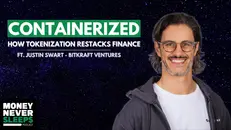
Containerized: How Tokenization Restacks Finance
Justin Swart is a Partner at BITKRAFT Ventures, a venture capital fund investing from seed through Series B across gaming, digital assets, and decentralized infrastructure. He joined Pete for a panel back on episode 240, and this is his first solo sit-down. In this episode, Justin makes the case that tokenization is doing to finance what the shipping container did to global trade, and Pete pushes back on whether that containerization is actually happening cleanly, or just moving the same old fragmentation onchain.
The Shipping Container Analogy
Justin credits the framing to a tweet from Aleks Larsen at Blockchain Capital, then builds it out with the story from Marc Levinson's book The Box: Malcolm McLean, a truck driver who spent hours watching longshoremen unload cargo piece by piece at a New York port in the 1950s, and the standardized steel box that eventually replaced that process entirely, cutting the cost of moving goods by roughly 95 percent. Justin's claim is that tokens are the same kind of unglamorous standardization, and that tokens are going to do to finance what the shipping container did to trade and logistics.
Containerization Already in Motion
Pete brings the receipts: BlackRock's BUIDL and Franklin Templeton's BENJI, the same funds trading across eight or more chains each, and Robinhood Chain, which did $85 million in daily tokenized stock trading in late August alone. But Robinhood's stock tokens are debt securities with no ownership claim, a different structure than what Coinbase, Kraken, and Superstate are each running. Pete's question cuts right at the analogy: if every issuer builds its own version of the container, is that still containerization, or did the industry just move the fragmentation problem onchain? Justin's answer leans on the history of the actual shipping container, standards fought over for years before regulators eventually forced convergence.
Trading as the New Entertainment
BITKRAFT's consumer thesis runs in two directions. One is personalized finance: an early bet on Roundhill's Memory ETF (DRAM), which broke first-day volume records, beating out even the Bitcoin ETFs, plus a newer, still-unannounced investment in what Justin calls a tutorial partner, an AI agent that helps retail investors navigate assets the way a game guide helps a new player level up. The other is trading itself becoming entertainment, competing directly with gaming for the same slice of attention, a trend Justin ties back to Matthew Ball's annual State of Video Gaming report. Justin points to Robinhood's early gamification playbook, streamers building followings around their trading skill instead of their personalities, and live trading formats in Korea that play out like esports on a big screen.
Founders and BITKRAFT
Justin closes on what BITKRAFT brings beyond capital, an LP and advisor network stacked with names from entertainment, media, and consumer, and a fund built to help founders scale the consumer experiences that sit closest to where people spend and invest.
Listen on Spotify, watch on YouTube, or find it on Apple Podcasts (links above)
Connect with Justin:
LinkedIn: https://za.linkedin.com/in/justinswart1
Learn more about BITKRAFT:
Website: https://www.bitkraft.vc/
Chapters
0:00 Cold open
0:24 Intro: Justin Swart and BITKRAFT
1:00 The container analogy, retold
3:58 Robinhood's own chain, and stablecoins at Visa scale
6:09 BUIDL, BENJI, and Robinhood Chain by the numbers
7:15 Is this containerization, or fragmentation onchain?
8:18 The consumer thesis: trading as entertainment
10:37 Gamification, streamers, and trading as esports
12:33 How founders should think about BITKRAFT
14:02 Where to find BITKRAFT
MoneyNeverSleeps: sharp riffs, big ideas, and real insights from smart people, in under 15 minutes. Hosted by early-stage investor Pete Townsend, GP at Norio Ventures.
LinkedIn: https://www.linkedin.com/in/petetownsendnv/
X: https://x.com/PeteTownsendNV
Instagram: https://www.instagram.com/petetownsend353/
[00:00:00] Justin Swart: It goes back to this point that once you have this containerization of these contracts these ways of interacting with different financial systems in a standardized machine-readable format, you're gonna have this kind of proliferation of innovation.
[00:00:14] Justin Swart: And to cap off Aleks' point, which I think is great, is that tokens are gonna do to finance what the shipping container did to trade and logistics.
[00:00:24] Pete Townsend: This is Money Never Sleeps. Sharp riffs, big ideas, and real insights from smart people. I'm Pete Townsend, GP at Norio Ventures. Let's go.
[00:00:37] Pete Townsend: My guest today is Justin Swart, partner at BITKRAFT, a venture capital firm investing from seed through Series B across gaming, digital assets, and decentralized infrastructure.
[00:00:47] Pete Townsend: Justin was on the show back in 2023 on episode 240 with a couple of other guests, but this is his first solo sit-down. Justin, welcome back to Money Never Sleeps
[00:00:57] Justin Swart: Pete, good to be back and good to see you again. Always a pleasure.
[00:01:00] Pete Townsend: Thank you, Justin. Listen, when you and I caught up last week, you shared an analogy with me, and I love my analogies, that I thought was spot on. Could you retell that story for everyone here?
[00:01:11] Justin Swart: All the credit goes to Aleks Larsen from Blockchain Capital.
[00:01:15] Justin Swart: Haven't met him in person, but, you know, great fund.
[00:01:17] Justin Swart: I think it's worth putting this tweet in, in the show notes. He came up with an analogy that I thought was excellent, so I'm just gonna retell it and just embellish a little bit on it.
[00:01:25] Justin Swart: And the analogy is that tokenization and tokens are the containers of the financial world. So what does that mean? This goes back to an excellent book by Marc Levinson called The Box which talks about the impact that storage containers, the sort of very long 20-foot rectangular steel things that you see on ocean liners and ships.
[00:01:48] Justin Swart: It's just a sort of book a-about this kind of boring but very impactful quote unquote, "technology" that fundamentally changed logistics and trade throughout the world.
[00:01:58] Justin Swart: It was a guy called Malcolm McLean. He was a truck driver.
[00:02:01] Justin Swart: He sat at the port in New York, I believe, in the 1950s, and couldn't believe that there were these longshoremen that were sort of moving goods and, and, and potatoes and wares and manufacturing equipment sort of on their backs from the truck and repacking it back onto a ship.
[00:02:19] Justin Swart: He would sit there in his truck and it would take hours upon hours upon hours.
[00:02:22] Justin Swart: The thought that he had
[00:02:23] Justin Swart: Instead of unpacking the, the truck and repacking it onto a ship, why not just move the entire truck basically onto the ship? It'll just save so much time."
[00:02:32] Justin Swart: I believe that it took about five... It was about $5 to $6 a ton to move things from a port onto a ship.
[00:02:39] Justin Swart: And the storage container from his first load when he kind of pioneered the storage container dropped that price to the order of 10 to 20 cents.
[00:02:48] Justin Swart: So a 95% drop in looking at an operations and a systems problem and o-optimizing it really with some kind of standardized interface of how we interact with trade around the world.
[00:03:01] Justin Swart: it's something that we've been talking about at BITKRAFT for some time, and It's just such a perfect analogy for what's happening in the crypto space today, where you have these very kind of old archaic financial systems and, and it's been spoken about in crypto for some time, where
[00:03:16] Justin Swart: a kind of Forex that is, is contained in, in contracts and legal documents and these financial wrappers that have a very high friction interacting with other either countries, their systems, their, their, their contracts.
[00:03:31] Justin Swart: And what tokenization does is really create this standardized machine-readable interface that allows entities, people to interact in a very seamless way with whatever it may be, a financial institution, a financial contract a commodity, an equity, a stock, a token in our case. And what that has it seems to be doing is fundamentally changing the way that finance is going to interact going forward.
[00:03:58] Justin Swart: You see it today already and I'm sure you sort of look at this every day, where you have $300 billion of stablecoins that have been moved onchain. And this is at sort of Visa scale. It's kind of 10X the velocity of M1 or M2 money supply. These are-- This is stuff that is solving real world problems.
[00:04:15] Justin Swart: . As a result, cross-border payment costs, cross-border payment fees have fallen by an order of magnitude as well. And I think when you, when you have this machine-readable interface that is standardized, that everyone agrees with, you have a wrapper that financial contracts can interact with each other in a very cost-efficient way, in a transparent way
[00:04:34] Justin Swart: you're seeing this happen on, on Robinhood at the moment, right? So Robinhood has its own chain.
[00:04:39] Justin Swart: It's kind of been one of the foremost institutions that sits at this tr- intersection of traditional finance and crypto.
[00:04:45] Justin Swart: They've kind of pushed far ahead in, in, in launching their own chain and integra- integrating both worlds, if I could call it that. And what's happened in the past couple of weeks is, is quite interesting. You have people launching tokens,
[00:05:01] Justin Swart: wrapped or linked to tokenized equities for the first time. So if you think of like the previous cycles, we had new tokens that would launch. Those were interesting. New chains that would launch, also interesting. It's just like a whole new wave of innovation that happens.
[00:05:13] Justin Swart: But now we have something interesting where you have this combinatorial activity happening where traditional finance, Nvidia stocks, are being wrapped with community-based tokens.
[00:05:23] Justin Swart: And what this is doing is it's, it's creating this new pool of capital, this new kind of innovation that's happening where others are thinking, "Well, okay, if I can launch an LP pool on Uniswap, and a lot of those fees that are generated from the trading goes to buying more stocks, well, what happens then?"
[00:05:39] Justin Swart: So again, just to wrap it off, it goes back to this point that once you have this containerization of these contracts these ways of interacting with different financial systems in a standardized machine-readable format, you're gonna have this kind of proliferation of innovation.
[00:05:55] Justin Swart: And to cap off Aleks' point, which I think is great, is that tokens are gonna do to finance what the shipping container did to trade and logistics. It's a great, great post, and I definitely think you should link it to the show notes.
[00:06:09] Pete Townsend: Yeah, I will. I think looking at Robinhood, like you mentioned they are going in a very interesting direction, and if we take this containerization thread a bit further, we can see with tokenized money market funds that it's already happening, right?
[00:06:23] Pete Townsend: You've got BUIDL from BlackRock, you've got BENJI from Franklin Templeton all trading on eight to 10 different chains. I think Benji just added Canton as well. It's the same fund, same instrument moving across chains in these containers, right? And that when you look at what Robinhood's done since they launched Robinhood Chain back in July I think they're up to-- They, they did 85 million in daily tokenized stock trading in late August.
[00:06:49] Pete Townsend: That's a big jump, right? Tokenized equities are moving so fast, and seems like the conversations have peaked up two or three X just over the summer.
[00:06:59] Pete Townsend: With Robinhood, the thing about the way that they're running these tokenized equities is that they're actually-- the stock tokens are debt securities. There's no ownership claim. It's a different structure than what Superstate is doing, a different structure than what Coinbase and Kraken are doing.
[00:07:15] Pete Townsend: And if every issuer is building its own version of the container, is that still containerization, or did we just move the fragmentation problem onchain?
[00:07:25] Justin Swart: So in both cases now, yes, there may be sort of different infrastructure stacks, but the speed of communicating that information or sending that money or assets or commodities across those different infrastructure stacks is very fast, and it's still cost-effective. Now, there's an interesting analogy though here with the, the, the book, the box, where at the-- w-when the containers were kind of just getting started, there were a few companies that tried to push out their own standards, right? The, the typical problem of launching new standards, you have someone else who wants to be the new standard. And what it did take was, and this is unfortunate to sort of come out of my lips, but what it did take was a bit of regulatory assistance, a bit of regulatory enforcement for bodies around the world to agree what should the standard be.
[00:08:07] Justin Swart: And I think you have good progress on this in terms of the, the, the regulatory progress you're seeing in the US, where you're gonna have some kind of framework of what standardization looks like.
[00:08:18] Pete Townsend: Definitely. And looping this over into the consumer side where you're spending some time on the consumer crypto experiences. When we caught up last week, you said that trading itself has become the entertainment competing with gaming for the same slice of consumer attention. For example, level up your own character in real life rather than your character in the game, right?
[00:08:40] Pete Townsend: But doing that financially rather than with in-game assets. How does this all sit next to your gaming thesis and some of the strands that we've just been talking about?
[00:08:50] Justin Swart: So there, there's two threads as that, that, that we've invested along within this theme. So the one is, BITKRAFT is a fund. We were early backers of, of Roundhill. Roundhill is one of the key and, and notable ETF issuers that, and the thesis around that was you're gonna have ETFs that are more tailored and more custom-fitted to individual users.
[00:09:11] Justin Swart: And for those who are not familiar with the name, you may be familiar with the DRAM, the memory ETF. I think it was a, a record breaking ETF at some point with the most volumes on day one, beating out even the Bitcoin ETFs when they launched.
[00:09:24] Justin Swart: So that thesis has kind of come to the fore at the moment, and we've invested in another company that really is your you can think of it as your tutorial partner, as if you're sort of running a tutorial through a game, you have this kind of bot, this agent, this system that guides you through how to progress through that game, how to get better, how to level up, in the same thread of you're gonna have these agents or AIs that are assisting traditional or retail users who have perhaps struggled to break into this kind of game, whether the entry level or the barrier to entry is, is quite high or perhaps a bit daunting.
[00:09:57] Justin Swart: And now you have this partner, this sparring partner, this, this companion that helps you think through investment theses, helps you customize what you'd like to invest in again, right? So the, the same theme of sort of personalized finance.
[00:10:09] Justin Swart: We can't announce it at the moment, but really we think is gonna be one of the key driving forces of building personalized agents and, and customized finance workflows for each individual user.
[00:10:19] Justin Swart: And this will be across traditional finance and crypto. And, and again, as, as we mentioned, as, as equities and, and commodities and assets move on chain and those become intertwined, you're gonna need this agent that, that invests and helps you navigate the execution, the thinking and the process through investing in those assets.
[00:10:37] Justin Swart: The second is as, as you've mentioned that- Trading and investing is becoming more of this kind of entertainment format. We actually see this in the data. Matt Ball uh, wrote a great po- post about this, as he does every year.
[00:10:50] Justin Swart: Users are choosing not to game anymore, and they're actually choosing to trade. Trading is becoming more fun. Of course, there are much sort of graver consequences, I would think, given that there's real money involved, but it's becoming more fun.
[00:11:01] Justin Swart: Robinhood was the first to pioneer this with frankly, animations, workflows, and sort of live ops the t- using the terminology in, in gaming, that they, they used all these animations to make investing seem like a bit of a game, right?
[00:11:14] Justin Swart: That's straight out of the mobile gaming playbook. And you're seeing this time and time again, where suddenly streamers are trading online, and they're becoming famous for doing so and growing followings.
[00:11:25] Justin Swart: But now people are really catching on that this actually is gonna become a thing, where streamers are not gonna be on- famous only for doing funny things on- online or having investors sort of celebrities visit their house or, or what have you. They're gonna become famous for sort of having a following based on their, their trading capabilities.
[00:11:43] Justin Swart: And there's businesses and startups that are being built that are trying to tap into this, right? You've seen probably images of the live trading format. You see this in Korea quite a bit, where they're kind of trading mad and you have sort of blown up on a big screen two different stock prices, and people are trading against each other like an esports.
[00:12:00] Justin Swart: And we think that that's-- there's something there that's an interesting content or entertainment product. And so trading as an entertainment form
[00:12:08] Justin Swart: that is something that we think is gonna be a pretty powerful mechanic, particularly when more assets and equities and commodities move onchain.
[00:12:18] Justin Swart: And our thesis as a fund, right, as, as being consumer experience focused and investing in the infrastructure that powers those consumer experiences, is when you have a product that sits close to the consumer wallet, it's gonna sit close to the consumer's heart,
[00:12:33] Pete Townsend: So with this, how should founders in this space be thinking about BITKRAFT?
[00:12:39] Justin Swart: Favorably, hopefully. In high regard, hopefully. I think it should be clear from what I mentioned that w-we're very focused on investing in the best consumer experiences as well as the infrastructure that powers those experiences.
[00:12:54] Justin Swart: Founders should think of us as someone who as a fund that can help them scale their efforts in building the best consumer experiences and products, right?
[00:13:03] Justin Swart: We have in our LP network some of the largest, most notable premier names in entertainment, media and consumer
[00:13:11] Justin Swart: ... A-as well as our advisor network are some of the heads of, of the largest media brands in the world.
[00:13:16] Justin Swart: This is a network that we can help provide to founders that we invest with and partner with for the long term.
[00:13:22] Justin Swart: And we, we look forward to doing so, especially in this world where you have all of these great tailwinds coming to the fore, right? A lot of capital moving much closer to the consumer's wallet, and therefore, moving much closer to the consumer's heart. A lot of innovation making it easier to build right?
[00:13:39] Justin Swart: With the use of AIs and, and, and LLMs to do so. And I think, throughout this kind of crazy world, you'll, you'll need a partner that can kind of stay the course, but open up a lot of these difficult doors to open. So,
[00:13:50] Pete Townsend: Definitely. That network and those relationships just add so much value. Absolutely. Listen, what's the best way for founders to learn more about BITKRAFT and to get in touch?
[00:14:02] Justin Swart: So our website is bitkraft.vc. Anyone can get ahold of me at my email. It's justin@bitkraft.vc. We're always reachable
[00:14:11] Pete Townsend: Wonderful. Thank you so much, Justin. It was great to riff with you on this, and I look forward to our next catch-up. Always insightful
[00:14:18] Justin Swart: Likewise, Pete. Let's make it three for three. Don't leave it so long next time.
[00:14:23] Pete Townsend: I won't. I won't. And to all of you out there, thanks for watching and listening, and don't forget to follow or subscribe wherever you get your podcasts. It helps others to find the show, and it means a heck of a lot to me. Till next time. See ya.