Spotify
 Apple Podcasts
 Amazon Music
 Overcast
 Castro
 PocketCasts
 Castbox
 RadioPublic
 RSS Feed
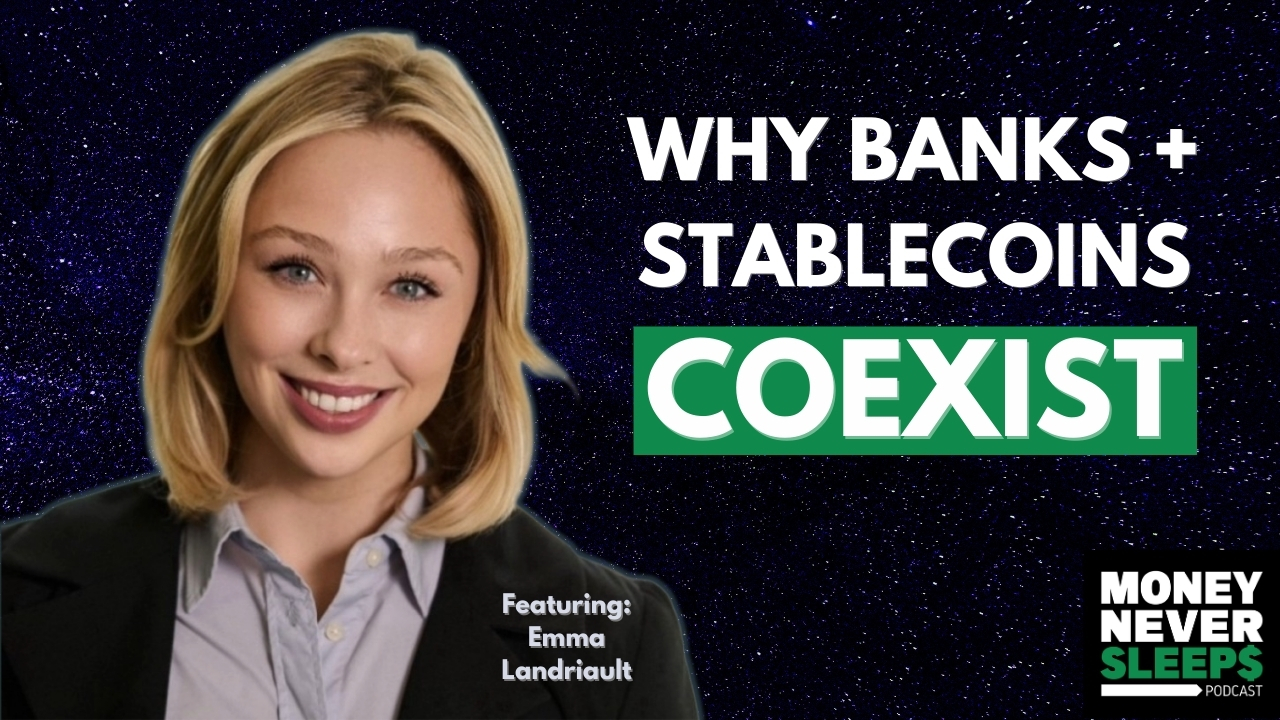
 Why Stablecoins and Banks Will Coexist | Emma Landriault | JPM Coin (EP. 306)
Money doesn’t become digital overnight.
It becomes digital when the rails of finance begin to change.
In this episode of MoneyNeverSleeps, Pete Townsend speaks with Emma Landriault of JPMorgan about why stablecoins and bank-issued deposit tokens may end up reinforcing, rather than replacing, each other.
Emma Landriault is Executive Director at JPMorgan and global product lead for JPM Coin, a deposit token that enables institutional clients to move money between accounts in real time, 24/7.
Drawing on her work building deposit tokens and financial market infrastructure, Emma explains why stablecoins, deposit tokens, and potentially central bank digital currencies represent different layers of the financial system rather than competing forms of money.
Across crypto, fintech, and traditional finance, the conversation around stablecoins, tokenised deposits, and onchain settlement is moving from experimentation toward real financial infrastructure. Companies such as Stripe, Visa, Mastercard, and major global banks are increasingly integrating these rails into payments, treasury, and settlement systems.
Rather than replacing banks, digital money is emerging as a modular system where different forms of value serve different roles — from programmable treasury operations to onchain settlement and institutional liquidity management.
This isn’t a crypto-versus-banks conversation. It’s a discussion about financial architecture, interoperability, and how the rails of global finance are quietly evolving.
We cover:
• Why stablecoins and bank-issued deposit tokens are designed to coexist
• How liability and trust anchors shape different forms of digital money
• Why corporate treasurers are beginning to manage liquidity directly from wallets
• What programmable treasury operations could mean for financial workflows
• How traditional institutions are approaching onchain assets and digital markets
• Why the future financial system may look more like interconnected networks than isolated payment systems
Emma brings a systems-level perspective shaped by building real financial infrastructure inside one of the world’s largest banks, explaining why operational reality matters as much as technological innovation — and why the next phase of digital finance will likely be defined by interoperability rather than disruption.
If you’re a founder, operator, or investor trying to understand how traditional finance and onchain systems are beginning to converge, this episode offers a practical perspective on where things may be heading.
⏱️ Chapters
00:00 – Why stablecoins and banks can coexist
01:00 – Layers of digital money
02:30 – Liability, trust, and financial infrastructure
04:10 – Deposit tokens vs stablecoins
06:00 – Yield, liquidity, and treasury operations
07:10 – How corporate treasurers use digital assets
08:40 – Programmable treasury and wallet infrastructure
10:00 – Institutional interest in onchain finance
11:15 – Convergence and network-based financial systems
13:00 – The future architecture of digital money
13:40 – Closing thoughts
For full show notes and guest links, see below.
MoneyNeverSleeps explores one big idea each week in under 15 minutes with founders, operators, and investors shaping crypto, fintech, AI, and onchain finance.
If you're interested in where financial infrastructure is heading — from stablecoins and tokenized assets to AI-driven markets — subscribe and join the conversation.
🌐 https://www.moneyneversleeps.ie/
#Stablecoins #DigitalMoney #OnchainFinance
0:00 But I think our view has been broadly speaking that these types of digital money will coexist, right? I think we usually view it as like layers to the cake and these layers of the cake will find finality into one another to make sure that like frankly we maintain financial stability within these specific currencies. This is Money Never Sleeps, sharp riffs, big ideas and real insights from smart people. IP Townsend. Let's go money. Never sleeps, pal. So joining the show today is Emma Landrieu. She's the executive director of JP Morgan's product lead for JPM Coin, which is a deposit token that allows institutional clients to move money between accounts in real time, 24/7 globally. Welcome to the show, Emma.
0:47 Thanks for having me, Pete. I'm happy to be here. Awesome. And you are one of the fantastic people that I shared a dinner table with, hosted by the one and only Adi Benari from Applied Blockchain after his event in Barcelona a few months back. What are the things you said over dinner that stuck with me? Is this you use the word coexist when you're talking about banks and stable coins? I'd love to dig into that a bit, but first I want to provide a bit of context and that we do keep hearing that banks and stable coins are competing, but that might be like saying that Fedwire competes with Visa. Are we just confusing layers of the system? What do you think? Yeah. It's such a, it's such a good question. And I think something that like I'm sure you hear like me all the time, right, when these conversations come up. But I think our view has been broadly speaking that these types of digital money will coexist and not just deposit tokens, which would be issued by banks as you know, insured depository institution, but also central bank digital currencies and staples, right.
1:47 I think we usually view it as like layers to the cake. So they will, you know, you have stables that can kind of be this idea of like M2 money. And then just like today you have commercial bank money that sits as M1 money and then central bank money that sits as M0 money. And to break that down, what it really means is like each of these types of money will find finality in one another. So you'll have stables which can trade fully on chain, but they still need off ramping right at some point. Or for things like deposit tokens where they're also on chain, you may have, you know, clients who will use stables for certain sets of use cases like making payments for hard to reach corridors or to, you know, counter parties that they don't know to those kind of more freely transferable use cases.
2:32 And then those stables will eventually find their finality to maintain, you know, integration into the existing financial system in commercial bank money. Broadly speaking, you know, commercial bank or central banks throughout the world are obviously having conversations of should there be finality for systemically important stablecoin into central bank money. But I think as it stands right now, the prevailing model is that they then need to find that integration into commercial bank money so that, you know, parties can want either off ramp or just trade the credit risk, right, and not be holding stablepoint credit risk, which can either be with the issuers, with the underlying reserve banks of those issuers, but also in certain cases with the exchanges or like even hosted wallet providers, right, depending on the model of how they're holding those stables. So find finality into that commercial bank money. The commercial bank money will you know, be sitting in existing either one accounts or if they're in the form of deposit tokens, nonetheless in deposit.
3:27 And I think from that you have, you know, the same risk management practices, stress Capital Management, right? The same practices that currently underlie the financial system today from a risk management perspective. But of course what we don't want to get to is a scenario where you have, you know, a dollar from one bank trading differently than a dollar from another bank. And so the same way that we do today in account based money in both of these deposit token scenarios and in the existing bank account scenarios, those dollars find finality with their central bank money, right, to make sure that you maintain singleness of that specific currency. And so I think our view has been like, yes, there will be different use cases at the surface level, but that relationship will continue to coexist and these layers of the cake will find finality into one another to make sure that like frankly, we maintain financial stability within these specific currencies and domestic economies.
4:21 Yeah, it's an interesting kind of juxtaposition in that like you said a minute ago that it what we don't want to happen is for there to be a lack of equality between stable coins and deposit tokens based upon the issuer. This kind of comes back to, like you said about who carries the liability and who carries the trust in that with stable coins, you have a full reserve and that is backed by usually high quality liquid assets. With deposit tokens, they are backed by backed deposits, right? That is a little bit of a difference there. Yeah, exactly. I mean, I think it's exactly that, right, Pete. So from a stable coin perspective, like you said, you know, high quality liquid assets, those high quality liquid assets are held at other underlying reserve institutions right across the board, usually more than one that are holding these reserve assets.
5:13 And you know it's deposits, it's treasuries, it's other super liquid liquid assets. And the way that these stables are maintaining their peg is that the net asset value. So the NAB of all of that basket of assets has to always be equal to or more right than the number of that specific stable coin in circulation. Whereas with the deposit token, it's simply that it's issued as a dollar. So currently we're live in in with JPM coin in U.S. dollar, so it's issued as AUS dollar off our U.S. dollar balance sheet. So one deposit token is 1 line item on our balance sheet from a demand deposit that we actually issue to our clients. So it's a claim against the bank that represents the client's funds. And so from that perspective, it is by design commercial bank money which brings, and I touched on this a little bit earlier, but it brings familiar right like Capital Management practices right behind the scenes. So it means if it's aggregated as part of our total deposit positions as a bank, from a risk management, from a Capital Management, from a stress testing, from a consolidated balance sheet reporting and a prudential liquidity reporting requirements, they sit the same as any other deposit because that's frankly what they are.
6:19 Because they are then, you know, structured as a deposit, it creates 2 really key benefits. The asset itself is able to bear yield directly because it is just a demand deposit and bears yield like any other demand deposit. And it also ensures that you have those like really quick on and off ramps into accounts without changing the nature of the asset, which I think is really useful when we talk about, and you said this at the top of the, the show, like this is designed for institutional clients. I think once you start to get into like really sophisticated treasuries, there's a benefit for this to not actually change nature when it's on chain versus off chain, right? It's like a ease of use. When I'm talking to the corporate treasurers and trying to, you know, trying to shed some light on some new options that they have, there's going to be points in time where they would reach for a stable coin.
7:05 There's going to be points in time where they would reach for a deposit token in order to conduct their business and liquidity and their flows. What? What's the split there? It's a good question. I mean, I think that with the like display, it could be a little bit down to like how does that treasure prefer to manage their liquidity? And I say this because having built this product out, which is really the first kind of deposit token of it's kind, right? That's on public chain, we're seeing a couple of different things. Like 1 is you have corporate treasurers who already have large, you know, Web 3 holdings, right? They're holding staples, they may be holding other cryptos, they're holding other tokenized assets. And I think for those parties, one of the things that we've seen emerging from a trend perspective is like an interest in being able to add their native deposits to the way that they're managing their treasuries today, which is out of wallets, right? Believe it or not, but if these are like web three native companies, they're not normally managing everything through the existing treasury management systems and rails, but they have this like more sophisticated wallet based infrastructure. So we've seen quite a bit of interest in being able to hold deposits alongside there, you know, for the treasurers who that's really their bread and butter of how they manage it. And I think like diving one layer deeper into that for those who are not maybe talking to a lot of corporate treasurers in this space, it's like it's super beneficial because you can add things like programmability to the wallet interfaces themselves.
8:28 So you have actually like this idea of like programmable treasure, which is something near and dear to our heart at Conexus and we've actually enabled on our private rails with programmable payments. But you have that natively with this wallet infrastructure. And so it's very beneficial for treasures who want to start automating some of these more complex work flows to be able to do that out of their wallet interfaces. And so we see that kind of sitting alongside, you know the other existing holdings that they would have and making sure that they have part of their deposit position within there. And I think importantly also like interoperability or rails where they can move from a specific natively, you know, crypto asset, whether it's a crypto or a stable and like move some of that credit risk back into a deposit and being able to fully do that on chain.
9:11 So that's kind of 1 profile that we're, that we're seeing. And I think the second profile that we're seeing, I talked about it a bit when you and I were catching up off camera, right, was we're starting to see this whole like ecosystem, you know, I, I call it like equitization, which is definitely not a word, but it kind of is equitization of crypto, right? Where it's like have like crypto dats and you have these like natively issued RW as that are actually first issued on chain. They don't exist soft chain, tons of money market funds. So all of like the development of this entire ecosystem. And I think from some of the other traditional institutions, they're very interested in coming into this space, right? And investing in this space or even market making this space right, but maybe didn't have the risk appetite or the compliance comfort right or lack the balance sheet certainty to actually be able to use the base liquidity layer of stables. And so the other big profile that we're seeing is like those parties who would be interested in potentially engaging in this Web 3 ecosystem, but need to do so with like a form of commercial bank money that they can move through day-to-day, that they can very quickly off ramp into accounts and perform their end of day treasury OPS.
10:22 And so all of those end of day treasury OPS don't go away just because you want to have exposure on the public chain. And so we've also seen the second profile is the treasurers who are very interested in, you know, engaging in this space for yield, right? Or their core business wants to invest in this space or even make payments on public chain, right? Whether it's getting feet dirty or seeing the benefit of making payments on a on a rail where it can be real time, but just having like, you know, an inability to really hold staples as it is. And that's the other parties that we start to see quite a bit of interest in this and where they may reach for a deposit token over, you know, other crypto assets. Looking at the future, Emma, if both models do succeed, what do you think the financial system actually looks like in five years? Will it be two parallel ecosystems or one interoperable stack?
11:10 Yeah. I mean, I think and I don't know if you've been hearing this in your many conversations in the space, Pete, but like the word of 2026 is convergence. I think we're starting to see like even certain stable coin of fintech providers like looking to get fed accounts, right. Also significantly more like I said that equitization of various like crypto assets and we're starting to see like not I talked about Dats and money market funds, but we're also starting to see like structured products right being developed in this like ecosystem. And so that becomes even more appealing to a number of like asset managers or other kind of traditional financial institutional parties who want that exposure. So I think we're looking at increased convergence. One of the things that I would say we're seeing already and we've been building towards that connects this for quite some time is that we do believe that we're going to see more proliferation of like network based architectures. Like Ethereum is a good example of this. Or even other projects that we've been a part of, like the global layer one project where you have, you know, specific networks that have all the parties on that network to begin with.
12:09 And then we build out foundational types of assets, foundational types of money and things like wallets and verifiable credentials. So those primitives to actually know like how can we trade at an asset layer and then who are the various parties trading and how can they hold multiple asset? And then from there you start building applications on top of that, right? Which again is like what we've seen with Etherium, what we've seen with the global layer one project where then you can have banks, you can have like you said the Defy protocols, you can have anybody really come in and build out applications that touch those foundational layers. And we do believe that doing that with the right permissioning will help increase resilience and security in the way that assets and money are moving.
12:49 As long as, like I said, you have the right KYC that's like sitting within that or the right digital identity sitting within that, that can really be a strong architecture that doesn't exist today and I think importantly brings unprecedented like access to new financial services and new applications. And so we do believe that like convergence will be a big part of this system that these different types of money will coexist, but that will also be moving not fully away, but more and more towards right and network based architecture for those benefits that it can bring. Absolutely. Yeah. It's so wonderful to talk about these kinds of things with you, Emma, because so many of the conversations that I do have outside of the day-to-day, people just don't know that this stuff exists. We're definitely in a strong period of convergence, so thank you for joining.
13:36 What's the best way for people to follow your work and learn more about what you're working on? Yeah. So thank you so much for having me and yeah, the best way. So I mean, of course, we have the, you know, connects this website as part of the JP Morgan website for any of the, you know, net new thought leadership that we're posting. It always kind of sits within there. And then for me personally, LinkedIn is probably the best place. So you'll see my name here. Feel free to find me on LinkedIn. Wonderful. Thank you, Emma. Thank you so much for having me, Pete. We'll have to have a dinner again soon. I can't wait to talk about all these topics one more time. Absolutely. Thank you. Thank you. Money never sleeps, pal.