Spotify

 Apple Podcasts

 Amazon Music

 Overcast

 Castro

 PocketCasts

 Castbox

 RadioPublic

 RSS Feed
293: Building Bridges: Simon Brown on Ethereum’s Cultural Gravity and Consensys Network State
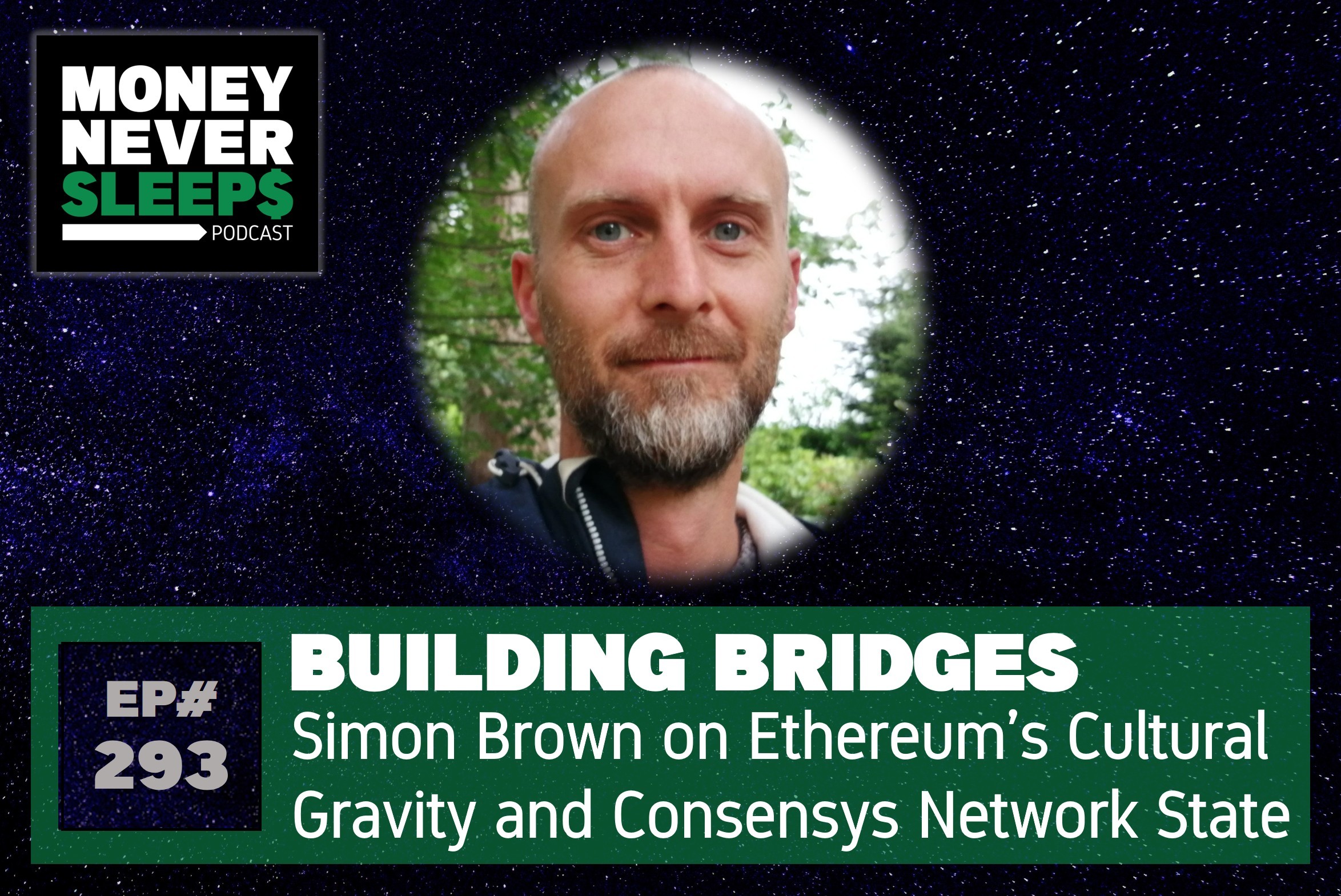
Simon Brown joins me to share how his role at Consensys has evolved since his last appearance in January 2024 and why he’s now leading the charge on the Consensys Network State. It’s all about reconnecting the sprawl of the Ethereum ecosystem, reinforcing the cultural gravity that made Ethereum magical in the first place, and creating a more cohesive network of builders, founders, and ecosystem experts.
In this episode, we dive into how the Consensys Network State initiative is setting the stage for Ethereum’s next decade, how it’s bridging gaps between projects and people, and what it means for the future of decentralized coordination. We also get into some big-picture thinking around the evolution of Ethereum, the rise of network states, stablecoin growth, and what it takes to keep that cultural gravity intact as Ethereum continues to grow.
Resources Mentioned:
Connect with Simon Brown and Consensys:
Simon Brown: X(Twitter) | LinkedIn | Medium
Consensys: Website | X(Twitter)
Leave a review and subscribe on
Email us: info@norioventures.com
Connect with Pete Townsend and MoneyNeverSleeps:
Pete Townsend: X/Twitter | LinkedIn
MoneyNeverSleeps: X/Twitter | LinkedIn | Newsletter
0:05 Money never sleeps, pal. Hey there, I'm Pete Townsend and This is Money Never Sleeps. We look inside the minds of entrepreneurs and at the crossover of startups, enterprise, finance, technology and life as we know it. Before we get started, just a heads up that E Dublin is back again to bring Ireland on chain with a hackathon and conferences May 23rd to 25th. Yes, Etherium Co founder Vitalik Buterin and Ave's founder and CEO Stanny Kulichov are both confirmed to speak. It's shaping up to be a pretty fantastic crypto weekend here in Dublin and absolutely one not to miss. This week I'm welcoming back a guest who absolutely lit up our first conversation in January of last year, Simon Brown from Consensus.
0:50 Back then we dove deep into the over centralization of crypto and Simon gave me a whole new perspective on what was really going on under the hood in the Etherium ecosystem. Money. Never sleeps, pal. Now Simon's role at Consensus has evolved, and he's now leading the charge on a new initiative called the Consensus Network State. It's all about reconnecting the sprawl of the Etherium ecosystem, reinforcing the cultural gravity that made Etherium magical in the first place, and creating a more cohesive network of builders, founders, and ecosystem experts. Today, we're digging into how this initiative is setting the stage for Etherium's next decade, how it's bridging gaps between projects and people, and what it means for the future of decentralized coordination.
1:35 We also get into some big picture thinking about the evolution of Etherium, the rise of network States, and what it takes to keep that cultural gravity intact as Etherium continues to grow. So let's jump right back in with Simon Brown from Consensus. All right here. On Money Never Sleeps. Listen. Simon, great to have you back on the show. Thanks for joining me again. Yeah, thanks, Pete. It's great. Great to be back. Awesome. When we did our last chat back in January of 2024 last year, that was really eye opening for me. So thank you for that first chat. Now I'm looking forward to kind of going in a little bit of a different direction this time.
2:16 So before we do that, can you just get the listeners caught up on how things evolved for you with your role with consensus since we last chatted in January of 2024? So I mean, what's happened since then? Well, a lot. At the time I was working with linear a lot. I think in consensus it was generally speaking, all hands on deck trying to get linear off the ground. And I'd spent a good deal of time working on linear decentralization. So figuring out technically how to decentralize the sequencer, the proofer, all of the various different options, looking at how the ecosystem was evolving, base roll ups, pre confirmations, all that kind of stuff. But then around November, around Devcon last year, a consensus really kind of pivoted its long term strategy around, you know, where it was going as a company. And Joe has this vision for really decentralizing consensus itself.
3:09 So my role changed from being like a researcher more to strategy. And I took on the role of leading the consensus network state group. And it's really about figuring out how that looks like. You know what, how we decentralize consensus, how we tap into the huge diaspora that consensus has built over the past 10 years of building Ethereum, how we actually create a robust network where people can really support each other and grow. And so it's a very ambitious vision, very exciting, very glad to be working on it. When you and I first met in understanding your role as a researcher and then now shifting into a strategy role, was that a major mindset shift for you or was that something that was just a natural next step? It was kind of a natural next step because all of my research had been supporting product strategy anyway. So it had a kind of a strategic focus. And I think, you know, most senior product managers, they kind of do a lot of research themselves, but they need someone to kind of specialize in certain areas that are very complex.
4:04 And that's what I was doing. So moving into a strategy role is sort of made sense, but it is a huge domain, you know, like go build a network stage. You know, that was a tough one to break down, but we've made some really good progress. OK. And Network state, what comes to mind is Balaji Srinivasan wrote a book called Network State. His proposal was it listen, we can build a state, a nation state that is network based. Interestingly enough, that was my first starting point when thinking about this, like knowing nothing about network States and trying to get my head around it. The first thing I did was read Balaji's book and it was interesting. But like, subsequently, I learned that a lot of the things, the concepts that he discussed are, I've actually been around for a long time, quite a long time actually.
4:48 The further down the rabbit hole I went, the more I learned that actually there's nothing new here. And there's been these sort of like parallel societies based on global diasporas for actually quite a long time. And you can draw parallels between all sorts of things, you know, like everything from the Freemasons to Zionism to the Armenian diaspora. But I think in the context of like a digital First network nation, network sovereignty, whatever you want to call it, that's new, right? It's in the context of this post globalized, hyper connected digital society, what can we imagine? And what we can imagine is quite exciting. And so I think the idea of network states, while it's still confusing and there's probably a whole bunch of different definitions, it's starting to enter the common vernacular a lot more. And I think people are starting to think about the possibilities a lot more, which is exciting.
5:38 It is exciting. It is exciting. Now we're going to get into the consensus network state in a minute and what you're doing with that. But what you shared with me, Simon, really got me thinking. There was an excellent one liner in your description of the consensus network state that really summed it up for me quite well that you said Etherium has grown so much that it is struggling to hold together the cultural gravity that made it magical, right? Cultural gravity really struck me, almost like a city that has undergone urban sprawl and is trying to hold on to its identity as a city. Can you talk a bit about the context of how Etherium can hold its cultural gravity together? What's the objective here?
6:21 That's actually quite a good analogy. A city that's undergone urban sprawl and is kind of struggling to to maintain that coherence. I think that sums it up pretty well. I mean, a lot of people are quite negative about Etherium at the moment. To me, the challenges that Etherium faces are really to symptomatic of its maturity as an ecosystem and any other ecosystem that has grown to the huge extent that Ethereum has grown both economically in terms of the use cases of the abandoned value on it would experience the same problems. It's you couldn't say that's growing pains, but it's definitely a symptom of its success. And I think when you look at kind of the conversations that are taking place, you can see certain topics that tend to emerge. So one of them is quite clearly about the value of Eve, right? People are always talking about the price of Eve. And that's an interesting kind of nuanced topic. Is Eve the asset central to their identity? Is it, is that what provides this sort of like cultural cohesion between all of the different participants and actors in the ecosystem?
7:23 Or is it something that people are just obsessed with, like the number go up and maybe it's just that trivial to be? I think it's more nuanced and I think there is, it's a very interesting conversation. And I think we do need to think about the price of Eve and acknowledge that economic alignment and cultural shared values are kind of two sides of the same coin. And so it is an interesting conversation as Sean Ryan Adams actually articulates it very well. And he talks about what does he call it, the United Chains of Etherium, which I think Justin Drake originally coined that phrase, but he talks about how eat the asset is kind of culturally important. And so I think, you know, that is an interesting conversation. It's not the only one. You know, like I think there's various other topics that emerge when you talk about like the implications of the pivot to the role of centric road map.
8:13 And now we have all of these different L twos. And like economically and culturally, Ethereum seems fragmented. Again, there's a lot of nuance to that conversation, but it's certainly I can see both sides of the argument. And also just in terms of shared values, like what does it mean? Like, what do we hold as important? I remember seeing the word like wartime used by people talking about like, you know, we have to win. We have to be the best. Oh, look, Solana or stealing or Thunder. It brought up some very interesting questions about like, what does Ethereum stand for and what do we hold important? And how do we balance our ideals with pragmatism? And I saw a lot of kind of soul searching, if I'm honest. And so like, you could take only three of those topics, you could spend a day talking about them.
8:57 They don't make me bearish for Etherium. Quite the opposite. I think, you know, seeing how the conversations are played out and the results from those conversations and what's happening in the ecosystem makes me more bullish than ever on Etherium. Yeah. And to me, and you know, it's important to distinguish like you said, between ETH, the asset and Etherium as a network, as a community, as an ecosystem, as the OG. There's two different conversations here. There is the token, the coin, the asset. And however people may view that on a short to medium term basis, I've become over the years agnostic to that. I still hold ETH because I believe in where it's going and I believe in the journey, in the mission. And that is what was a critical point for me in my own development in this space back in 2014 where I read the Bitcoin white paper 1st.
9:54 And yes, a bit late in the game for that from where it came from. But then it was just very lucky with the timing of when the ETH white paper came out. And that for me from my point of discovery and learning about Bitcoin and the possibilities of blockchain. And then I saw Etherium take it to a whole new level. I'm like, well, and that's been the trajectory that I think, I'm not going to say the entire space is beyond, but the theorem has made so much of this possible and that is all still there and it's undergone metamorphosis over the last few years. Do I have this right from an outsider's view, or is there a lot more going on behind the scenes within the community? Right?
10:41 Within the community, there has been, I think a lot of soul searching and there has been a lot of what is our North Star, what are we aiming for? And I think there's been a lot of arguing to be perfectly honest. I think it's really healthy because what you're actually seeing practically coming out of that are real innovations and real things that are happening. Take even like this 24 hour period, right? We have the Pectra upgrade going live in about an hour, huge amounts of innovations in there, everything from inclusion lists to like Eips for account abstraction period. Us like really pushing Ethereum forward. Yesterday there was an announcement from Flashbots and Beaver build, that Beaver build who built something like 40% of Ethereum blocks, they're moving over to Flashbots building it. So they're decentralizing a lot of the building infrastructure, removing a huge choke point for centralization. Again, there's other technological innovations happening all the time.
11:37 So there's an argument to be made, would there be that much technological innovation if there wasn't this kind of competition between different perspectives, if there wasn't the lack of complacency that we have? Maybe not, you know, So I think if there is really, like, making great strides all the time. And when you see this amount of innovation happening, you know, we're 10 years into the Etherium project. I think it's like June 30th is the anniversary of the genesis block. And 10 years later, it's still going strong. It's still innovating. It's still pushing the boundaries. So the next 10 years, you know, shows no signs of slowing down. So yeah, in the long run, I think Ethereum is very, it's a really good place. It's so crazy is that some of the tendencies here are to think about any blockchain ecosystem, any blockchain community as a centralized company, as a centralized corporation.
12:28 And the media and people in general just will tend to look at that and say I'm looking at that as if I would look at, OK, I'm hearing about stuff happening in NVIDIA where I'm hearing about stuff happening in Microsoft. But it's not that it's different. There is this intractable tension between like decentralized polycentric governance and then very centralized and efficient system. Say for example, institutions coming to Etherium, who do they talk to? Do they talk to the EF? Do they talk to consensus? Do they talk to Etherialize? You know, and like the the governance of Etherium, I think, you know, is it's well, it can always be improved.
13:08 I think it has strikes a healthy balance, but it can be quite opaque and it can be kind of difficult to make decisions. And yeah, that comes with the territory when you have a really decentralized system. It does, it does and you know the longer term view will be the one that wins out on the consensus network state. Digging into that a bit, can you give us some insight as to how you expect that to unfold? There there are a couple of different perspectives on it. The consensus network state aims to be a sort of like connective tissue between companies, collective communities who want to build an Ethereum. So ultimately it's about empowering people that want to build an Ethereum by providing tools and infrastructure that consensus has developed over the years, as well as tapping into the broad network that consensus has built over the years as well.
14:00 And it's important not to understate the impact that consensus has traditionally had on Ethereum. Consensus really did help to build Ethereum in the early years and they the diaspora is enormous. So it's really about tapping into that network in a way that the participants can help to support each other. So we are looking at various different coordination tools for around using AI agents for discovery, for networking to kind of form this connective tissue between the different organizations so that they can provide support for each other. We're not the only ones thinking about this. I think there are a number of ecosystems that are kind of thinking similarly. So I'm thinking in terms of like Arbitrum recently started using the nomenclature of building like a network state or a network nation, thinking very much along the same lines about connecting kind of an Arbitrum aligned entities with each other.
14:52 I think Protocol Labs is another example that have been arguably pioneering this sort of network of aligned entities. So that's one aspect of the consensus network state, but it's also about making consensus more porous. I think Joe's vision was never to be like a company. It was to be like an ecosystem that helped to support Ethereum. And so giving people the ability to join consensus, to join the network and participate, you know, with various other teams and organizations is part of it as well. And so we're looking at various different ways to do that. But ultimately, it's about empowering people to build an Etherium. And I suppose that's the tagline, right? The North Star?
15:33 And any insight as to kind of connecting some of those dots, right? Like, so take my example and we talked a bit about this before, Simon, is that we've brought four classes through the Tech Stars Web 3 Accelerator, 40 companies or projects that have come through that. We probably have another 60 that have gone through other Tech Stars programs in Web 3, and then probably another 200 on top of that would be considered to be Web 3 adjacent. So I can start with a 40 and connect the dots between them, between myself and Hugh McGurk, who runs Techstars Web 3 program with me, and then extend that out a bit to the additional 60 beyond that. But once you get beyond 100 projects or companies, that becomes quite a bit of an undertaking. And it's almost like you said that it's not about being that central focal point, it's about being the bridge. And it's about allowing these interactions to take place and allowing people to learn from each other and build with each other, perhaps, and taking advantage of this diaspora, as you mentioned.
16:30 I love that word, you know. Can you talk about the types of things to connect the communities and to build the bridges? As you pointed out, like once you kind of get beyond that Dunbar number of like a hundred 150 people, it starts to kind of breakdown and it gets very hard to scale. So what we're looking at is kind of like how do you scale it using technology? So there's various different things that we're looking at. One of them is looking at reputation. I'm very lucky to have on my team very experienced enterprise architect who previously worked for Madamask building out a reputation technology layer for the distribution of snaps. And so they stood up a prototype which worked really well and allowed people to just list snaps without any gatekeeper, but in a way that was safe for people to decide whether or not to install them. You're right.
17:15 And so this was based on this kind of peer-to-peer subjective reputation system. And we're bringing that forward and developing it further to try to like scale the introductions and discoverability and networking features. You know, because it gets very difficult when like you need an introduction to somebody, you have to find the person who knows the person, you know, it doesn't scale very well. So we, that's one approach we're taking. Another approach is we are thinking about agreements and going back to first principles and trying to imagine how agreements are made between people and between organizations. You know, when you look at Web 3 right now, you've got incredible innovation. But to get anything off the ground, like you still need to go back to lawyers, right? 90% of agreements involve legal professionals and ink on paper and those, the legal profession, you know, maybe it's bread and butter is like understanding how these agreements work, understanding the workflows, having this kind of like arsenal of workflows that they understand really well. And that's fine.
18:16 But we're thinking about how this intermediation of Web 3 and crypto can be applied to just agreements so that people can make agreements between each other really easily without centralized gatekeepers in a way that they can just like make the agreement and then get to work and build. So one of the first things we did was we are have been doing a lot of work with the so ball team, who are kind of legendary in the DAS space. They've been working in the DAS space for about like 20 since 2017. And this year they built a novel agreements protocol that we've just launched. It's at signet dot build. And so this agreement protocol is like, how do we make this really efficient, really simple, really easy for developers to create agreements? How do we create agreements so that people know like which one is actually robust and trustworthy, has been battle tested in the real world again, back to the reputation system. And then really efficiently get to work and solve a lot of the problems that, you know, most founders and builders don't even realize that they're going to encounter when they said we feel that will help to scale the kind of networking and connections between people.
19:21 One of the concepts I've been working on recently as well, Simon, is this, you know, building and scaling Web 3 by having this connective tissue back to Web 2 and having the Web 2 champions and leaders out there have already embraced where we're going with Web 3 and saying yes, there are strong elements that they need to adopt and bring into their business. We're going to have this gap for a while. Yeah, absolutely. I'm glad that you brought up like web two companies, right, because again, through CNS and the wider ecosystem, I think is starting to Orient toward how do we make Ethereum relevant in people's everyday lives. And I was actually very heartened to seek this statement from Aya and Vitalik recently from the ES saying that the twin goals of the EF like one of them is about the usage of Ethereum and the other one is about like improving the maintaining the decentralization. But with regards to the usage of Ethereum, they stated that the primary goal was to make Ethereum. Useful such that people everywhere benefited directly from it and directly as opposed to, you know, indirectly via their institutions that they may have their mortgage or their loan or their pension or whatever. Instead of institutions adopting Ethereum and then people indirectly adopting Ethereum, it's like directly in people's lives in terms of community initiatives, crowdfunding, lending, payment, invoicing, et cetera. So like, these use cases are incredibly important to the future of Etherium.
20:49 Otherwise, like, what was it all for? But in order to get there, there's a lot of work to be done. And I think, you know, this agreement is a perfect example in terms of like what founders need to do to get off the ground, in terms of like a corporation, in terms of like billing invoices, in terms of like creating agreements with other organizations, agreements between the different members, managing the cap table, it just goes on and on. And all of that is currently, you know, behind legal professionals who really understand where the gotchas are. So I think going to ChatGPT isn't enough. You know, you need complex workflows. There is like the way we actually looked at agreements. When we actually got into the details, we realized, well, actually Victoria in Sobel, who's very exceptional engineer, realized that all agreements are basically this deterministic finite state machine that has all of these conditional branches and stuff. And it's basically like an arcane form of coding, right? So in that respect, there is a way to actually simplify the whole process using technology and make it much more efficient and much more accessible for people. Oh yeah, I worked with the startup years ago who was like, we need to take legal documents, put them into the top of the machine and out the bottom of the Sheen becomes plain English language that people can understand. It's awesome to hear about the momentum that that you're driving on this because it's well needed. You mentioned, yes, the Etherium Foundation, and obviously there's the theorem community and the governance around that. There's the Etherium Foundation
22:22 and consensus. Your positioning within all that. Obviously you're coming at this from a consensus perspective with consensus network state, but how do you then connect the dots with the Ethereum Foundation and the wider Ethereum governance community? Yeah, that's an interesting question, especially in, you know, against the backdrop of kind of the reform that we've seen in the Ethereum Foundation. And now we have these two very talented directors that are leading the EF. And I've worked with Thomas in in in the past and he is, you know, exceptional individual. You also have the emergence of other organizations that are maybe like have more specific concerns. So you have like for example, a serialized that are more have a more institutional focus and maybe more of a marketing focus than the EF who seem to be, you know, looking more towards the research kind of end of things.
23:15 You have organizations like the PBS Foundation as well that are taking on very specific kind of concerns such as like out of protocol innovations research around PBS. They recently took over the maintenance of Nevada Boost, which like 90% of Ethereum transactions go through. And then you're seeing things like fabric, which is like all of the, you know, rollouts and L2's coming together to figure out how to reduce fragmentation and work toward more interoperability. And so this seems to be painting a picture of a more sort of like Poly centric governance within the Etherium ecosystem, which is good. It also presents its own challenges, you know, in terms of coordination, in terms of like marketing and branding for Ethereum as a whole. But I think everyone is cognizant of that. So I think that's not insurmountable. Consensus itself, you know, has a role to play. Traditionally, consensus has had a huge impact on Ethereum. It was one of the first companies created to support the Ethereum ecosystem and had a huge outsized impact. And you know, 10 years into the Ethereum Project, I think consensus has a pivotal role to play going forward. Consensus network state specifically has a very strong focus on builders and founders who want to build on Ethereum and innovate in Ethereum in a way that makes it, as I said, you know, relevant to people's everyday lives. So a lot of our focus on this kind of network state and creating a network of individuals and teams that support each other and have this like tightly knit network that's easy to navigate and it's very accessible. That's part of making Ethereum relevant. So we may not be the only one
24:47 addressing that concern, but it's certainly something that we're going to take a role in going forward. That's not to say that the names that I've mentioned are the only people who are contributing to Ethereum. There are there are a huge number of teams that are all rowing in the same direction. OK, good. One of the other things I've been thinking about, you know, I mentioned Web two, you mentioned Web 2 and I'm going to mention again, particularly in Fintech in that one of the most exciting things for me back in reading the Ethereum white paper way back when it was the concept of stable coins and seeing how important that has become in the growth of blockchain. And Web 3 and it particularly over the last probably two to three years that been a lot more focus on that.
25:29 And you can look at the whole traditional finance industry, you can look at credit card networks, you can look at institutional banking, you can look at retail banking, people's financial lives, looking at what fintechs have been doing over the last 15 years to basically put a new skin on top of an old banking system. And that has brought us forward considerably. I much more enjoy using Revolute than I do using a Bank of Ireland app, right? You know, 110%. A number of the conversations I've been having recently, Simon, is about connecting Web 2, connecting traditional finance into stablecoin processes, into stablecoin networks.
26:10 And we see a number of the big names out there that are working on this as well with MasterCard, with Visa, with Circle, with Ripple, that we're all working on this. I've got this thought that if I am a three to four to five year old fintech startup and seeing the writing on the wall, if I'm going to be doing anything in terms of putting payment flows in the hands of consumers and or enterprise, whether that's SM, ES or institutions, I need to have a consideration in there for connecting to stable coin flows. If I am looking to grow an ecosystem, A blockchain ecosystem, looking to reach out to those that are in the web to space and it doesn't just have to be fintech. There's a number of other use cases here that are applicable where the natural stack selection that you end up doing when you're building something or you're perhaps looking at how do we scale this at the Series A level that I'm going to look to a blockchain ecosystem, look to building on blockchain, start connecting with some of these alternative payment mechanism and alternative payment flows that have come to bear over the last number of years. In a roundabout way.
27:15 The question is when you're looking at consensus network state and thinking about that and thinking about bringing in new entrance into the community, are there specific pockets that you're looking at in Web 2 that you think are going to be relevant and that we're an outreach may be helpful there? In my team's remit, we're probably not looking, we're not probably not at that stage yet. Like, we're still building out the core primitives. And broadly speaking, what we're doing is breaking things down into two very broad buckets. Like 1 is capital formation. The other one is like labor provision, which is essentially like connecting people so they can exchange goods and services and stuff like that. And capital allocation, which is also like a huge area that just has untold friction as a massive barrier to entry for people who want to build. And so like, those are the two kind of things that we're looking at.
28:05 Yeah. Moving beyond that, we're still in the exploration phase. This isn't me talking about consensus. This is talking literally about my team. I think consensus is, you know, has a lot of conversations with various different institutions, which does touch upon stablecoin. How we can, you know, leverage statement coil for payments and also for yield? 1 interesting initiative recently has been the launch of the Metamask card, which has caused a lot of excitement and which I say it is pretty cool. So you can like put a stable coin directly on your address on linear and then you can just spend it in the shop. What's cool is the rewards that back it as well. So I think you know, the rewards that you would get on say like a Visa credit card can be kind of cool, especially if you manage them properly. But what you can do in a Metamask card where you have the hold of web three out there is even more cool. And so I think that's a huge space for innovation. And again, it bridges the gap between Web 2 and Web 3. Where it goes from there.
29:00 I can only speculate about it, but I can start to see how these old kind of interbank networks that have the merchant bank and the acquiring bank and a whole bunch of different connections between them, a lot of those banks now will start going, well, you know what, I could use stablecoin yields and I can bypass all of these and I can bypass all their fees. And if I do it properly, I can actually earn yield on my stable coin reserves. Why am I not doing this? And so for the user at the end, like you're in the shops, you're paying with your debit card or credit card. But behind the scenes, infrastructure is slowly moving on to web rails. And eventually, I hope my dream would be that a point of sale system you present your credit card, it will just do a check to see if there's a Ethereum address associated with that credit card number and just do a stable coin, but like an on chain payment from A to B and that would be cool. Yeah, no, I see that happening.
29:52 That's where this is all going. And it's amazing that you're kind of dropping in some little hints of incentivization there, which is where this all comes back to, right, Which is how do you get the users on board? You provide them with a better mechanism, you provide them with a better point system, for example, that they can do more with. You know, and I myself just, I mentioned Revolute before, but I started using that a lot more because they don't have the Rev points where for every two euro that I spend, I get one Rev point. And so, and you need to use that through either Apple Pay or by using a card. You can't just, you know, send money out of your account. The Rev points that I'm accumulating now will allow me to upgrade to business class on Aer Lingus when I fly back from New York in June, for example. Yeah, I mean, so that's a really good example. So you mentioned how like using your ref points that you acquired just through like doing your shopping with your Revolute card allowed you to upgrade, you know, your seat. That's kind of cool.
30:49 We can't argue with that. Imagine what you can do with the entire web, 3D5 Lego, permissionless innovation and composability. Like you can do amazing things. And so imagine what sort of points and what sort of rewards you can unlock, especially when you think about like what people have been doing, you know, the kind of like rewards that people have been getting. Oh yeah, Unchained transactions. Link that up now to just your everyday spending. And I think that's a pretty compelling offering. So if I can kind of like extrapolate that into like a much more speculative long term kind of imaginary future like you, you mentioned like Revolu, right? And I think what's part of what has made Revolu so successful is it's a drive for financial privacy where you open the Revolu app and you have everything you need.
31:35 You want to take a loan, you get a loan. If you need travel insurance, you can get travel insurance. If you need to like open a savings account, investment account, you can access crypto, etcetera, etcetera. And so it's fantastic from a user's perspective. So I think that's sort of like where Ethereum needs to go. We need to start thinking more from a product perspective and like how do we actually make this applicable and relevant and useful to people. So instead of opening up a wallet and just having like Defy and a list of Daps or NFTS and a list of different stuff, you know, it's just like, how do we think about opening up a DAP and get a loan, access insurance, open a savings and investment account.
32:16 And then from there you can kind of explore the options, but like making it actually relevant and then from there moving forward to things that people don't even realize are possible. So like manage my local community currency, like community currencies should be far more ubiquitous than they are. How do I enter like rotating savings account or a rotating labor account? How do I, you know, there we can move forward into like what web three can really unlock at a local level? And I think that's really exciting. Again, it's sort of speculative and long term and more in the future, but it is an exciting North Star to follow. It is and it's patterns and it's seeing what's happening with stable coins and seeing what the possibilities are. And the keyword you mentioned there is composability and that you can build on top of what came before in the Lego blocks.
33:00 And what I was going to say is, well, Simon, is that from the perspective of product building and that product mindset, that's what consensus is there for, right? You're in the right seat to drive this. Yeah, I think we are. I think that, you know, consensus is first of all like still very focused on supporting Ethereum. Like I think the PECTRA upgrade, what's it going live now in like 1020 minutes or something, we had like 35 people working on that, you know, so we're still very focused on the infrastructure itself. But in terms of the actual like lowering the barrier of entry to actually people using that infrastructure, I think that's what we're going to be focused a lot on over the next, you know, the next decade. And maybe it's not directly, maybe it's indirectly through actually supporting builders and founders so that they can build the apps that are relevant to people. But I think that is definitely something that we will renew our focus on for sure.
33:52 Good. And what's the best way for people to learn more about the Consensus Network state? The best way is to follow the consensus account or follow my account probably for the most up to date information. We will be making some announcements over the next few months. The agreement protocol, which is really exciting if you're into the more technical side of things, has gone live and we'll be doing some marketing and announcements and some Twitter Spaces and stuff. So follow me For more information there. And if you are my founder or you are an investor or you are working in the space, please get in touch. Just reach out to me directly and I'd be absolutely lovely to talk to you. So yeah, reach out directly to me. We can have a conversation.
34:33 OK. And I'll share all your details in the show now to everybody has them. The last question that I asked on this podcast, Simon, that I didn't ask you the first time around because we're taking more of a news review type approach to our conversation the first time. But when I do get into these types of interviews of folks, I do say, listen, the last question is what is one thing that people would not expect to know about you? What people would not expect to know about me. So there's a few things that people are often surprised by when it comes up in conversation. So one of them is that actually my background is not originally computer science or technology at all. I was actually, my training was in Chinese medicine. And so originally I was in specializing in acupuncture and other complementary therapies.
35:16 And I had a clinic in Dublin, I trained in Beijing. And that's what my passion was. I loved it. Yeah, until the, you know, the GFC, the global financial crisis in 2008. So most of my clients were actually publicly funded by the health service and stuff. So complementary therapies and acupuncture was like the first thing they could. So that really harmed my business. And then it was just difficult to get business off the ground. And I think I started kind of going back to my other passion, which was technology. It's interesting. I think the global financial crisis had such a huge effect on me that I'm only starting to realize it now. And it's a big reason why I'm in crypto because I saw like, you know, the ugly side of how the global financial system works. So combining my passion with technology with, you know, the, the personal impact that had at the time was probably what brought me here today.
36:10 So that's, I think one thing that surprises people though. And the other thing that has surprises people is when they find out that I live in rural island, they're like, why do you live at rural Ireland? Why wouldn't? You. Yeah, Yeah. I mean, it's very, it's beautiful in the summer and it's peaceful and it's very quiet. It's a big grim in the winter. I'll give you time. It's fine, It's fine it. I absolutely love everything about it. So even, yes, the grim winters, the rain, the unexpected Four Seasons in one day that you get here in Ireland, but it's people do ask me from time to time why I live here and I that's what I tell them. I'm like, why wouldn't you want to live here, you know? So, but listen, Simon, it's been a fantastic chat. Great having you back on the show. Thank you so much.
36:52 We'll link all the details that I mentioned in the show notes that our listeners can follow on and get in touch with you. So thank you. Always a pleasure Pete, thanks for having me on. That does it for this week folks. Thanks to Simon Brown for opening up his mind to help us figure out why he does what he does. Check out the show notes on Money Never sleeps dot IE for all the relevant links to learn more about Simon and consensus. If you like what you heard, please leave us a rating and or review on Spotify, Apple or on Money Never sleeps dot IE slash rate. Thanks to Conan Brophy from Createside for mixing and editing this episode. Conan is an excellent media man to work with on your own podcast. As for me, I'm an early stage startup investor in the next version of the Internet and I lead the Techstars Web 3 accelerator. There are plenty of links in the show notes on money never sleeps that IE on how to get in touch, so don't hesitate to reach out. Finally, till next time, thanks for listening. See you money.
37:43 Never sleeps, pal.