Spotify

 Apple Podcasts

 Amazon Music

 Overcast

 Castro

 PocketCasts

 Castbox

 RadioPublic

 RSS Feed
292: Done Deal: Ollie Walsh on Pipit’s 12-Year Journey to Qenta
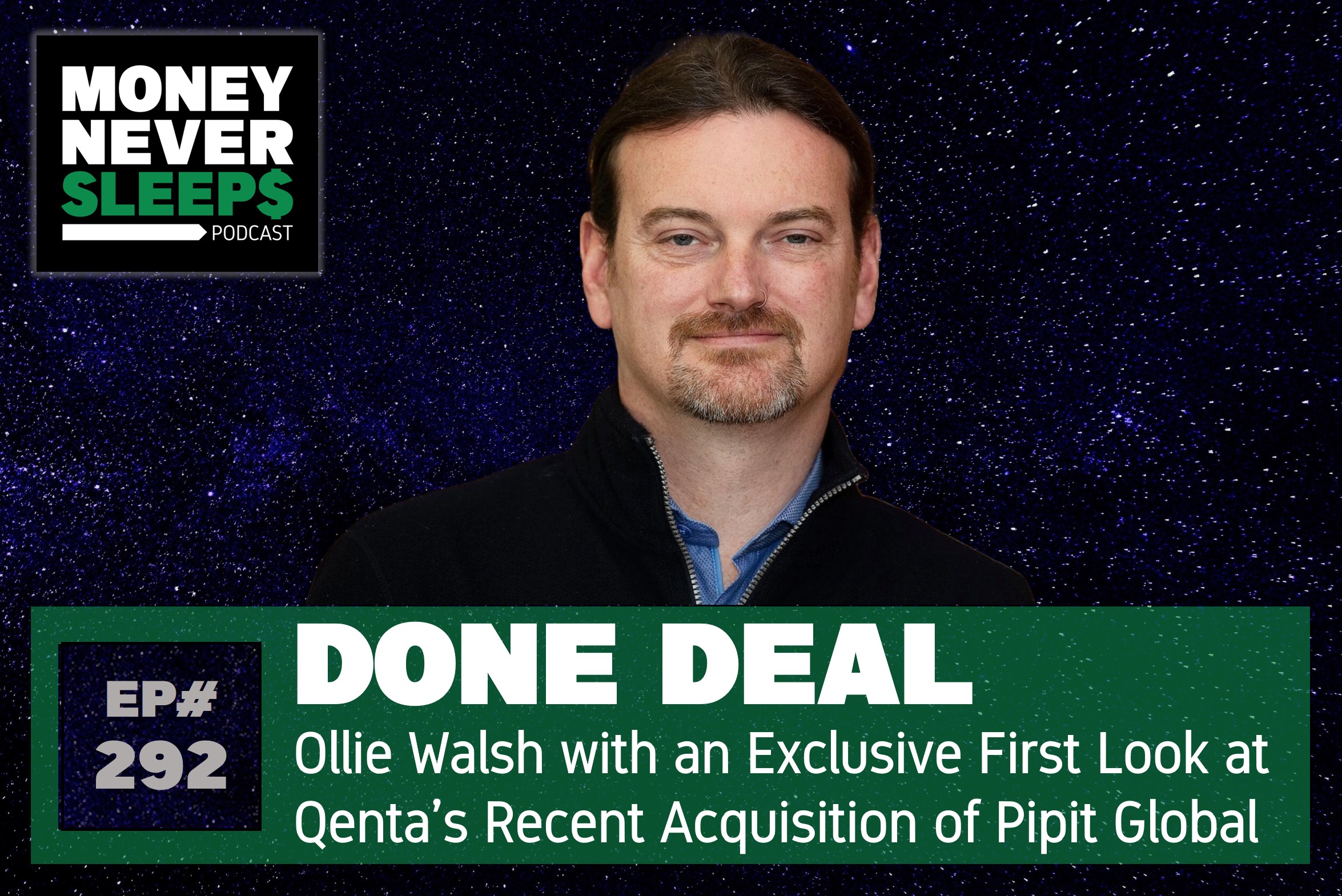
This week, I’m welcoming back Ollie Walsh, formerly the co-founder and CEO of Pipit Global, and now, the President of Qenta, following Qenta’s recent acquisition of Pipit. This is Ollie’s fourth appearance on MoneyNeverSleeps, making him the all-time guest record holder on the show.
This conversation is a special one. Not only has Ollie been building something purpose-driven and globally relevant for over a decade, but I’ve also had the privilege of sitting on Pipit’s board since 2019 and seeing the full journey from the inside.
In this episode, we dive into the first public conversation about Pipit’s acquisition by Qenta. US-based Qenta is rethinking how money moves around the world, blending fintech, blockchain, and impact into one powerful payments platform.
In this episode, Ollie and I get into the weeds on what it really takes to build a startup with social impact at its core, what it feels like to finally get a deal across the line after years of trying, and how it all unfolds when you're leading with purpose rather than flash.
We also get into:
-
The “rollercoaster on fire” of startup life
-
What makes a startup acquirable, especially in emerging markets
-
Why leading with social impact turned out to be Pipit’s greatest strength
-
Lessons learned the hard way: cap tables, crowdfunding, and mental resilience
-
Ollie’s unexpected deep dive into Daoism and Tai Chi, and how it shaped his founder mindset
This one’s packed with honest reflections, tactical insights, and a rare look inside the real M&A journey from a founder who lived every second of it.
If you're building with purpose, fundraising under pressure, or just trying to stay centered through it all, this one’s for you.
Connect with Ollie Walsh and Qenta:
Ollie Walsh: LinkedIn
Leave a review and subscribe on
Email us: info@norioventures.com
Connect with Pete Townsend and MoneyNeverSleeps:
Pete Townsend: X/Twitter | LinkedIn
MoneyNeverSleeps: X/Twitter | LinkedIn | Newsletter
0:05 Money never sleeps, pal. Hey there. I'm Pete Townsend and This is Money Never Sleeps. We look inside the minds of entrepreneurs and at the crossover of startups, enterprise, finance, technology and life as we know it. This week I'm welcoming back someone who now officially holds the all time record for most guest appearances on the show, Ollie Walsh, Co founder and CEO of Pipit Global. Now, Full disclosure, I've been on the board of Pipit since 2019, so I've had a front row seat to the remarkable and occasionally soul scorching journey that Ollie's been on. But today's chat isn't just another update. This one's different. It's an exclusive first look at Pipit's acquisition by KENTA.
0:47 KENTA is rethinking how money moves around the world, blending fintech, blockchain and impact into one powerful payments platform. Money never sleeps, pal. In this episode, Ollie and I get into the weeds and what it really takes to build a startup with social impact at its core, what it feels like to finally get a deal across the line after years of trying and how it all unfolds when you're leading with purpose rather than flash. We cover everything from cash in, cash out points for the unbanked to roller coasters on fire to what it actually means to let go of your startup baby and become Mr. President. So let's dive right in with Ollie Walsh. All right, here on MONEY Never Sleeps. So Ollie Walsh back for a record fourth time on Money News. 4. Yeah, the Fantastic Four.
1:45 Awesome. You remember who was in the Fantastic Four. Oh, Mr. Fantastic, The Invisible Girl, Human Torch and The Thing. The thing very good. All right. Anybody in this world that would be able to answer that question, it'd be the former owner and operator of Needful Things in Galway back in the 90s, which is where we think we might have first. But not knowing who each other was at the time, where we probably would have seen each other back in the 90s when I was Galway as a student. You were in Galway as a your first entrepreneurial venture. Yeah, it was 30 years ago in December touched. We opened the doors 8th of December 1994. That's crazy. That's. Crazy. That's my entrepreneurial journey up until the 16th of January this year. Yeah, and and you've been on quite a wild 1. And so, First off, congratulations. Thank you very much.
2:36 This news that we are now sharing with the world and we'll get into this in a minute. I know it's been quite a journey for you and I've been pleased to be part of it with you. And let's give the listeners who may not have heard the first 3 episodes just a quick history of you and Pippet and what led you up to the point of this conversation that we're having today. OK so like Co founded Pippet 12 years ago. Originally the model was cash payments for e-commerce orders. So my friends, Julian Callahan was the usual ideas man, you know, it approached me, but doing the research, but there's been a potentially good idea.
3:17 The market being the unbanked or underbanked or security conscious who didn't want to use their cards or didn't have a card to use online because obviously 12 years ago. So payments has moved considerably since I've brought in another friend, Rory Ryan has our CTO, Co founder. We've built a model basically on on a locally on a laptop using a demo website to show how you could create an order on a website and then send a bar code to somebody's phone to to pay that. We got that funded, 3 Dublin Angels, we got more funding from Auk Accelerator, Forge Social Impact to tech and Accelerator moved to England and then experienced to difficulty in being a migrant and to difficulty in getting a bank account in a new country. And that kind of led us to thinking about what else can we do with this platform we've created.
3:58 How are migrants getting money home? And we realized the Western unions of the world were charging people 9.5% to send money back to Africa. And as a social impact company, which is where we, we came from the idea of the social impact idea, we kind of aligned with our ethics and our mission that, that we could do something to help migrants to get money on cheaper and faster. So we, we built a model where I can't send you €100 to pick up locally Western Union style, but I can large cash, physical cash into an E wallet and then transfers and the cost was 3.5%. Is it a 9.5%? We launched that model. Our first transaction was from, from the UK to Ghana, somebody loading an E wallet. We connected with a lot of the big African networks, Z pay, Flutter, wave, salient to be able to offer payouts, remittances on AB to B to C basis for their customers in Europe.
4:44 And then we realized that we'd a lot of potential connectivity with these companies and he's been the biggest financial institutions in Africa. So, so we integrated all their payments capabilities into our stack and then we were able to offer European, Western Asian companies payments in Africa. So that kind of evolved into what we call the bridge to Africa. That's through our partners. We could offer payments, but we could also offer regulatory cover. We could offer licensing. It meant that our merchants didn't have to have an entity in any African country or a bank account. So we could completely de risk them because we could also do the FX, we could collect naira and CDs and shillings and and settle it in USD or Euro. So we, we were able to de risk Western companies from operating in Africa.
5:25 We built up a big network, 50 countries across Africa, Latin America, reconnected to every bank account in Africa, every mobile money account, same for Latin America, alternative payment methods. And then we had physical cash as well across a lot of Western Africa, which led us to a kind of a point where our plan was always to get to a certain stage and then look for an acquirer for scaling. So we, we started that process 2019, I would say 2020 maybe slightly before COVID. So COVID complicated the process considerably. So we started looking for an acquirer and we eventually found KENTA, Houston based fintech company. So we were acquired by them in January of this year. So that's just been announced.
6:05 Congratulations on the deal, but things started to ramp up a bit probably about two years ago. And tell us about the energy and momentum that you had to say. All right, listen, you know, we've looked at a few deals, we've looked at a few opportunities here. What was the conversation that ultimately led to Pipit now being acquired by KENTA? I think the first conversation we had with Brent Sprinter Jong as the founder and president of the group, we built a lot of capability. There's five on the team. At one stage it was 12, but we had reduced down to five. We built a network that's I just outlined there with five people essentially and with about 2 million in investments.
6:46 Which for a huge achievement for. AUS Fintech. That was a shocking, yeah, shocking outline. So he was just intrigued by how we had done this and how we'd managed to do it. And it was, you know, it was obviously a very good team, very focused team. Does the social impact mission, does that mission Driven Mind, did that allow you to do this with only two million in funding and five people? It did because you know, you start just founders journey and you know I mentioned those angels that those angels between them put in €125,000 which at that point in your journey you think is going to last you forever and then Fast forward a year or two and you're getting 750,000. I think it is only the last six months. The funding is an ebb and flow process.
7:28 It's not a constant open up. So there was definitely lean times where the the mission got us True. I think as well, the very first person that I've pitched very first investor that I didn't know that I pitched Pippa 2 and I told him a social impact. He didn't invest and his advice to me was never say that we're a social impact company. Based on that advice, I going forward LED with the fact we're a social impact company in every investment conversation I've ever had. And the ones that immediately glaze over, you know, you're wasting your time and you can wrap it up. And the ones that connect, you know, OK, this person is, is aligned with us. And you know, when we're moved to England and doing that social impact accelerator, we're meeting the big English banks. We're talking about what we're trying to achieve.
8:08 And they kind of put us into their, you know, their CSR department and their marketing department because for them this was like publicity PR as opposed to something real. But when you started talking to the like the social waves and the big fintechs in Africa, they really bought into it because they know on the ground the differences that remittances make and the difference of a 9.5 or a 3.5% fee can make to somebody in Ghana or in Sierra Leone or in Senegal receiving money from a family member in England. You know, the difference for you and me is a cup of coffee or two. The difference in, in Syria alone, that's kind of three days wages. So that social impact enabled us to get to the senior people in these big payment institutions and and get deals signed because we were very hurts on our sleeves that were a win win operation that we didn't price our model slightly below the Western Union of the world. We did it as low as we possibly could to make as much impact as possible with the model that the more merchants we got, the more consumers we got, the more transactions we got, the more revenue we made, but the more good we did at the same time. And in those early conversations that you had with KENTA about putting a deal together, how much of A balance was there in their interest between social impact that look what we'd be able to build with a lean team versus, hey, look at this great network that we've built 50 countries around the world? Both helped.
9:35 What? What I think really helped from both sides in the conversation is that Canada themselves did have a very strong social impact position group. There's a lot more outside of fintech. They align with UN sustainable development goals in terms of employees and working in emerging markets. The group owns, you know, responsible gold, which is a model that traces gold from the mine to the vaults, ensuring that there's no child labor or there's no cyanide used or sulfur used in mining. They already had an impact position across the group. So our position and our model faced with them, which I think is why the conversation proceeded and from Brent's clicks quite quickly in terms of we're both trying to achieve. The journey that you had been on with this deal, M&A is never a straight line, ever.
10:19 What were some of the unexpected twists along the way that you can share? Well, we, we, we made the decision, we've been the board to start looking for an acquirer. A lot of work within obviously to do in pitch decks, acquisition decks and then lining up potential buyers. And we worked with AUS based investment banker to help us source conversations. I had kind of thought that it was a 6 to 12 month process to get really dug in. It may or may not have been the COVID effects, but like it took 18 months to get our first meaningful conversation. We had a term sheet from a Swiss fintech. We went through a six month process and got I think 8 days out from the signing days and then that fintech lost her funding to a virus. So, 6:00 AM E-mail, sorry about this, was affected immediately Christine was pulled. That went through your head.
11:06 Nothing that can be shared I think kind of hello kind. Of over a hood cast earmuffs earmuffs. Yeah. And what, you know, it was a real sucker punch. You know, I'd already really taken up my position in the new company. I'd already written a strategy document for the new company and how we would align with it. So it was very unexpected. And now the CEO of the company, it was as unexpected to him as it was to me for stats, you know, there, I suppose that was in November. It was kind of pretty close to Christmas. So we kind of regrouped over Christmas. And then here's it again after Christmas. We had two potential offers that following year, which would have been 23. We had two more deals potentially that fell apart relatively quickly. 24 was the conversation with Brent.
11:49 So from deciding to sell the company to signing the deal was four years, with three deals falling true in that time frame. The the the insanity of that is accentuated by the fact that I'm sitting here thinking that feels like with everything that had gone on during that process for me, Obviously I'm a non executive director on your board and witnessing it and seeing it that those four years to me have just been Zook encapsulated and accordion style. It just feels like there was so much activity there that how could that possibly have been that long ago? You know, unprecedented in terms of three deals out of four not getting over the line in a period of four years from the point in which you decide to sell the business. It was tough for years.
12:37 And you know, and as the CEO, you know you need to run the company and you need to sign deals. And as a small team, you're reading contracts and you're doing compliance and you're doing the marketing and you're doing sailors and you're doing events and you're doing podcasts and you're doing stuff as your day job. But you're also selling the company is is kind of 80% of your time. So you're trying to fit all the rest of it into 20%? I talked to early stage founders Ali about when you are raising money that that is basically 100% of your time for the CEO and that everything else just goes on top of that. If you can. And depending upon the size of your team, you may be able to spread that stuff out. If not, you just you wear it right. So you, you definitely wore it for a very, very long time. When you think back to the early pivot days, would you ever imagine that this is where you'd end up? I founded Pivot when I was 40 and it was the start of what I'd set out as a 10 year personal strategy to establish a tech company and social impact company and sell it by time I was 50.
13:34 That was the plan. I missed that deadline by two years was I'm pretty happy with my 10 year plan. Doing kind of this kind of two ways you can go I think would start a tech company in Ireland. One is to do it on a more lean basis in Ireland and you don't want us to move to the States. And when I started his company, my son was, he wasn't born actually he was born the following year. Well, that's the founder journey. You know, we got the funding on a Friday from the accelerator on the condition that I moved to Sheffield to do the accelerator. So I got the call on the Friday and I moved on the Monday and my wife and then 11 month old moved the following Monday. We spent seven months here in Sheffield. I always wasn't prepared to move to the States. It wasn't afraid to do that, that maybe a younger man's game, a younger person's game. So it really was that.
14:15 We need to get this company to a certain size in terms of our technology and our capability, not in terms of revenue. We need to build something here that that is worth buying for the stack because we were never really funded enough from driving kind of real Unicorn world, funded enough to drive growth to have revenue to show this works. And I have, you know, transactions every day in Nigeria and Mexico and Ghana and Kenya and be able to say, here's a stack that it works. And interestingly, those 3 failed conversations and one successful one in terms of an offer, but we probably had 4050 conversations with potential buyers. Pretty much all of them said that to build what we would build would take three years and cost $10 million. The also three years and the also $10 million we probably took longer, but we spent way less. But that was kind of how we positioned the value of what you're buying.
15:05 So you really weren't buying billions in revenue, which you were buying something was going to save you three years in time and 10 million in money to get there. Just thinking back that I've always looked at what you've built is being, you know, when I've said this to people, you need to look at what Pipit has built here, look at this network that they've built and it's ready to go. It's the volume. And adding the volume into that from a global player is something that is going to drive tons of value. And not just tons of value for the shareholder, but tons of value for people on the ground, right? The people that are trying to send money back home cheaper than safer.
15:46 And that's almost answering my next question, which is what was the key thing that made Pipit acquirable beyond just having a good product and beyond having the social impact mindedness and mission? Although I think a part of that is from the seller's perspective aligning with the buyer, I've mentioned doing doing the acquisition deck, there's probably 50 of them in folders now, each one tweaks or significantly changed to align with the buyer and what their requirements are. So we were talking to companies in the US that had bought AUK based remittance company. So we kind of aligned that to say, you know, this is how we face with what you've already bought and this is how we can scale what you have together. So it's not a case of just firing out the same memo of understanding to everybody.
16:29 It's a case of really aligning what you're selling with what the buyer needs. And as you got deeper and deeper into this process, I know that you got closer and closer to KENTA, much like you did with the first one. This was one where, you know, you said you basically wrote a strategy document for them and then that deal failed. Now, this time around, you did more and it got even closer. And obviously it's been since January and we're just announcing this now. But you kind of had to go into that with just, hey, listen, we're going to get this deal done. We're going to get it over the line. I'm going to go in and I'm going to start doing strategy right. I am a relentless optimist.
17:10 I'm just supposed to. Go between those two. Was there ever any kind of gut feeling like here we go again, I'm going to go all in. But you know what, this one may not get over the line but to help with it. Absolutely is, yeah. Yeah, you know, it is. It is a roller coaster process. I'm kind of startup guy, you know, I'm a strategy guy. I'm a marketing guy. Background. When you start getting stuck into the legals of your company being acquired, it's an absolute nightmare. And then you just realize there's all these potential hurdles that you never thought of. So yeah, I went all in was the only way to do it as far as I was concerned is show them what you can do. You know, really show them what you can do. So when these hurdles come, they don't want to just let it go because it's more hustle than it's worth. You've kind of proven you, not just me individually, but the team as well, because we all got stuck into our various departments and meeting people and meeting teams and aligning strategies.
17:59 So everybody in there knew us. And and when when hurdles appeared, which it did multiple times, there was the wheel on both sides to to find a solution. And and tell us now three months on from closing the deal, three months plus, where is Pipit now situated with in KENTA? How will the branding unfold? What will the presence of Pipit be with in KENTA and within the market? How does that all fit together? So the brand Pipits will be disappearing over the next couple of months. We didn't can't. They've kind of restructured around a few other acquisitions they made at the same time. So the the group is now called the Q ecosystem, which includes also KENTA. So KENTA is the payments company. I got the job as the president of KENTA. You've been AUS company, that's the title. Congratulations, Mr. President.
18:47 Mr. President yeah. And the rest of our team got VP roles, so VP of technology of operations and product of sales and partnerships and of treasury and finance. So we, we've gone from, you know, a team of five, including me to now leading a team of 35, probably 25 with those are tech and mostly based in Pakistan. But the trader business units in the ecosystem, which is create, which is a, uh, regulated entity, QoS, which is our kind of in house blockchain, which we're developing into an operating system for fintech and QID, which is AID verification and data tracking company. So not just ID for people, but ID for things, which is a very interesting model. So I've three other presidents to work with and then the group CTO and the group head of accounts are part of this team. And then Brent as the big boss.
19:32 So between those four companies, we've got 150 people, including share of resources in terms of compliance and legal and marketing and websites. We continue to to be a payments company as KENTA. The 4th presidents are meeting next week in London for a kind of QE code strategy where we'll be positioning Q ecosystem as we can do everything from onboarding your customer ID for vacation validation to tracking logistics would have blocked chain to doing your payments in and payments else on a global basis. So moving to much bigger projects and there's conversations going on at government levels for projects that we can provide. Even though obviously I've known that all of this has been going on, just hearing you speak about it in a way that I know will be public is just gobsmacking to me. You're finally.
20:21 There your Irishness now. You're finally there that, you know, becoming president of a division within a global fintech, the whole team taking on VP roles, being responsible now for a strategy for a much larger team. All of this and to know that the original Pipit vision is being carried forward into KENTA and that you're championing that. Is it tough to let go of Pippet as an independent company? No. Why? Well, you know like I said to start his 30 years since I started this entrepreneurial journey. So Pippet's been the last 12 of us Yeah, I've been 30 years self-employed. I've been 30 years dragging businesses along behind me. Yeah, you know that they're hard yards been self-employed and and when you get into, you know, a lot of those years were consulting years.
21:11 I'm not sure I would consider consulting to be entrepreneurial. It's service provision really, but it's self-employed. You know, there was there was many, many hard years. There was more hard than easy years Pipit. So I'm satisfied where we've gotten into as a company. And I'm also very satisfied as a personally that entrepreneurial journey that I've, you know, closed that loop and gone from an idea and start up true to growing it, scaling it, funding it and selling it. It's a loop that not many people get to close. No, it's not. So just hearing you say that, Ollie, makes me think of an e-mail that went out after the deal had closed to shareholders. And there was a list of bullet points there that sent chills down my spine when I read it.
21:55 And what you're talking about here on being on that journey really was reflected in this very quick list. And do you mind if I read these bullet points from that e-mail? So what was said in the shareholder letter that you wrote was that it's been quite the journey for us. The full range of the startup world, The original idea, researching markets, developing strategies, building tech, building the team, sourcing funding from angels, VCs and crowdfunding, going to market, onboarding merchants and collections partners. Our first transaction, then our second. Traveling to exotic destinations, traveling to boring destinations, recruiting staff, having to let staff go, needing to raise more money, having good days and having bad ones.
22:43 That was poetic, you know? That's one thing before has been a poet. That is like the founder's poem right there. OK, the founder's journey poem. Will you be doing more writing? I'm trying to develop a more ongoing blog habit. I mean, my own website, hollywatch.com has probably 20 blogs on a sort of space at the last four years. But I've been trying to get into a, into a more weekly flow of doing blogs. You know, I used to do a lot more blogs when he's doing more traveling. I found that kind of having two hours in train was time to write a blog, whereas I'm not doing much traveling now. But but yes, I do like writing so I do plan to do more. Yeah, it can be quite therapeutic. What are some of the most important lessons that you've taken from this chapter or this book that you wish you could kind of send back to 2015 Ali?
23:36 There's a lot of things that you don't realize on the way that when the problems in the future, I think funding is because of those. When you're in the startup world at the beginning, you don't really think of things like cap tables being a problem in the future. We'd some significant angels. We, we did around 20/17/2018, which is where Western Adventures came in and Enterprise Ireland with some people who wanted to invest relatively small amounts of money in that round. Relatively small as in you know, between 1500 and €5000 and they become kind of names in the cap table and your cap table starts getting longer. And when you're at that stage, that money is really useful, but it kind of becomes a problem when you start dealing with legal people in a, in a fintech institution that are like, why is there so many people on your cap table? We also do crowdfunding round, which is in that list there. That began really problematic.
24:22 I certainly wouldn't recommend crowdfunding for any anybody in the so well and good. If you're doing a brew dog kind of style where you put in $20 and you get AT shirt, put it here. If you're people who are who are getting kind of a nominee structure in your company, it becomes very difficult then when you're trying to unwind that. So that's certainly something I wouldn't do again. And you can't solve that with a free pint of beer. No, no, no. And you can't solve a good drink of the beer yourself either. It needs to be faced up on whole. What makes? It worse, yeah. Yeah, yeah. So but you know, you, you kind of along the way you've, you meet people that excel and you meet people that really let you down and it's difficult not to take it kind of personally a lot of time. So what they always say when I'm talking to people myself, it is a roller coaster, ups and downs and you need personally as an individual to stay centered.
25:11 And as that goes up and down, you're doing a straight line and not get too carried away by the successes and not get too down failures for the problems. And as ACEO, you should always have like support structures out there and a particularly good board who are including yourself who are supportive all the time. You know, I'm a member of a kind of leadership group called Power 7, which is a very well from just no no relation, very Welsh with it's a nationwide peer leadership group for for business owners in in batches of seven where you can kind of go for a day every second month and just support other people to get to problems off your chest. I'd kind of tree friends in particular that I'd spent a lot of time with just like structured plans time. Thus I'm just coming here to meet you for coffee to rant for half an hour because of some stuff to get off my chest. And two of our investors were also in that list and and and my wife as well, which is debatable for a lot of people. For me, it's my my wife was crucial in keeping me on the straight and narrow.
26:01 But for for a lot of people that like to keep the business world away from home, which I know can accentuate the problem as opposed to solve it. But you need an extensive list of close contacts that can support to the process, because you can't always go through the problems with your team because other problems are your own. Yeah, I found in all of this, having a supportive spouse is absolutely essential. And what I've also found is having kids. You want them to be proud of you. You want to be proud of what you've built and proud of what you do. Do you ever have any of that element in what drove you? Yeah, my well, my son's 11 now. He recently asked me can he, can he start working in Pippet? So he now, he now does my computer updates every every Friday afternoon and he charged me 7 year old.
26:43 So he's the team. When you think about where you sit now, what does this acquisition mean for the people that Pippet was originally built to serve, the unbanked and underserved globally? Oh, it means we can, you can really scale those benefits. I think the velocity of the company is definitely limited by the size of the team. You know, there's only so many contracts you can read at the same time. You know, we fight at the moment that we've gotten in, in the last for this month, we've, we've got 5 new contracts being reviewed now by our legal and compliance team as opposed to by me and Trisha was our Head of operations. So we, we can really accelerate what we're doing as part of a group with a lot more heft for want of a better words. You know, we can go and talk to bigger institutions and when they do their due diligence.
27:31 We're not a five person team in the West of Ireland. We're a part of the global fintech organization and it's a meaningful entity that bigger institutions don't have to be concerned about dealing with. We want more global reach now in terms of the senior people through the Q ecosystem are kind of spread geographically quite wide people coming from different backgrounds, we've a lot more reach into different networks. So I mean networking is really part of how we prove this business. So we we, we can see that expanding quite a lot. Excellent. Big opportunities other than that for PIPIT as part of KENTA. Oh, I think so, yeah, yeah, yeah. People first, geography second is kind of their their mantra in terms of their team. So there's there's a lot of opportunities for growth for all the team that we're start of world wise, we're quite mature for our team. This is the ways to go for is yes, career wise. So there's I think big opportunities. There's a lot for us as individuals learning and growth. And, and for me, it's my first time having a job where I'm not the CEO.
28:26 It's my first time having a job where I'm not responsible for making enough money. There's one to pay my own wages. No, it's not getting a a bit more insightful into all of this. And you've been very insightful in this conversation, Ollie. So thank you. But if the first ten years of Pippit were a book, what would you call it? Probably roller coaster on fire or something like that. And hair on fire. The roller coaster on fire. Roller coaster on fire. We had, we had a part of our, you know, part of that group Power 7 piece. We do like a retreat every year. And Barry's very good at kind of exercises like you should exercise. We have to draw where you are in life. Last year, what I drew was a rollercoaster on fire. OK, there you go.
29:14 Probably a good title for the book. There you go. Yeah. And, and what you're you're talking about with with Barry that the power of seven. It feels like Founders Anonymous. Yeah, well, you know, you've, you've 7 founders in a room and you know, there were quite different businesses. But essentially we all have the same problems. The Power 7 is itself family and business in that order is, is how things are structured. So it's not like Enterprise Ireland do a similar thing called the Founders forum, which I think Barry might have been behind actually setting it up. But it's purely business. You know, you have to look after yourself 1st and then your family and then then you can take care of your business. So 7 founders, we all do the same business problems and we all the same life problems. So like I said, those support structures are very important. You have the opportunity to do this while going through this Pipit journey of the roller coaster on fire. I'm glad you had that.
29:59 Yeah. Oh yeah. I'm glad you had that. Absolutely invaluable. If you were to think, well, maybe a bit early to ask you this, but can you name book 2 now that you're part of the Kenta family? Could you actually give book 2A name yet? Well, something like The Future is Bright. Sounds really cliche, but it's just it's the new dawn. It's a new dawn, new day. Yeah, I, I kind of like I said it was, it was a 10 year plan that took 12 years to, to complete, but I haven't started much. We're going to do a 10 year. I went to an 8 year to up to 60 plan, but I haven't started that. Yes, I'm just kind of settling into my new role, really. I heard the redemptive sigh of relief there and the optimistic smile there for a minute there.
30:42 Ollie. So, like, you're in the right place, yeah. Yeah, a friend of mine that sold his business a few years ago said it doesn't really settle in for three months. He said it's 3 paychecks. The first paycheck, great, because my first actual paycheck, 2nd 10. Brilliant. This happens every month and the third one is like so I'm on 4. Yeah, yeah. You've been on the show now, you know, three times before this. And I may or may not have asked you this question each time. I know I did ask you at least once, perhaps twice. But this is the last question that we ask everybody on this podcast, which is what is something that people would not expect to know about you. And in your case, this will be one more thing that people wouldn't expect to know about you.
31:26 Giving me a lot of secrets on the show. You have? Yeah, Yeah. The first time you asked me this, I think the answer was about my Tai Chi practice. Yep. Which at the time was very much a physical practice contradi classes. But over the last two or three years I've gotten very much into the, into the philosophy behind it as well and Taoism and reading a lot around Dao's philosophy. And that is really aligned with my mindsets, but aligned with the requirements of being a founder and, and being on that rollercoaster on fire of aligning with the universe and its energy. You can't, you can't fight, you can't swim against the current. You need to find a way to swim with the current. So that's been taking up a lot of my my spare time recently. Is, is really getting deep into the study of that.
32:09 Where does that intersect? With Zen, Zen comes from when when when the Indian Buddhists were moved east and into China and they they kind of interacted with Taoists. The original Taoist philosophy didn't have anything like Buddhists or temples. When the Taoist and the Buddhist mess, that kind of became Chinese Buddhism, which then developed Zen from there. So it's kind of part of Chinese Buddhism. There's, there's some roots there and I found a lot of that calming for me. And that the whole way that I got into that was just reading one of Phil Jackson's books, the famous former coach of the Chicago Bulls and Los Angeles Lakers with Michael Jordan. And then Kobe Bryant, may he rest in peace. You being obviously a huge student of this and being totally immersed in that is, you know, has had a fantastic, almost necessary impact on how you keep saying in that roller coaster on fire. But I, I definitely have started to dig into that a little bit. And the one thing that I've gotten out of it is that there are things you can control and there are things that you can't control.
33:10 And there will be times where you feel a certain emotion that can be all-encompassing and you kind of just have to sit back and think, why am I actually feeling that and what does it actually mean? And then put it where it needs to be and get on with things. You know, I feel like that's Ollie Walsh in a nutshell. You, you just kind of waste energy on something you can't control and something people do, you know. So Tai Chi is, is the, the physical manifestation of Daleism. It is the way they put it. So I kind of started with the physical manifestation and work my way backwards into the into philosophy. And that versus startup life roller coaster on fire, night and day.
33:50 Yeah, what is? The best way for people to get in touch with you and learn more about KENTA. Well, you can get in touch with me and LinkedIn is probably the best way. Olliewalshwiththemollie.walsh@kenta.com with my new e-mail address. Fantastic. And then it's QEN ta.com for KENTA. Yep, fantastic. Well, listen, Ollie, thank you for coming out to the show to tell the story and thank you for keeping me on board with you since 2019. And I know this bitch. Thank you. You were part of the aforementioned support mechanism. Absolutely doing my best and that I think this journey, you know, Book 2 is not written yet.
34:35 I think there's some thoughts and ideas on how that might all unfold. And anything that will come in the future between you and me will be completely agnostic to any of this because it's been such a pleasure being on this journey with you and I can't wait to see how this all plays out. Super. Thanks, Ollie. Thanks. That does it for this week, folks. Thanks to Ollie for opening up his mind one more time to help us figure out why he does what he does. Check out the show notes on Money Never Sleeps dot IE for all the relevant links to learn more about Ollie and KENTA. If you like what you heard, please leave us a rating and a review on Spotify, Apple or on Money Never Sleeps dot IE slash rate. Thanks to Conan Brophy from Create Sound for mixing and editing this episode.
35:21 Conan is an excellent media man to work with on your own podcast. As for me, I'm an early stage startup investor in the next version of the Internet and I lead the Techstars Web 3 accelerator. There are plenty of links in the show notes on money never sleeps that IE on how to get in touch, so don't hesitate to reach out. Finally, till next time, thanks for listening. See you. Money never sleeps, pal.