Spotify

 Apple Podcasts

 Amazon Music

 Overcast

 Castro

 PocketCasts

 Castbox

 RadioPublic

 RSS Feed
196: Forever | Nigel Verdon and Railsr
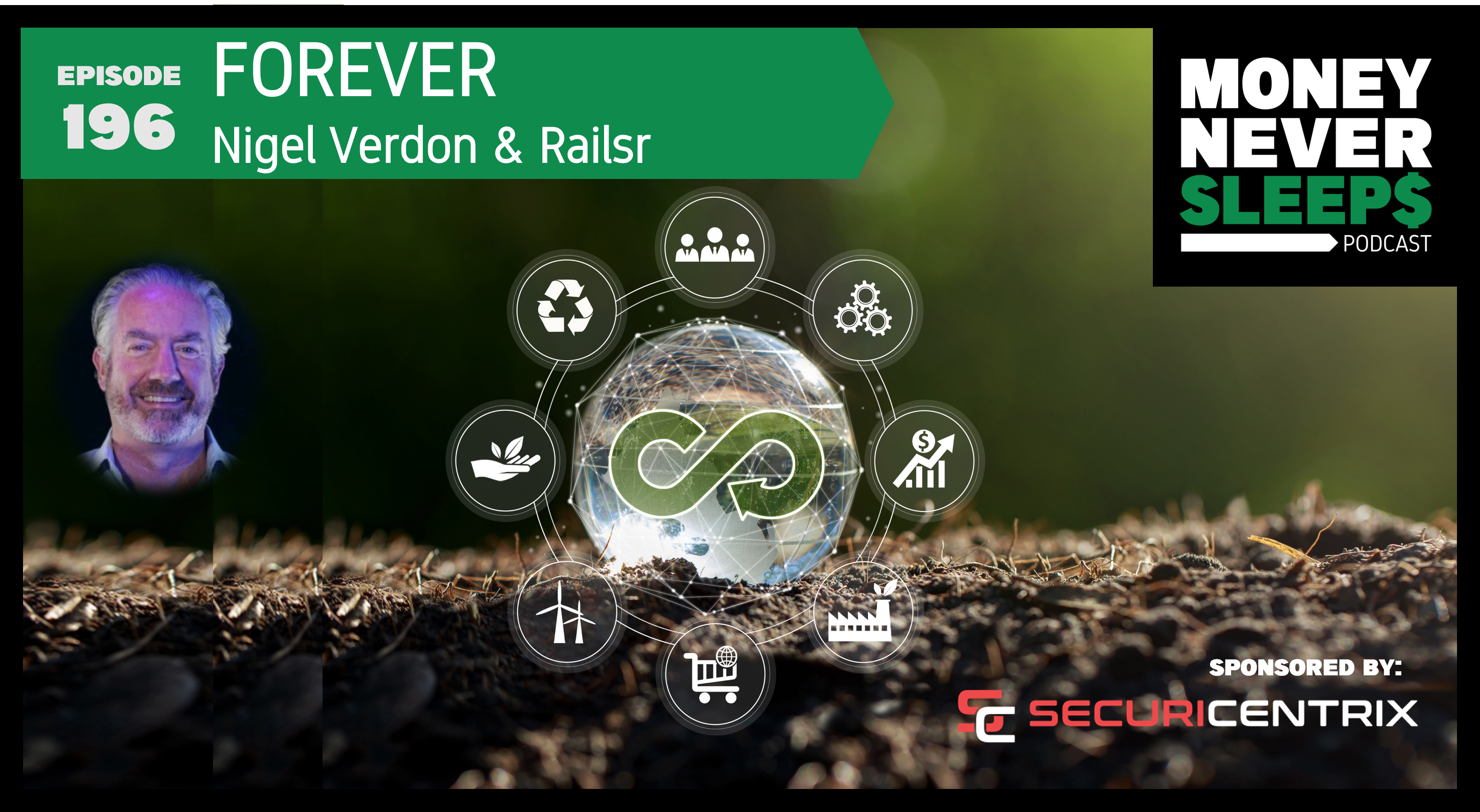
Nigel Verdon is the CEO and co-founder of Railsr (formerly Railsbank) and is a 3x fintech founder and ‘Finance 4 Good’ evangelist focused on building great ideas - first with Evolution (exited to BAE Systems), followed by Currency Cloud (exited to Visa), and now with Railsr.
This episode of MoneyNeverSleeps is sponsored by SecuriCentrix. SecuriCentrix is a trusted cyber security company with offices in Dublin, Cape Town and London. SecuriCentrix provides expert advisory services, primarily in the finance and fintech industries, with tailored security solutions to fit your specific needs and regulatory challenges.
In this episode, Nigel Verdon riffs with Pete Townsend and Eoin Fitzgerald on the foundational experiences that pushed him towards becoming a fintech founder before the word fintech even existed, the rebranding of Railsbank to Railsr, the impact of Railsr’s $46mn Series C funding round and spending it on the right things, fintechs as public utilities, Nigel’s view on the digital asset market and decentralized finance, and the difference between starting a startup and scaling a startup.
KEY QUOTES:
Nigel Verdon on what’s inside him that has kept him going as a third-time fintech founder:
“It's really the frustrations of coming across something you feel that can be sold, and then being able to build a business around that. I do like solving problems as a trained engineer - I’ve got two engineering degrees and that sort of mindset that’s always sort of inquisitive and trying to solve things.
“I also found working in large companies that I’m probably not the best sort of employee in larger companies, and that it's better to go and find something where you can actually make change and do something that helps other people or other businesses in their journeys as well.”
Nigel Verdon on the inspiration to build Railsr:
“A lot of our inspiration for Railsr came from Amazon and their AWS business because when we set up Currency Cloud, we had a data center, we had rackspace, we had to buy computers and routers, and we needed people to manage those. You’re a few million down before you even started running your platform.
“With Amazon, it’s your credit card and 15 minutes and you’ve got a data center for a few thousand bucks. The inspiration for Railsr to be able to do that for financial products, and not just for fintechs, but for other businesses as well that want to engage with their customers using finance.
“Why finance? Well, ‘A’, to make revenue out of it, and ‘B’, you get data on what your customers are doing, especially in the retail world - where they're going, where they're shopping, and what sort of things they're buying. Any brand that wants to engage better with their customers can use finance strategically now.”
Nigel Verdon on focusing on the importance of a customer-driven product roadmap:
“We focus on the things that are super-impactful because customers always ask for tons and tons of features. When you actually look at usage of the features, you'll see it skewed up to only 20% of the features have the massive usage.
“We think we can sit around the table and say ‘these are actually going to be killer features and everybody will love them and want them’ and we pay for all of the investment and launch those features - and then nobody uses them. Part of being a product company is having a clear roadmap that's very driven by customer feedback.
“When you start the company, you’ve got to have the mindset to really switch the motors - the customer drives everything.”
Nigel Verdon on hiring smart people and letting them get on with things:
“While you think you can do everything if something’s not going right, you’ve got to give people the space to get their way as opposed to your way - it’s a different way of looking at things.”
Nigel Verdon on starting a startup vs. scaling a startup:
“Scaling is way harder. Doing something once - getting something out there and getting your first customers - is easier than scaling. Scaling is a lot harder.”
Nigel Verdon’s view on decentralized finance:
“This whole fear that people have is ‘oh, it’s decentralized, nobody owns it’, all this type of thing. If you look at the infrastructure, which is the ability to essentially create a transaction that has all of the history in it, all of the provenance, you can see that fraud and money laundering suddenly become quite difficult. It has huge potential, but people have to get over the fear that it’s trying to destabilize countries.”
LINKS:
Follow Nigel Verdon on LinkedIn and learn more about Railsr
Follow Railsr on Twitter
Episode title inspired by Forever by Drake, Kanye West, Lil Wayne and Eminem
Amazon Bay (referenced by Nigel Verdon) - 2005 short video narrative written by Sean Park predicting the financial services landscape in the year 2015.
Leave a review and subscribe on Apple Podcasts | Spotify
Check out our MoneyNeverSleeps website and email us at info@moneyneversleeps.ie
Follow us on Twitter: MoneyNeverSleeps | Pete Townsend | Eoin Fitzgerald
--- Support this podcast: https://anchor.fm/moneyneversleeps/support
0:11 Hey there, I'm Pete Townsend, and this is money, never sleeps. We look inside the minds of entrepreneurs and at the crossover of startups and a prize Finance technology and Life, as We Know It, This episode of money. Never sleeps is sponsored by security. Centrex security Centrex is a trusted cyber security company. With offices. In Dublin, Cape Town in London, security Centrex provides expert. Advisory Is primarily in the finance and fin Tech Industries with tailored Security Solutions to fit your specific needs and Regulatory challenges on the show this week. We've got I'm not as if I didn't. I'm the CEO and co-founder of Rosa, Nigel is a three-time fintech. Founder focused on building great ideas, first with evolution in the 1990s, followed by currency Cloud, a decade later and now is CEO.
0:54 And co-founder of rails are formally rails Bank since 2016 who are empowering a new generation of embedded Finance experiences in this episode own and I riff with Nigel on the foundational experiences that push Nigel towards becoming a fintech Founder for the word. Fintech even existed rebranding of rails Bank into rails. ER the impact of rails has 46 million dollars series C, funding round and spending it on the right things Nigel's view on the digital asset market and the difference between starting a start-up and scaling a startup. All right here on money. Never sleeps. All right, so Nigel. Welcome to the show.
1:34 Awesome to have you on. No, thank you for the invitation. It's great. You've been a stalwart in the fin tech industry for the last last couple of decades. So it's awesome to have you on for this chat and probably a good place to start is, maybe just share a couple of the foundational experiences that you've had that have gotten you to the point where you are right now. Yeah. It's really the frustrations of if you come across something, you feel that can be sold being able to then building business around. That says, been a challenge of myself. I do like solving problems as a trained engineer and got to engineering degrees. And that sort of mindset is always sort of acquisitive, and try to solve things and also and found working in large companies, and for being not not best sort of employee and larger companies. Let's go and find something where you can actually change and do something out of it.
2:31 Helps other people either other businesses in their Journeys as well. Yeah, definitely had you been in an employee of a company for that long before you started your first startup, when I left you a, I was at a comically dies from a bigger Services business owned by General Motors uptime. And that two years is good training actually because it would put us through a particular training program. Like I sent you used to have Alanis and assaulting and school in those days and the experience I think actually over the Liga and the discipline and cetera and the processes that large companies sent out successful larger companies, have I think was good and foundational and then working in the financial markets are basically a buddy of mine, Johnny peacock, who is a co-founder of the first business?
3:19 He was also, he dies and he phoned me up one day saying, I'm leaving to go to company for Goldman Sachs. And I've never heard these people and said he got a great job here, working and lovely Luther. And I said, look for the same engineering maths, okay? 20 or 30 times the money so I then went and joined the mirror in the fixed income business and then in Swiss bank come off to that. So it's a is a sort of a transformation into there are large organizations but in the capital markets businesses and that time you didn't really silly working for a big company. Cuz each trading desk was pretty much like an independent business and is very sort of entrepreneurial, especially Swiss bank called just today, call UBS. And we went to the whole transformation of syntax really doing for the move.
4:10 The non cap them off its world. We did that in sort of early 1990s, when there's something called internet appeared, and I looking at how you use Tech and I use that to engage with the customers, very simple things. Like an effect salesmen could be much more To using slack towards resolution at that time to handle five or six customers, when they could perform hand, just on the phone and one customer to time, those just seeing how you to leverage Tech. And we were the, I think the second biggest customer of NeXT computers because of the death of Anguish, and I become the IMF, essentially, and that gave us, oh, give out ago, the teams met with runs, especially on the, the ethics options drawn, the Chicago Board of Trade and others where the The trailers are all given sip charts essentially or the surfaces that you're trading on.
5:01 And so it looks like this by if it looks like this. So okay. And so that was revolutionary today. It's probably people think that's quite okay. But so do all the pre-compute stuff and having Devin violence that was called open step. Choose the dev environment on next was completely different Wells, or writing software everything down, the traditional Ways work the time. So thanks to Steve Jobs. He revolutionized letters and he's a man in a mid. Mid to late 1990s. Wow. And then your first start up from that point, was Evolution. And that was 96. Yeah, this current. Yes. And then Evolution we was working Swiss bank, cool. And what I said, my colleague, everyone is working at Goldman and they the four of us co-founder at once. And they just been setting up the equity derivatives business, or they didn't almelo.
5:54 Simon and Joan Boyce came. From Goldman, my Cayman Swiss bank was because this internet thing appeared and that Swiss Banker. We did the very first for a change trades on the sinkhole internet and so we built a business around at helping front office. Capital markets firms, utilize the internet for Price distribution customer to engagement with fund managers automation of Trades as a straight-through processing on trades at Center using a in there is prevalent in Industry who can think of X Fashions change protocol and so that was a great company. We built about 120, other people and then sold it eventually to to be a systems and it's 200, but really capitalize on instead of building websites is actually building the capability to trade between organizations.
6:46 Not just how websites and that was all based on fix. Yeah, those are fixed and various other pieces are one of the projects It was the very first effect options, pricing tool. That was delivered over the internet to customers so they could solve price option structure. They're looking at the forehand at they had to phone up the cells guide cells go and go on the internal tool and then give them back a price and they're just a label that same. There's similar thing with insurance world with they made their tools available to their customers. I'm going to a real sort of how do you scale up your business? Give it thumb to mind of your customer was before home is very much a telephone based business.
7:31 Gotcha, gotcha. And then after, like, you said, you exit out of that to Bae currency cloud in 2007, what was the impetus for getting that started directing to? After I left you delusional, strengthened to the equities business of jazz and rock climbing wall and they'll just a clone investment bankers called at the time. Correct, mine equities suspect pool. They needed somebody to come in and help him. Turn around equities business, and they they took a whole like the whole bunch of extra spank or people to help and that we turn around for my 90 million loss business, 250 million pre bonus profitable business, free bonus in 18 months because it was a doing stupid things. Basically, and markets went up.
8:18 So, if he's worried a bit of the market going up as well, but when I was there, I met a guy for shooting Park who you probably know they Sounded and Thomas, and Sean set up a business with interest and climbing wall called digital market. And we basically had created the machines and everything. I did all flow trading for Woody's FX government debt, corporate that list of features acid options and thought that all together and there's a sort of amalgamation of tech, guys. And truly, guys Ops guys, in one unit, It that rather than will be split apart and that's was the center of the precursor of water became an Thomas and what essentially became a country clout.
9:07 Wow, thinking of it because there's a video Sean did or which is called Amazon Bay which is looking at the markets and integrity and his office and going through the script, right will seem to be ours and Bay and it's actually a quite legendary video now I've never seen that. I gotta check that one out. We will let wilty that one up for the show notes later on great. So your experience in a collaborative effort with working with a few folks that was digital change Partners in 2015 to 2016 and that the whole rails Bank idea came out of that. Can you talk to tell us about that a bit?
9:47 Yeah we were advising a bank in Luxembourg. If I had they can leverage their infrastructure and make the pipes, the pipes and Sharon was a sunk cost with them to make money out of those pipes. In those pipes, about Connections up to switch connections into Local payments, Etc, and the project, and go anywhere, and you and the board and sign off on it. But what we were trying to solve for was every Syntec that have been built, sort of in the 2011, 2012, onwards, that sort of initial when the Syntec and Monica appeared in q1 2012. So transferwise revolutes, currency Cloud. All these others.
10:28 The everybody is building the same infrastructure and spending 12 to 18 months doing that. That and then we could start going to customer. So we sought world one, we shorten Up Cycle, wine, building infrastructure, which is where we went to this bank. Got the infrastructure, put an API layer on it, like we do at County cloud and make it available. So we instead of working with that bank, we set out to build an API LED Central Banking infrastructure business to accelerate syntax and then the markets growing because it's more than fintechs. So using some marketplaces or sorts of Digital first companies and that's essentially where it's all or came from.
11:09 It was a failed project to bank. That's the thing I know back in my days and operations and capital markets, I came up with this great idea called blade which was the business logic algorithmic data engine and it went nowhere. It was a fantastic idea but you know definitely a failed attempt and then and tell us about specifically about rails ER what it is and why this is really this sort. Cursive your conviction as to the perfect thing for you to be working on. So we close embedded Finance, experience platform. And what that means is anybody wants to put a financial experience into their customer journey and embed it into their programs, their Journey, basically, using apis as opposed to White Label.
11:55 Or yes for the white label think it's gives you the control whereas the the tools and the Lego to build. Team wallets cards that will Wards and also credits as well. And so you suddenly, you've got the ability. What something that took say Marks and Spencers building the marks of Spencer's bank which is Summit several several millions of dollars and and basically was we badge HSBC to inheritant everything. That's bad with HSBC and your new ux Mabel anybody at a much much, much lower price point and much, much quicker. Icarus. It wasn't a two-year project. It was two to three-month project to to unveil it. So really it's of democratize access to putting Finance where you've always.
12:43 Wanted it in your use journey or business models like kind of wage stream wage advancing they prototypes on us and that four days out of working prototype. And then launched in two months, whereas beforehand, that just wasn't available to people that have to work with a bank, gets a banking partner, all the different pieces and planned Thanks going through that. Where was it was just, it was sign up with us and go. So love inspiration, came from Arizona AWS business because when we said currency Cloud, we got data center. We had wrapped space. We had to bite it letter by computers, that's by Rousseau voters, yet people to manage those and your few million down before you've even started, running your back Amazon, it's your credit card, 15 minutes and you go daily. Center and a few thousand bucks and that is the inspiration for rails are to be able to do that.
13:40 So data centers, just Financial products. So where we've seen it to the going now is that not just fintechs other businesses want to engage with their customers using finance and wise Financial what a to make Revenue out of it. The you get data on what your customers are doing and you get more data, especially in the retail World in terms of Again, whether shopping, what's of think, the vine and the? And so the, what was just to help fintechs is now expanded out to something that pretty much any, any brand that wants to engage better, the customer care and it can use Financial TGT there.
14:23 Well it was vastly expensive, the other advantage over allowed, we allow people to run experiments. So again back to the Lean Startup way of doing things before. Hand me over to. So, go with HSBC to do your wine label bank or you had to go with a big card, implementation and spend five year contract, one of our custom Sainsbury's, literally three months, built a prototype tested, it with customers, which is basically looking open loop in the nectar card and making Expendable device and was able to get data and decide which is a project that we're going to go small and scale. So the, another side effect that we discovered as we built a world of is I like customers to prototype like they've never done before and save freeing up a large company to be able to like do the Amazon two thousand dollars in the credit card.
15:14 Almost to do something that they can take data rate and they'll get their Capital allocation internally to be able to build product and no jobs going to CD your career spans. I suppose fintech before was fintech to a degree, but a lot of it obviously. Is that infrastructure piece? So I suppose, you know would it seems like a natural almost progression to the point, no, a Trails or that you you understand the pain on that side, in terms of infrastructure and the pipes in the plumbing piece and you're taking that pain away from the customer like that. Being able to have someone prototype something in a short space of time without the massive expenditure I presume. Like obviously there's huge opportunity then for that to scale. Giving you're able to do that at speed for for companies and lots of different sectors.
16:01 Sure. It's also giving commonality Us different regions because the infrastructure is different as a radar or different payments and methodologies of payment schemes etcetera. And so Lori. We set out if we again inspiration from AWS, I'd arrested pretty much common around the world, even though your data rate and your processing may be sitting in Luxembourg. Also not enough swaggin in Frankfurt, torn and doubling will San Francisco. So the the we really did set out to see if I common API Hide all the complexity hives that he had to know industry terminology, which is not very exciting or interesting to people.
16:43 So you could do a very simple thing, which is issue an account, the seed, money into their account and send money from that apparent programmatically and it's super simple and consistently whether it's on euros and step over its you can use a faster payment of backs or Swift or whatever the different sort of bank transfer mechanisms and then to back to cards as well. So car Make it super simple issue a card. Spend money. I can't. And then you control the cars with reset pin and other functionality. And if you wonder, if we saw as the industry was so complex and frightening to people to engage with it, sort of people thought, well it must be expensive or west to be.
17:25 It's must be exclusive. And so democratizing it through simple apis, that will be called human Centric design. If you issue an account, it will call it shit on the count of call. It send y send money rather than saying that the UK faster payment or that's a separate whatever step to payment, I don't care. That Swanson, I won't send you as a way to be. That's what the you ATI does. So that's, that's right. Where I think the, the other value, we do not. Everybody's got apis now and the Art of the API, we learn to come to clients. When they my original CTO that I'm Nick, borre has worked at all. It's painful. We both said the same trading floor was the thing. We cracked the probably partly by Design partly by luck smoke. Everything is creating apis that people understood how to use either?
18:17 If you want to develop because you can realize it's called, This is the hook these things together and give them good doc out. You can get functionality out, only three people up and then lots of other tools were available after that to be a blog post from and everything else. And so suddenly Only this API economy. Just we just and we were part of that, just Again by luck by welding this thought we were so forward-thinking node, we just was a cool thing about it. Is it any kind of, you know, you make your own lock, right? But right place, right time, right industry, right? Stage of technological development, the world, where your inspiration, and the idea is that you wanted to pursue for the financial world that the technology was available for you to do that. Right?
19:04 When I think it was was it Elon Musk know? It was Mark Cuban. That bought broadcast.com back in the 90s before Broadband was actually available for streaming, right? Imagine if it was, how would that have looked different and was it that, you know, did you have to force this at all in terms? Or was it, you know? Hey, the Technology's there, we can creatively assemble it in a way that is actually going to create tons of value, or did, was there anything that they? Like I said, like the Ed you did have to, Force there is also much about full Senate because we just thought about Twitter's going to make the eye and tons of people can use it, wake up Finance, be like that was the General thinking.
19:49 And so we just created an API layer and then figured out afterwards. How do we connect in the banking industry, infrastructure up to the lilacs, I do what we launched to encounter our spacious stubbed our API that too. With sold the idea to one of the school transfer lies and one was for Pedro bank. And and the guys behind feel of a very old person friends. So they wanted multi-currency accounts of the time so do we can do that violent API so he gave him a pi. This up as fantastic, very Pi missile. Right now, let's figure out and touch. You build it and the scenes, we had a vague idea. And that, that sort of the fact that the customer like the proposition and like the fact that they can see, Simply integrate an account into those existing infrastructure without talking to the bank, or going to the the all the technology for banks and was all, like, file transfer, sci-fi stuff, batch processing stuff, they loves it. And so that's right.
20:49 Then spider tattoo gun, build a bill, that would back end of it, into into Barclays and the into Seb for FX rates and stuff for come. See cloud and ourselves in in males Bank who was we built initially on starting brain? And credit me to our in France and then we move directly to the clear directly with the bank of England and clear directly with some new European Central bank's. So the vector sum of knowledge, which we learn to count. In fact, we basically just applied in rails are just for different use cases, got it mix lot of Science. Now, obviously, you're at a different stage now with rails, ER, and that you've just recently completed a big series see of 46 million dollars and with that being 20, six million in equity and 20 million in debt, right?
21:37 You know, last year you raise 70 million a year before you race 37 million. And you know with any raised that you do especially a big Ray, is that the hardest thing to do is to spend it on the right things. Do you think you've had any takeaways from the last one? That would you know, maybe the last one or two that might inform, how you deploy this series? See if 46 million especially with a part of that now being in debt. Any any Challenges that present. Sure. I think it's the column world markets and macroeconomic conditions. And everything really need to focus the Mind especially because with expanded over into Singapore and Australia and we've been closing those businesses down because the investment returns were looking far too far too long out and we news has a double down in UK and Europe.
22:32 So a very much investing in you. You are new and just improving the product, making some of the processes Etc, more robust think. In this downtown Market, it's a good opportunity to look back and say what are the things that need improving behind the scenes because of growing so fast, we let some processes and be less than optimal. It's my time to invest in those processes, so you can make things scalable again, so, bizarrely enough. It's downturn can also be effective at four, See you lined up with like thing as well. Okay, yeah, cuz we typically hear that once you hit series be you realize what you built isn't scalable and it's held together by bubble gum and sticky tape, right? And that you need to actually spend some time, you know, rebuilding and that well you at series see that, you know, continuing to iterate on that.
23:26 Do you ever find yourself now? Even still? And I know this probably happened when you're in the capital markets but that where, you know, you've got a great big Plan on doing something at the infrastructure level, but then a big new business opportunity with perhaps a big new customer comes up and they there specific things that they want. And that then derails, your your own strategic build in that, where you put the customers bigger needs. On top of that, is the rails are business at a level where you could have one big perhaps new Revenue opportunity priority cause you to kind of take a other ideas, take a backseat. What? We built the the portfolio of customers. So I largest customer and it's a any about 67 percent of our revenues.
24:11 And so, the reason for that is what the lantern County, glad where we did that a little bit was you've got to build a feature that is the mantha product companies Isabel the feature that majority of the, the market will use and we've a lucky to have a joined as Chief product officer just been promoted to achieve offering officer. Stewart to Gregory who spent six and a half years of transfer whites. And transferwise is a very premium product business, eight days, super focus on a feature. That's Souls problems for the customers and their use of other data from us, poor tickets, all these other things.
24:52 That if we improve this, we go big return for the customer and also Cuts us at what cost down massively. And so, that's the, the, the mindset we thought into we've a much focus on. These are things that Super impactful because customers always ask for tons and tons and tons of features when you actually look at usage or features, you'll see it's queued up to only 20% features. I have a massive usage and having a look at that tail feature intuitive in might think that's going to close the seller. It won't the the usage of be over here. That's a real nice to have and go on the road map and part of the art of of also and a product company is having a clear roadmap Map.
25:34 That's varied riddle by feedback because we think we can sit around a table and think these Go. The actual killer features over your love them. A lot them. We launch them and you paid a lot investment into it and load the use of it because that's the mindset. You and you stop company, got to sort of be like that. I have a bit of a vision and you really like to switch the mode as the customer drives everything. And it's not just the customer who shout aloud us. It's looking at what Pain points for really solving for you and keep doing that and doing that again. And that's it sort of a switch coming back to your series A B and C sort of questioning but where things change that's a real switch to after to the series a you've really got to get into not the temptation to go into. Oh my God there's a big wrecking opportunity here, all passed over there.
26:27 You got to keep going. You're, you're slow path going forward. Because one of the big fears is the The sort of bear hug client that is sort of 60 to 70 percent of revenues and other think squares of massive business and Marquette has their biggest customers square. But it's that went that's massive systemic risk. And so we planned, I said lots of customers. Generally you can serve as the market because you're focusing on everybody as opposed to just 11 custody of lightning made Yeah, I guess longevity breeds consistency, right? And in the same vein then Nigel have you because obviously you're a dick, the business is at a different stage.
27:09 Now would you say the skills that you've needed or that you need at this point, as CEO are very different, have they grown or change it or they have change, obviously, but o, have how is that change being in terms of the skill set from, you know, this the seed series, a mindset to know a Serie C in a very different mindset on skill. Set I presume as CEO, how we find out how he found are changing. You've got to let go and let highly competent. People just get on with their job, and try not to meddle, because it's see whenever he's around sort of C in series, a, everybody's hands to the pump doing everything. You were the only legal contracts you're coding. You getting on testing relating field, vectors feature everything. And so you've got to step back that you got highly confident people to, to get on and learn the business line that pop a business Builder.
28:00 Cause of business Discord over agreement of his a direction. And while do you think you can do everything your, to like, something isn't going right to vote to give them the space to get their way as opposed to your way. So it's a different way of looking at things. It is it pales in comparison is 0 and mentioned, before we got out are we're both at the seed the Irish seed, fund launch event that middlegame Ventures had and they had 18 Corbett there. CEO of way flyer and they're obviously, you know, they went through right up to series see in the matter of three years. They move pretty quickly and given that their product, which is are you familiar with way flyer? No, no, yeah, they have this great Trojan Horse, which is an e-commerce analytics platform and that once that's embedded that they use the data there to determine the risk profile of these businesses and whether or not, they want to lend them working capital because that's one of the biggest Needs of e-commerce.
29:01 Companies is working capital because of the gap between the supply side and the demand side. So they only launched in 2019 2020. I think and what the founder said who they're, you know, the clearly still thinking of a series a type of mindset. Aidan Corbett, was that your job as CEO is to go stick your nose into what everybody else is doing? Because if they're not doing it your way, they're doing it, the wrong way, which is obviously pales in comparison to Where you are right now. We're you know, you've built the business scaling it. Now you've hired some really smart people that you want to just, you know, you hired smart people for a reason, right? But it earlier Stage Company may not yet.
29:43 Be at that point, where they've hired a whole bunch of people to be able to run the business every day, right? It is, it's going to be, is this a business that runs every day and that's where it got started early and take a step back, as I say to rebuild some of your Tech stack as well. So yeah. The good thing is if you don't good engineering to my left, I have some very good Engineers. He don't have this sort of release once a month, type of mindset. The he gets like the Google and Facebook and of the got multiple releases day everyday and increment features going out. So that's been able to do that in a social services where doesn't matter of Twitter fans tweet on the Giants and to change the world but if you lose your money people to people get fussy and things.
30:32 So it's a good liquor that bit guys have platform for that. Let me take a minute to tell you more about our sponsors security Centric. Strives to be the trusted partner that secures your information assets deemed critical for your business security. Centrex also delivers the highest level of security, expertise and support to their clients. Even further security, Centrex provides independent cyber security assessments and advisory against best practice industry, standards and compliance Frameworks working. An extension of your team security Centrex helps you recognize and Control Data risks to your business, by understanding your level of risk.
31:16 In short security, Centrex provides many solution offerings from assessment and advisory managed Security Services Cloud infrastructure, validation vulnerability management and testing and payment security. Get in touch with the team at security. Centrex.com to learn more or email info at security. Centrex.com, that's SEC. You are. Ric, entr, I x.com. What do you think is harder that early stage of getting the business started? The zero to one phase or the scaling phase scaling is way harder zeros.
31:56 Ones relatively easy because it's, it's a relatively easy. It's getting something out there and getting your first customers is nothing easier than scaling scaling as a lot not harder. Yeah, yeah. Well, they say 95 percent of companies do not make it to Serie C, right? So, you know, once you do get to that you know you start scaling obviously at a and so you're going to stumble between a and C most likely. And there you go because you either sink or they get acquired, you know, 95 95 percent do not make it seriously. Wow, yeah, doesn't matter. Yeah yeah, absolutely. So Nigel, a question for you actually because most values the chance when we Have the opportunity to talk to we on the podcast. Recently, myself and peace were talking about with fundraising round by Nova credits, which is a US company connects into credit bureaus, a district, win some money from HSBC, and it got us thinking about fintechs as a kind of public utility. So you know, rails is probably really good example. You're, you know, you're embedded Finance solution which you have about 300 customers or something. At what point do you become structurally important to an industry, you know.
33:09 And I'm thinking A of players, like yourselves and bigger players that you almost need to stay in private hands as opposed to strategically aligned with one, you know, Banker One Financial Services Company because does that take away from the value then that you're bringing to the entire industry. It's good question I think is better to have private investors and so we have a couple of banks in our studies. Small slices on our cap table. But I do think Independence is is good because Doesn't secure your you're thinking. Plus it's the decide to actually exit that business and banks of a strong reputation of exiting businesses.
33:50 That leaves, you high and dry and we found Rosa County Cloud one, major US Bank loved us. And we're doing lots of their payments infrastructure. Back to Poor Side Effects, over to the liquidity and some suddenly, a spreadsheet said known, and they decided to exit this business. It's so we love that sort of the, the hardware being dependent on some of even if they were strategic investor. So the I think Independence as usual. And hence, that's why we've gone directly to the bank of England, directly to Visa directly to MasterCard directly into, so through yours as well. Well, then can operate with the third party under the table. We do in the u.s. because of radioactive environments, different.
34:33 And that, that in pens, I think does give us some some control of our own destiny. It's, we can control our destiny end up wins. We don't impacts our customers because that US Bank pulling out meant that transferwise basically lost. I got lost their opponents by the payments runs as well. Let ported over quickly to another provider where had massive with back to a transferwise on a couple of days and we can't really we can't do. That is browser. That was beckoned currency. Glad Gotcha. Gotcha, that makes sense. Shifting gears a little bit and this came from going down a bit of a Nigel. Verdun rabbit hole before this interview and and trying to figure you out, okay?
35:19 And seeing that you mentioned earlier about Lego blocks and that you've got a Lego block, that is AWS and with rails are trying to make the layer. On top of that, the financial are on top of that, a bit of a Lego block and I am a student of fintech a student at decentralized Finance, crypto and blockchain. And I was looking for something, something having to do between Nigel, burden, and digital assets, and I had hard time finding it and, you know, but I did read your thoughts on the metaverse. And the point of mentioning this is that because one of the biggest topics within D Phi is composability, is this ability to build on top of others and others build on top of you and everything being Open source and be able to go to GitHub, and get it and actually, then build build on top of that.
36:11 And that everything only gets built once in others, just build on top of the same thing. So I did read your thoughts on metaverse on N FTS and buying digital goods and metaverse experiences, right. And I saw that and you stress a couple of times in that post the important role of real money in in metaverse and Owen. And I were talking about Meadows metaverse earlier this week with a bit of a you know, tongue-in-cheek moment on Meadows, metaverse mass and Seeing how they're bringing that in is a bit of a private closed metaverse, okay. And, you know, hearing you talk about real money, the metaverse I can obviously understand your view and obviously the context of when you were talking about that I think was in that matter of being at a conference, right?
36:52 So makes total sense but given your positive views on the potential to crypto and the middle ground and regulations thought that I saw you Sharon City, am with that letter that you did. What about giving your customers who were maybe pursuing a matter of strategy. Te G that ability to conduct Commerce and crypto assets. Have you thought about that much so much? The metaverse is driven by Gaming and in gaming there's monetizing in-game rewards usability to offload those all this stuff is very nascent though you know and and that it's early early days. But any thoughts on that area? One of my concerns is say there's a big sort of movements and that's a bit coin and crypto Bitcoin for example will solve the International payments. The numbers attacks transmitted seven trillion dollars a day institutionally, I think is about 350 billion of liquidity or something else in Bitcoin globally, half of that's lost. So, they just have a liquidity are over the past two more liquidity to service that tub market. So, there's that side of those areas. I think there's reality but most of our customers at the moment have really wanted just War money, simply the money and we've talked to us ETO about fools are for one use case, we're looking at is funding credit card receivables and at the moment, you know, I got to get a warehouse credit line is turned up the fill that and they
38:24 take it out of that Securities market. So that paper out and it's quite a cumbersome process and as any open to a few. So you've got three laps handles, you've got to be experienced personally at the line to get the lining of my spirit. Us and so it's quite difficult. So, we're looking at defy networks of liquidity pools. I've been able to place a single credit card, receivable in a liquidity. Put some way and the at the moment, the infrastructures there, there, there's various pools, you connect up to, but I'm seeing got to wait to see some of how these say liquidity pools on the defy networks, go through matter. Crashes, for example, and these have Black Swan events, It's because I think the this massive potential because you can disintermediated Capital markets and by going direct to the consumer and consumables that that align to certain risk and they'll buy that receivable. I don't think we're there yet.
39:20 I think there's lots of great experimentation out in Bitcoin. Has been a phenomenal. What I call an experiment because of that was it's also tradable digital asset versus nothing backing it but was volatility is our people trade it. But when you saw connecting things, Like Central Bank as a real money from central banks and others and making that digital. This whole, this whole 10 years of service perriman and see its campaign, massive dividends, because I've seen some downturns in credit crunches of seeing the current markets probably even worse than the credit Crunch and so the special. So volatility is going nuts and so victim, worked for area. So I think we're in a big massive supporter of it but it's still early days, it's you. Came out for the prayers for those people. That remember those a again I know Marc Andreessen obviously and now where is the bulk of Andreessen Horowitz investing going.
40:20 It's defilement was. Yeah absolutely. So any thoughts to be that 10 year ahead drives and from investing in it to take a somewhat. So in a sense you lucky enough to meet Tim berners-lee Dover de Gaulle. Cool. That's thanked him for his work in there. 290, Tim berners-lee folks, for those who don't know that individual who we can all, thank you for creating the internet, right? Or the, the modern day. So I think we want to cuss some lapis this V5 world. This whole nft thing has just been quarters of name but it's just really a contractor. Yeah. Italy is a her people refer to it. Whether others like it or not as a backpack of data on a token. I prefer.
41:07 Or is this a secure data container on a token? Yeah but you know I think Bitcoin like you said Bitcoin park it right Bitcoin is its own thing and I think it's going to stand the test of time as its own thing. You've got the rest of the whole crypto asset space and the theorem being obviously a key tool. And you know Network utility and the ability to build on top of that the composability that aetherium offers is you know is significant and I think what I've been seeing a lot of is what we call the defy mullet so syntek up front. Find the back, right? Like business up front party in the back, right? I never had a mullet so and where it's crypto rails in the back. And it's not generally anyone trying to move Bitcoin, it's table coins it's USD. See it's issued by Circle who from all intents and signals seem to want to become a regulated. Financial institution is whether or not the SEC will allow them to do that or not the SEC, but the US Regulators in general. And I think, you know, glad to hear that you've got this in the corner of your minds and that, you know, you've got an appreciation for the space as well because it's let's say yes, they've got to get out of them.
42:16 Is there's little these evangelists that blockchain will change the world. The Maxis, the Bitcoin maximalist. I mean, you know, Nick Carter from Castle Island, Ventures took a whole bunch of crap in the last few months because he kind of disability disassociated himself from the Bitcoin Max. He's just going to toxic, it's too volatile, right? So it's a wonderful First incantation of a crypto asset. It's fantastic. And it's totally decentralized from day one, the group that was Satoshi Nakamoto. Not the individual, but the group, you know, thank you because the world needed that most. The world says, thank you are not like a dude Tim berners-lee but, you know, we're I think we're in a good place. There is also look at the this whole thing to say of and regulator has of own decentralized. Nobody owns it all this time.
43:06 I think I think if you look at the infrastructure it has which is ability to essentially create a transaction, you've got the history in it and therefore specially say it is your Central Bank digital currencies. Yeah because you got all the provenance and your history fraud and money laundering. Is it suddenly becomes quite difficult? It is that because you got very sort of ready to be payload as part of such a good quote, by the NSC, whatever. But the so I think it has huge huge. Potential but starts get out of the city of that. They think it's people trying to destabilize countries yet me. I know. I know, I know we talked earlier again before we got an air about Chris Adams vac and shout-out to Chris. He's a friend.
43:53 And he said last year after 70 million dollar raised in 2021, he said I speak to dozens of Founders every week and I've rarely gone through a week where a company doesn't tell me that they are. Are working with rails. ER, obvious said, rails bank at the time, but can you talk about the benefit of having someone like Chris on your cap table know? Chris is great because he's both investor and the next operator and he deeply understands companies. And ridiculous stands entrepreneurs mindsets and deeply understands his philosophy of who we invest him and so he's a great sounding board a great net worth to are a. He's deeply understands how to work with Founders to go.
44:37 Better outcomes and not be judgmental and stuff. So it's a, he's quite a unique person as great as in Europe was. There's quite a lot, of course, I was back in the US but having Chris hero in those American but he he's living here. He's in Europe, has a new core system was fintech. Angel investor in the top votive was of last year the year before. Yeah, so for the ecosystem suppose, it's good also going to other in the ecosystem. Now post-transfer Wise and the colleague, Stephen Stephen. And for example, is that Aunt kunti Cloud, all coming as X operators and that sounds very selves well to the come out of there because one of the thing observations of the European Venture Wilders as a lot of X fund managers and x-coordinates announces its accountants and everything working in that very ecosystem, where as there aren't enough founder, led the, we've got a Tonica as well as FanDuel But this the I think the US has a real sound of mentality within the money because they're technically the money.
45:45 Then I were investing and giving and also taking the 10-year Vision where some of the other funds don't really have that low vision. So the crystals back is a sort of the is the sort of person we need in Europe, and in this market, superb guy? Yeah. Yeah it definitely is. We definitely need More of him. There's another one, like the Jacksons. Another good one. Is he known mr. CEO of Skype. Okay, the followed of Angel Investments is and and in the equipped and defy World, he's very, very active definitely, definitely. All right, cool, we're at the point of time in the podcast.
46:26 Were own Fitzgerald likes to ask his favorite question that we ask everybody at this point of the podcast Nigel own. Would you like to go ahead? Put yes I do know. She'll tell us something people won't expect it. It's one of my better judgment. You went to pick her up from the accident at all, but I also work on mentoring, the English rugby team and two, that were closely will calling on that word trans 0. Because the Mobi players post rugby they on looked after in England, they are in New Zealand. Have a whole thing called the network and wolves. No, setting up the Z England's Network pest. Copy the guys are doing really well and so lovely. Having passion Willa life, I never played any and it sort of high standards or anything but it's more the philosophy behind the fun behind it.
47:14 The engagement throughout something like no knowledge, been advising things team. That's awesome. Cool, that's awesome. And have you ever hired any x-ray players? Yeah, I have many times. Very good, Claire green, one, religion, people in Wales. 35 caps for England in the women's Team Awesome. Very cool. We have all the X. Irish Rugby players investing in fintech, not all of them. Two of them, Rob Kearney and Jamie He Slipped. Oh, yeah. Are both investing in fintech here at Ireland. I see, Rob Carney kicking around elk Stone external partners because couple of weeks. So you said they do doing pubs as well. So, you know, gastropubs as well as investing in fintech.
47:57 No better combination, right? Very good. We'll listen, Nigel, it's been a pleasure having you on the show really great conversation great chat You are a mountain of knowledge and an awesome combination of fantastic experience. In the startup scale up space and fintech. So thank you, thank you for the time and hopefully see I'm right, I mean Dublin next week, it's a stock. So very cool for yeah, we'll definitely will, definitely drop in there. Thanks, Nigel. Thank you. That does it for this week, folks. Thanks a nodule burden for opening up his mind, to help us figure out why he does. What he does links to get in touch with Nigel and learn more about rails are in the show notes on our website money never sleeps that.
48:45 I, so check us out online. Also, thanks to Conan Brophy, from create sound for mixing and editing. This episode Conan is an excellent medium and to get in touch with when you're thinking about launching your own podcast. As for me, I'm an early stage, startup investor focused on where fintech meets crypto and crypto meets web. Three flights to talk to me about your business, drop me a line on info at money. Never sleeps that, I I finally till next time, thanks for listening. See you