Spotify

 Apple Podcasts

 Amazon Music

 Overcast

 Castro

 PocketCasts

 Castbox

 RadioPublic

 RSS Feed
074: Crossover - Rudi Falat and the Voice of Fintech
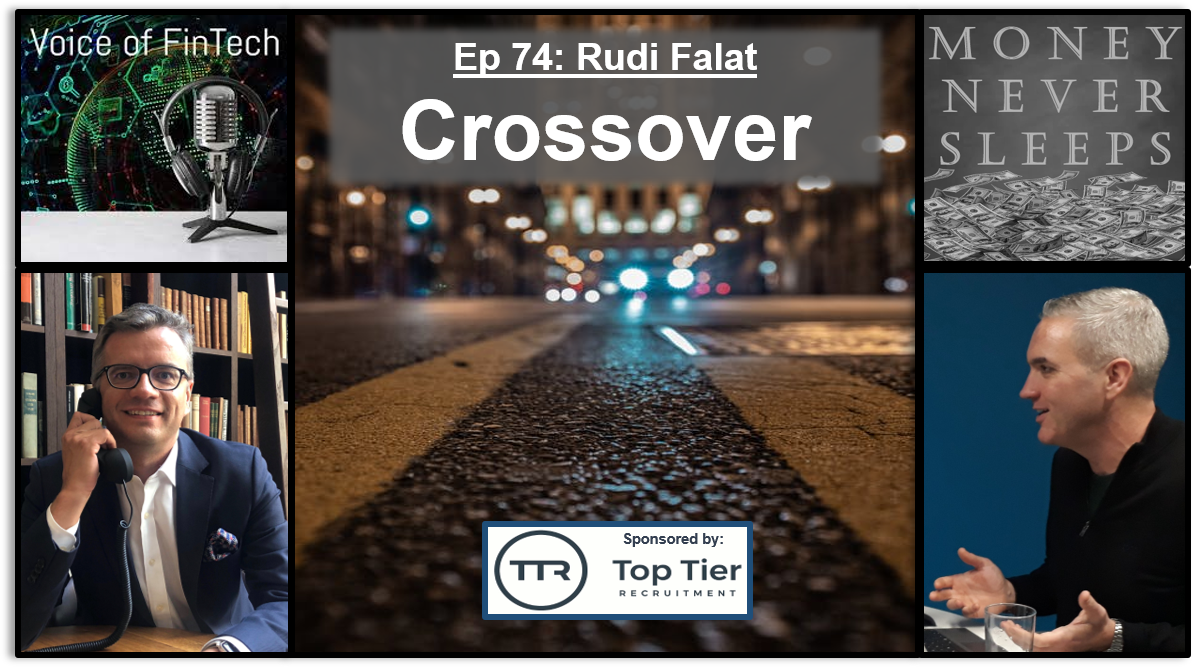
Rudi Falat from the Voice of Fintech podcast joins Pete Townsend to riff on crossing over from the corporate world into the startup ecosystem, learning by doing, startup and corporate collaboration....and flipping the table with the final question on every MoneyNeverSleeps episode!
This episode is kindly sponsored by Ireland’s fintech and financial services recruitment specialists, Top Tier Recruitment. If you would like an intro to the team at Top Tier Recruitment, please click here.
The Voice of Fintech is a podcast mapping out the Swiss and European fintech ecosystem, with the aim of inspiring entrepreneurs to launch their new ventures and connecting them with incubators, accelerators, investors and incumbents. Rudi runs the podcast from Zurich, Switzerland and has expanded beyond the spoken word with focused events connecting people across the fintech ecosystem in his neck of the woods. On this episode, Rudi and Pete cover the below topics, and if you'd like an intro to Rudi, please click here.
- Rudi's inspiration and his affinity for people who understand and believe in the imperative of growth, fueling innovation and relentless new product development.
- Teaching entrepreneurship versus learning by doing or from those who have done it before.
- Raising capital outside of your home market when you're from a small country but have a global ambition.
- The rational or irrational approach of dealflow sourcing by VCs.
- Corporates engaging in "open innovation" and what startups should look out for to reduce "innovation theater" to a minimum.
To listen to more, please visit https://www.moneyneversleeps.ie/ for all of our other episodes. Also, follow us on Twitter @MNSShow for updates and more information.
0:12 Hey there. Welcome to money, never sleeps podcast, it looks inside the head of entrepreneurs and it what makes them do what they do. I'm Pete Townsend your co-host. A money never sleeps. Along with Owen, Fitzgerald this episode of money. Never sleeps is kindly sponsored by Ireland's fintech and financial services recruitment specialist. Top-tier recruitment, if you are calling need help attracting and retaining great talent. Your fintech or financial services company. It is highly advisable that you build a relationship with a team of top tier recruitment. You could find them atop your Recruitment.com and tell him we sent you in this episode. I talk to Rudy Philip from the voice of fintech, a podcast mapping out the Swiss and European fin Tech, ecosystem, Rudy. And I met in 2013 while we're on opposite sides of the table for an m&a deal that we're working on. If we both moved on to other things, we're reconnected by another guy from the same deal team Benoit. Mercier just last year since then we've been engaging a lot more frequently and I'm really impressed. What he's built up around, his voice of fintech brand and the past year.
1:03 So let's get on with, Rudy for lat and our first podcast, crossover episode of money, never sleeps. Here we go again. Welcome to money, never sleeps. I'm Pete Townsend, we're on today with Rudy for lat Rudy and I go back a few years, he and I worked together on a deal. Way back when we were both in the corporate world, he's now got his own Podcast called voice of fintech and we'd like to welcome Rudy to the show. How you doing, really great to have you today. I'm great. Thank you very much. Peter, thank you for having me. Awesome. So, why don't we just dig right in and you get into your back story and tell us what you're up to? Yeah.
1:43 Yeah, absolutely. So first of all, I'm a finance guy, last few years, I worked in banking, post NBA, that's where we met. I worked in in-house and a team of credits views, and we sold you guys a business. I in Ireland, when you were at BNP Paribas, And before that, I worked in the in London, for do Chen HSBC but I started in New York in finance and consumer goods and then I switched over to Banking and now I looking into the startup World, The Innovation World, sometimes it's a crossover of the corporate world in the startup world, but we can talk about it a bit more.
2:23 Okay? And tell me why you started getting involved in the startup ecosystem. Um, I know we talked a little bit about this last year but would really like to understand your motivation for doing what you're doing, right? I mean it started with a bit of a self-reflection and also I try to read a lot and and I've been inspired by people who understand and believe in the imperative of growth and I believe that the growth comes from Innovation and from Relentless focus on new product in new product development. New services and improving. The way we do things around in the business and I started looking into this and I've been attracted to people who think things along those same lines and they know that sometimes it takes a while to bring the business to lie for a new product and they are patient and they're also can experiment.
3:24 They try to be creative. So I'm still looking for the right home on the right role in that ecosystem. System. But in general, I love to hang out with the founders at the courage to get going and start the business from their own and also the incumbents who are the Believers in what I just said, or the investors has got you and is there if you think about the last last year or so Rudy and some of the inspiration in terms of the reading that you've been doing anything really stand out as being an author book that made. I think, wow. Yeah, they're onto something. Well, I mean, in terms of growth, I think it's one of the books from dambisa moyo.
4:06 Where would where she talks about that? The growth is the imperative. If we don't grow, then the business cannot function, right? So but of course, if you're in a large corporate, sometimes you need to get stuff done today or this week and you don't think about the things that can bring fruit in next next few years or something like that. So that's one of the ideas here and in general, General. I mean, of course, they are different sort of different sort of motivational clusters or incentives that work for the corporates and the startups. And unfortunately, the professor Clayton, Christensen just passed away and they talked about it a lot when you could look at Kodak and you will see, oh my God, why didn't they go for digital? I take could F and they didn't, but Be honest at that time, it didn't really make sense for them, right? So but essentially that that led to their demise. So I'm attracted by thinking about those sort of problems and see how you can prevent that you could be an incumbent, and maybe you can be still agile and change things. Still Foster Innovation and Entrepreneurship. Also, within that sort of large framework, Or am I being naive? I don't know.
5:29 I'm still hope. No know you're onto something there. Rudy, I mean, you know my reflection really from leaving the corporate world and getting into the startup world's, I mean it's really night and day, right? And in the corporate world and some of that I nearly went to work for a few years ago, said Pete, you sure you want to leave the bank? Do you know that when you're working for a bank you can just go hide in the corner for two weeks. If you don't like the way things are going, you know? And I said no, no, I'm I'm ready for that, I'm ready for that. And then you know, I didn't I didn't take that job a few years ago and then when I left BNP Paribas a few years ago and the story I've been telling recently when people ask me why I laughed. I said listen I in 2014 I kind of woke up to the some of the technology that was going on around me and I felt like I was the manager of a Blockbuster Video Store you know and that there's going to be folks that will still want to go back and stock videos on the show.
6:26 This. But, you know, in the long run, everyone's getting need to be able to eventually go do something else right for the part of the business that I was in. But long story short, you know, that when it comes to the the startup world, my first real Lesson Learned was that the very first one. I went to go work for a sure hedge here in Dublin. The, we had this great agenda. for what I was going to do or the first month and then once you get into it and you see where things are you say, we'll listen, you know, the main objective here is fundraising because this is about survival, this is about getting to the next stage of funding and everything else that you think about, in terms of building an organizational chart for the next level, building, a culture building a stock ownership plan, all those types of things like listen, it's just about survival, a lot of these times, you know, and contrasting that to the To the corporate world.
7:28 Those corporates Will Survive, its inertia its momentum. And that's one of the things that yes, rest in peace, clay Christensen that he talked about as well, competing against inertia as well as his book competing against luck. But yeah, lots of lots of thoughts in there. Speaking of thoughts, what do you think about the Swiss and European fintech seen? What are you seeing happening there? Well, I mean, I, I'm a foreigner who was fortunate enough to being able to live in Switzerland for more than 10 years. So I obviously Joy it. I think it's a fantastic country as people know. And now it's winter or some people. People basically think about Switzerland and skiing or chocolate and the watches and things like that, but it's actually a huge startup scene as well and especially fintech scene.
8:14 And in particular that that's that's true for Zurich. You have lots of people coming out of the grade technical universities like e th in Zurich and epfl into sound. And the coming up with the great tag which is amazing. However, I don't really see them pairing up with the founders from Business Schools and that's where the incubators come in. So I've been mentoring and F10 which is also called home of fintech. And this is what the F10 does. You know, they fill in the vacuum in defense of Education, we can debate whether you can teach entrepreneurship or not, but I think there are certain things that you could learn as Founder that would improve your chance of survival whether that talks about, whether that relates to how you should pitch or 1 minute, 3 minute cetera. What should be in the deck?
9:08 How you should prototype, how you should test and things like this? This is sometimes something that I don't see in the. I don't see that as a skill, that people have developed in a business grow the either learned that in the incubator or just by doing. Or from advisors, or mentors and people like that. But the hard core Tech skills. Yes, they are being taught and developed in the Richard within those Tech clusters as I mentioned, in Korean or sound. So that something would I seen? And I've been mentoring enough Stan and I'm trying to help as well. Leverage my experience from a big corporate especially helping B2B syntax and that relates to basically saying also how to navigate that decision making at the big corporate And and also maybe share some knowledge about how just the packaging should look like right.
10:05 When you go to see big boss what should you focus on how you should play this? And thinks I'm with you, I'm with you that the interesting point you raised about teaching entrepreneurship. And you know, when I did my MBA back in the 90s, I took an entrepreneurship course, right? Did I learn entrepreneurship then of course I didn't write all your doing. As you're learning about these themes and these topics and doing a couple of projects. I think we did a project on creating an online tea time system in. Boston, right back in 1998, it was, it was novel to be doing something like that. Entrepreneurship to me is and, you know, we talked about this on a number of episodes of this podcast is that, you know, sometimes can you build a great incredible tech product?
10:49 Absolutely, but is that entrepreneurship know, that's, that's Tech. Can you build a great product. Yeah. But it is, can you sell it right? And can you build a team? Can you grow that team? Can you build a culture of people that just want to do an incredible job for you for the business? For the shareholders for customers, right? Those are much, much bigger questions than just entrepreneurship. And I think that what the Business Schools do is just give you some of the repetition with things like case studies. And just basically put a few Tools in your toolbox so that you can draw. Draw on these things and draw on these other experiences that you've heard from folks. But it's really entrepreneurship is just getting out there and doing it, right, right. And there's one thing related to it, which I didn't mention is ambition and I did speak to Jeff Rosen from y. Combinator about this on my podcast and he said, look ambition comes from within, right? And your good ideas can come from anywhere, but when I meet Founders, I tried to try to be a good coach. As, you know, I love 10 days.
11:55 I think the best coaches are the ones who are positive as well, so they try to stretch the players but they stay positive. So, the tech I think very often is great but sometimes people aren't not ambitious enough on the continent. You don't have that problem in the, you know, you don't write don't know. I mean, Ireland, you know, I'm still a student of this and I will forever be. But in Ireland, you see. Yeah, you can get it off the ground here, but in order to get to that building, Alien level valuation, you need to go to the UK to Europe, to Asia to the US, right? You see that same thing happening in Europe is that, you know, whether it be in, in Zurich or whether it be in lausanne where people are thinking. Well, I've got to get my product off the ground and get up to maybe series a level but then I got to go somewhere else. Do you see that?
12:48 Yes, I mean, I'm, I'm more aligned with the founders who say, look at Switzerland is our launch market. And of course we'll go to Rope, that will go to the world, right? So that's kind of my bloodstream or my kind of thinking or philosophy even though there are other people who say, well, there's nothing wrong with having an SME and having a higher chance of having a smaller business that can sustain you etcetera it. And that's, and yes, there's nothing wrong with that. But then when you go to business, angels will be seized. Let's be honest about it, right? So, I'm more in line with people who say, look, we have a tech it, The software. So why not to be ambitious, right?
13:28 So you need to go further then from Zurich, to dock, which is, you know, Germany Austria, Switzerland need to go further than that. And if you struggle because sometimes people say, well, there are not even funds here who can grow with me, stay around or something like this. Then again, you know, what is the problem to raise money elsewhere? Right. So I think just have to think big, especially when you developing a software. Or Tech business, why not? And learn from others, look at the examples. You know, there are some people who don't lack ambition and they are Week in Tech. Once you, if you have a strong Tech, I think the, the ambition should be an easy fix.
14:15 Yeah, yeah. Absolutely. I mean, they say that being a really successful entrepreneur takes half, determination and half delusion, right? So It's a learning experience all the way throughout you mentioned investors a couple seconds ago, Rudy and would like to hear your thoughts on that. What do you think that investors could be doing differently so that we get to see more unicorns in Europe? Well, a lot of the things I've heard we're also about sourcing right? And that the people want to only deal with with Founders that have been introduced to them by other people that they know and they trust and I understand that but I think also the investors should think more widely and spread their net more widely.
15:03 So I like the some of the founders who are also starting to think about the startup that we're example would be a software that. Does your long list for you? Ideally, it replaces. First round of analysis. If you are small funding, you don't have 10,000 Alloys to look at one thousand startups that you Like around the world you use that software and then yes, you find out whether you get a reference on the team on the company on the tech and you see if there is a warm introduction that you can use, but I think to limit yourself only to do business or invest in friends of friends. I think that's that's not the way to go, especially in Europe where we have lots of frictions in terms of Revenge. You know, preventing us from scaling up. So let's try to break those barriers down and compete with the US and China.
16:04 Because, you know, I think there's great ideas here, but we need to be a bit stronger around commercialization. Yeah, I'm with you. We talked last week on the episode that we did with a valued the vile. Oh Jordan off. I finally got his name right after after a few months of saying it wrong, he's from 7% Ventures there, an early-stage. Tech investor based in London and on your note on growth that is a critical part of what they do. They on their website, they quote, Paul Graham. The the famous investor who said a successful growth rate is 5 to 7% per week. The bastard doing 10% per week. If you can't hit that five to seven percent, you really not going to get too far as a start-up. So that's why they call it seven percent Ventures and they only invest in what they consider to be billion. Our opportunities.
16:56 But in that conversation, we were talking about the warm intro and I said, listen, it almost feels like the warm intro has become a bit of a cliche in the VC Community but there's a lot of truth to it and that it helps to somewhat D risk. The proposition or D risk this relationship, but if you take a look at what some of the other VCS are doing well, not even other VCS but some more creative approaches to this Rudy. I think it's signal fire. VC in Silicon Valley. They spend about 10 million a year on their own Tech platform that goes out and runs these algorithms and run the Run. Z, social media programs to find the startups, right?
17:39 And find the ones that might fit their thesis just based on an algorithm. I even heard about one that went so far as to say, we're going to do a personality type, screening on folks and Linkedin and find people that may end up becoming. Excellent Founders and invite them to an event. For those thinking about starting a business and out of the 100 people that they invited 75 came and maybe five startup businesses and you know I think out afford it for them, they invested. Right? So you know, people are taking new and interesting approaches here the VC business, you know, in terms of what I've seen of it over the last few years, it is, it's cumulative. People say it's not scalable, but yeah, it's cumulative, right? And that every single deal you do is just nother deal on top of another deal on top of another deal and that it is hard to make that as an individual partner.
18:31 Scalable, you can scale a VC business but the individual partner has trouble doing that. So you look for anything, you can get right in terms of saving you some time and those warm intros do you help? But in the longer term even perhaps in the medium-term, there's some more interesting technology plays coming to Market here that I think is really going to open up VC to a whole new approach which is going to be fun to see. Yeah I mean I don't want Sound, you know, to academic go anything but if you want to end up with some sort of a rational portfolio at the end, you also need to have a rational approach to sourcing and that may mean that you need to use some AI algorithms. That also obviously can have biases built into them but you can be careful about that. Then on top of that you would obviously have the analyst in your judgment but to just feel, you know, purely rely on referrals.
19:23 I think that's that. It may not lead the into the right direction, the end, you may get lucky. So you will never see it or you will not see it in the near term. But I like the some of the Innovative approaches that you mentioned where people also can leverage that to, they don't have to develop it in house for themselves. Some of the bigger funds, they just develop it for themselves and they have kind of an algorithm that they don't want to share. But there are others who could benefit from using that as a kind of standardized software Then of course, the knowledge and experience of the partners and the team would would be feeding into it. Absolutely.
20:04 And it just a flip it a bit. If you think about those things that are perhaps coming out of the corporate world right now, people talk a lot about open Innovation and I've been hearing that a lot lately. What's your opinion on that? What do you think? Well, I think it's, I think it's a necessity, right? I mean, these days, the people in corporates cannot rely on being able to Develop every single product or service themselves, they need to look outside. I like the people who respect the other people of time. So if they do speak to startups, I think it's great that, you know, they engage with them but also, they should be clear process and open honest.
20:45 Communication in terms of what the corporates are looking for what, the startup is looking for, what the milestones and definitions of success are so that the people know, I mean, you can have a situation where somebody just meets with the startups makes it makes the report out of it and entertain their bosses. And in the meantime, the startups are starving and hoping that it would make any some money out of this, right? So it's no problem if you don't do business with them but just tell them right? Or tell them what they should do differently and things like that. That's what I would say to the corporate. So on the other hand are from you know, on the side of The startups, I think in Europe, we see that startups are hoping or trying to do more of the partnership, partnership deals and partitioned, take a partnership approach. That's something, maybe in the US. Some of them, they you know, some of the founders, they have already some experience with they work in the corporate. They don't, I would really encourage them to get an advisor or Mentor who did and that they can save them a lot of time and prevent some miscommunication and then, the things can move slowly.
21:57 And lastly I think of course is when as it is with every corporate or individual, you need to see whether you're dealing with somebody that I call a Believer or not. So when you are startups, Ethan advocate for your project, for that particular corporation, that Advocate has to believe in you and I still have Cloud within an organization to push it to a resolution whether that's positive or negative. But, you know, so it's not a zombie project. So that's another thing I would I would say, Obviously open honest communication and by the people and the driven by the people who are actually capable of doing that and and they are, they are willing to do that. Then everything can work nicely and you know in terms of innovation theater, hopefully we can reduce it to the minimum. Yeah, I'm with you, I'm with you. You know, the I've been having some conversations around open Innovation recently with with a few corporates and the main message I give to them is you just need to be transparent and be respectful about what this really is about, right? Yeah.
23:06 Some of the time. It's just about branding, right to be able to A to all their corporate customers that we are doing something in the startup ecosystem, right? That, that can be one. Sometimes it's about giving your exact your Executives and your middle managers, an opportunity to go on a bit of a field day and go play in start-up land for a day or two. And then go back to their day job other times. It's about inspiring new and creative thought. And when you start getting to that level, where you're kind of expecting it startups that you're engaging with, To contribute at that level to your business. You got to give something back, right? So whether it's a paid pilot, whether it is leveraging their technology, as a true customer or perhaps making some well-founded introductions for them to other corporate buyers, that might be in your network.
23:58 That's where it's really got to start to go both ways but it's, you know, I think there's a place for it but it just needs to be transparent and clear as to what the Dar a both parties before you really spend too much time on it, right? Right. Cool. So when you're looking for the at the rest of this year, Rudy what do you think your plans are for the remainder of 2020 given that we're at, you know, beginning of February now. Well, I have a very strong Pipeline and fantastic guests in store for the podcast, but also I'm doing Live Events and I want to do more, the reason being is that, you know, it's great fun.
24:39 To to do the recorded in this but it's completely different experience. If you do it live and in front of people, I try to do it in a small group, where people actually ask questions. So, and the topics range from digitalization of the art business to AI in recruitment, or AI in financial services, things like that. And I do a bit of entertainment and hopefully in June, we'll do one year anniversary party for the voice of in Tech podcast. And other than that, I trying to graduate from being a mentor, to begin Advisory Board member in the startup and ideally an investor like yourself. Absolutely, absolutely.
25:21 That's it's, it's a journey that's different for everybody, right? And it's been 3 years for me, actually approaching three and a half years now and March it'll be three and a half, which is pretty crazy. But it's all about listening is probably the biggest lesson learned that I've had over the last Last three years that when you're in the corporate world, it's all about trying to get your point across when you are doing what we're doing, Rudy, you do really have to listen, right? Right. So, how was the last year for you, and what's in the store for, for you in this year and, or this the cape, or what's in the store for you? This this year, or this decade? Yeah, I 2019 was interesting.
26:02 It was my, you know, my third full year and Q4 was was excellent and I built The number of new relationships on the advisory side as well as on the non-executive director side. I'd like to try to contribute in one or the other of those two areas, it's hard to kind of do both but what I spent a good chunk of last year doing was helping a new Venture Capital Fund in Ireland to get off the ground. Did the full ten-year projections the portfolio? Instruction did the modeling the pitch deck, the legals with a lawyers, but then I think the fundraising appetite was less than anticipated. So I stepped away from that in August but going through that experience, really supercharge me to be able to hold my own as a venture partner within a within a VC. So focusing really on one specific plan right now in that area.
27:07 And I will be able to share more The future as those discussions move along but I have my own strong-willed ambition to participate in the upside of the companies that I have been helping and I'm shifting gears so that, yes, I will still be helping companies on an advisory basis but where I'm really going to see the upside is through direct investment towards them and as a venture partner, so that's for this year, right? And Probably going into next year as well and perhaps year after and it's each year each month. Each week that passes there's new Lessons Learned and feel like getting stronger and stronger doing this as each, you know, each day passes even. So it's just about determination staying on the path knowing what it is that your main target, your main ambition is and but allowing yourself to Veer a little bit left of center or right of Center in order to continue to have these interesting.
28:09 Of experiences that still form perhaps an alternate path towards your goal but perhaps not a very straightforward straightforward path. So, right fantastic. So what do you think, just to just to wrap up before we get to my last question, you know, what do you think in terms of, you know, business partners, right? The that you're targeting? You know, who would you like to hear from, right? So if you have fintech be to be That things that could use some help in sales strategies that or in fundraising or if you're an investor that focuses on B2B fintech in Europe.
28:51 Then I would love to hear from you. Also, if you have ideas on regarding the podcast that either the themes of the speakers as well. And for the Live Events, I've done them so far in surgery, but I think going forward, I also to do them in London or elsewhere in Europe. So you can email me at info at voice of fintech.com or you can check out the website voice of intake.com. And you will see a lot more of what we've referenced here. Whether that's the episodes of the events or other activities that I have and I'd love to hear from you. Thank you very much. Yeah that'd be great Rudy and I'd love to get you to Ireland here to Dublin and we could do a joint live event, right?
29:34 That would be pretty cool, because there's lots of opportunities to do that here in Ireland, and it's a hungry Market. That cunt asked the guide, I mean I would love to do that. I have seen that you're very active on the conference or speaker circuit as well. So I'd like to do more of that as well. So, in many ways you have been very inspirational and very positive and that's what you sometimes need. When you thinking about doing something new, you don't know how it's going to pan out. And as we talked about a broadcaster a year ago, you know, you sounded so positive about it. I thought you know I have to give it a try and And it's been a great journey since that. Yep, someone said to me, sometimes you just got to get out there and tell the story and see what sticks.
30:18 Right. So it's so awesome to see how far you've taken this Rudy. It's just fantastic from. From, in only one year to see how far you've gotten, which is great. And I've been following you a podcast and I know that you always ask the guests of a tough question. If not, you know, if not all of them are tough, right? And And that's why I'd like to ask. What is the one thing that people don't know about you that you'd like to share today? Well, I've shared so much about myself over the years and have been pretty transparent, but the one thing that I was thinking about that many people may not know, they want you to not be too surprised, but that I'm quite a spiritual person.
31:01 Never been very much of a religious person. But, you know, if you asked me what I believe in, I believe in the universe and I believe that there is a That we haven't discovered about how the universe works. And I think the next hundred years and unless, you know, someone plugs in a hyper drive into the Health Care system. I don't think I'll see the next hundred years, but hopefully see at least, you know, 40 of it that we're just going to see such a massive change in humankind and our awareness of the universe. And I think that You know, just the imagination of what that might be.
31:42 Just keeps me running, keeps me moving towards helping to create that future. So whatever it may be. But yeah, that's my, you know, my deep thought for the day and, you know, I didn't know about this. So I can concur that. This is a new piece of information, right? Absolutely, absolutely. And it's just, you know what, I think it's because one of the books I read recently Amadeus. Bye. Noah. You've all her Airy or you the other way around, but right now where he really gets into where humankind is going and it gets you thinking and it's like cheesy, right? It's such, you know, the way things have been unfolding of last 10 years around technology and just the human race. It's, you know, where this could end up is just completely fascinating.
32:32 Yep, but, you know, let's say positive right and the they should be Roaring Twenties in front of us and hopefully Ali will make the best out of it and make the world a better place then than it was at the end of last year. Absolutely, absolutely. Well just let's wrap up there then Rudy. Thanks so much for coming on the show. Really appreciate it. And let me just give a shout-out to all of the voice of fintech fans. And I know you've been building up that bass and will hopefully be able to either see you in Dublin, sometime soon, or get down your way to make a stop to her. Yeah. And thank you Peds and money, never sleeps, and we'll keep in touch Touch, thank you so much. That does it for this week folks and thanks to Rudy for opening up his mind.
33:22 To help us figure out why he does. What he does. Thanks and show notes for this episode or on money never sleeps dot IE so check us out online. Remember if you were colleague need help attracting retaining great talent for fintech or financial services company. It is highly advisable that you build a relationship. The team of top tier recruitment is a really know their stuff. You can find them at top-tier recruitment.com. Also, thanks to Conan Brophy from create sound for editing this podcast. As for me, I increase the odds of startup success getting touch to the Contact page on Nori adventures.com. If you could following on Twitter at Owens 09 finally till next time. Thanks for listening. See you Contact page on Nori adventures.com. If you could following on Twitter at Owens 09 finally till next time. Thanks for listening. See you
Host, Voice of Fintech
In 2020, Rudi Falat, host of the Voice of Fintech podcast, joined the show to talk about crossing over from the corporate world into Switzerland's fintech ecosystem and connecting founders with investors and incumbents.