Spotify

 Apple Podcasts

 Amazon Music

 Overcast

 Castro

 PocketCasts

 Castbox

 RadioPublic

 RSS Feed
135: Tipping Point | Oli Cavanagh, Charles Dowd and Strike
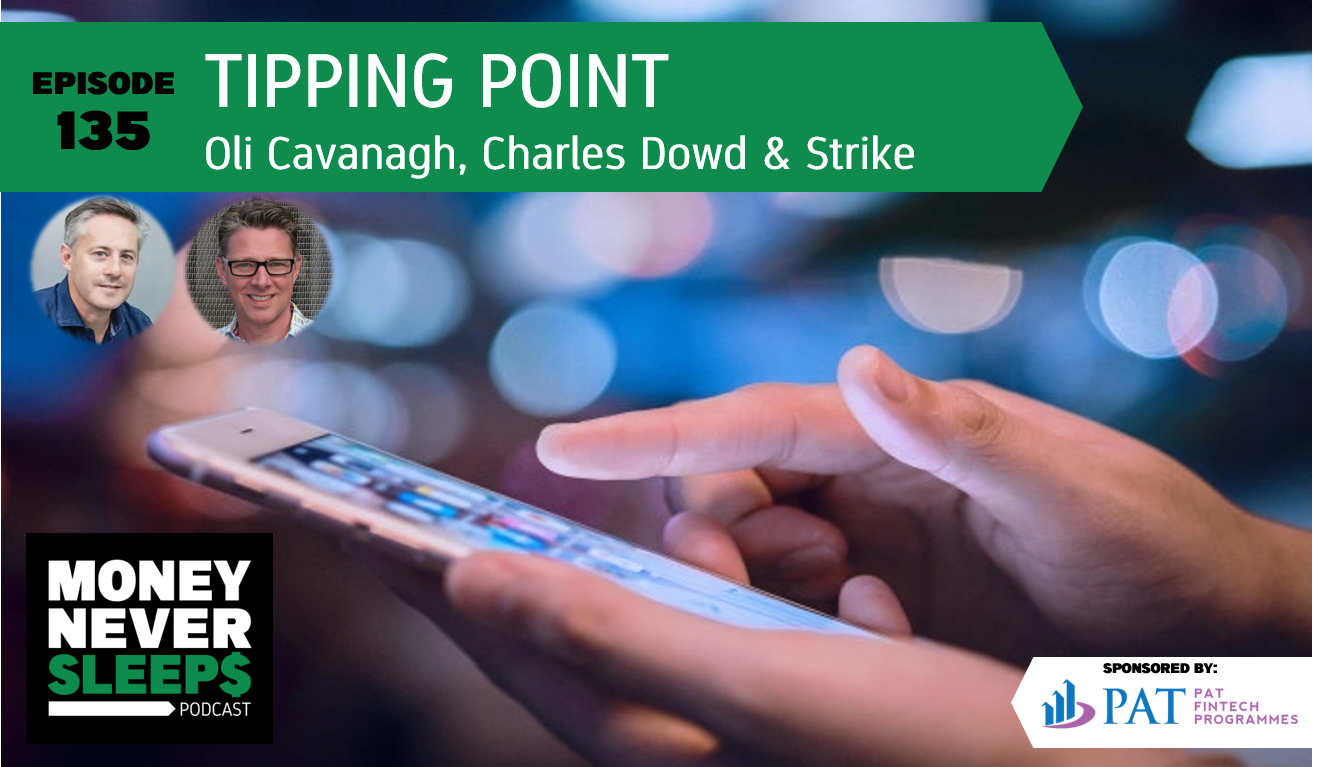
Oli Cavanagh and Charles Dowd, the co-founders of Strike, tell the story of the confluence of experiences and ideas that brought them together to launch Strike, getting a product live and raising an angel round in less than 3 months, the benefit of having done it before when you need to build a team swiftly, and the big road ahead for Strike.
MoneyNeverSleeps is sponsored by PAT Fintech, the training partner that demystifies fintech and digital finance for financial services professionals.
Strike is portable personal payment tech designed to make tipping, giving and paying convenient, safe and easy for all. Strike and its patent-pending technology has been successfully deployed in multiple verticals in Ireland and is expanding to a number of international markets.
HIGHLIGHTS:
Oli Cavanagh on moving fast: “I've been involved with a number of startups, but this one is really different to any of them. None of them have ever moved this quickly, and it's because we had the idea and within 24 hours Charles was building the product. We had an MVP very quickly and we were revenue-generating within three months.”
Charles Dowd on the problem-to-solve: “I've always been fascinated by the performance of cash, it’s a really interesting product. When you engage with someone and you hand them a ten-dollar bill or a five-euro note, it's a person-to-person transaction. It's instant transfer of 100% of the value and it's irreversible. That's really difficult to do on digital platforms.”
Charles on the confluence of technologies: “Technology hasn't really moved to where we needed it to be until very recently. We now have a ubiquity of mobile phones. NFC tech is available in almost all of them. QR codes are ubiquitous, especially in Asia. So now we've got this combination of technology on the doorstep when the pizza arrives that actually matches the problem that we're trying to solve.”
Charles on timing: “The pandemic has accelerated the density of the need, but it's actually a tipping point. This was a perfect combination of events that was ready to happen [and the pandemic just accelerated that].”
Oli on Strike’s first customers: “The first wave of launch customers we had were food delivery drivers. The first night they used Strike, each time they came back into the restaurant and had a chance to check their phone, they were saying, ‘wow, I just made ten euro,’ - it was amazing how quickly that happened.”
Charles on the market validation: “The first trial we ran was a really important and valuable first step. We went through that process and the outcome was product market fit. I was actually really surprised that we came out of the gate and built a product that made the delivery drivers feel that they were listened to.”
“This was the first time they had a product that was built just for them. Everything else in their world is built for somebody else. This is the only thing that was built just for them to solve a real problem that they had.”
Oli on A-B testing in the market: “What was quite successful was printing these oversized QR codes on big cards so that they could be scanned from two meters away, socially distanced. So, when the delivery drivers drop off the food, the end customer can be quite far away and can still scan it and tip them. We're continuing to try lots of different things - we keep the ones that work and throw out the ones that don’t.”
Oli on building the Strike team: “We were able to bring 13 people into Strike - six full-time and the rest part-time - normally it would take a long time to build up a team like that, and we did that in a few months, and they’re all fantastic.”
Charles on why it works: “One of the reasons why we're able to move at the speed that we're moving is actually not just our experience, but actually our experience with these people. Almost everybody on the team so far has actually worked with either Oli or me at some stage in the past on another venture.”
“The team have made all the difference and they’ve allowed us to move really quickly. There's nothing like being able to bring a group of people in that you gel with, you can work with and negotiate the difficult times. It looks all nice and cool and swimming on the outside, but inside it's hard work.”
Episode title inspired by The Tipping Point by the Roots.
LINKS:
Leave a review and subscribe on Podchaser| Apple Podcasts | Spotify| Google| Overcast
Check out our MoneyNeverSleeps website
Subscribe to our newsletter on Substack
Follow us on Twitter Podcast| Twitter Pete| Twitter Eoin
Get in touch at info@moneyneversleeps.ie
--- Support this podcast: https://anchor.fm/moneyneversleeps/support
0:06 Hey there, I'm Pete Townsend. And this is money, never sleeps. We look inside the minds of entrepreneurs, in at the crossover of startups and apprise Finance, technology, and Life. As We Know It, This episode of money. Never sleeps is sponsored by Pat fintech, the training partner, demystifies fintech, and digital Finance for financial services professionals. On the show this week. We've got Ali Cavanaugh. Hi, I'm Alec Havana, and I'm co-founder and CEO of strike. He and Charles Dowd. Hi. I'm Charles Dad. I'm co-founder and chief product officer at strike. Sharing their story on strike, which is portable personal payment, Tech designed to make tipping, giving and paying convenient safe and easy for all. In this chat. We get into the Confluence of experiences and ideas that brought all Ian. Charles together to launch strike. Getting a product live in raising an angel round in less than three months.
0:53 The benefit of having done it before. When you need to build a team swiftly, and the big road ahead for strike. All right, here. On money, never sleeps. We're rolling right into it. Ali. You fly any helicopters lately. Hey, no, not in a while. My license wouldn't be current but I do have a private pilot's license for helicopters for which so I got in San Diego in California when I was over there working for a start-up that I co-founded. Did, you know that was still in your LinkedIn profile? No. I was wondering how on Earth did you know that? It was all there. Dude. It's all there. How did that come about? And what I was living in London and I was getting the Tube home one night after a few drinks and office party and it wasn't that late, but I was reading a private eye Magazine and there was an ad quite simply just said, Learn to Fly helicopters and I always wanted to fly helicopters. And so it's kind of like 67 years old and I just thought, hey, I can actually probably do this now and I actually called the number and someone answered.
1:58 This is probably maybe eight or nine o'clock at night. And this lady said, yeah, we'd love to have you come along and Saturday at 10 a.m. And I went to Denim Airfield, which is just inside the M25 and and I started flying learning with this guy called Q Smith who at the time was the world helicopter aerobatic champion, and he took me up in a helicopter and try to freak me out and did crazy stuff and, you know, Loops barrel rolls stuff that you're not even technically supposed to be able to do and Robinson Helicopters, and it tried to fight me and when we landed he said you like I said, I loved it. He said okay. Yeah, you should do this and so I felt so I started that and ended up getting the private license. I planned going commercial at one point, but I then went down a different track which is Snow, I'm going to try and make some money and then just fly for fun. Yeah.
2:41 Wow, I think we should end the podcast right there to, you know, you can't get any better than barrel, roll in a helicopter. Right? Well, listen, Olli and Charles great to have you guys here, co-founders of strike. You guys are doing quite well, in Ireland, making lots of noise, and obviously want to see that noise continued to grow Ali as CEO Charles, as Chief product officer, but I got to imagine you guys. Were just kind of like, alright, who's going to take what role? I would say to you guys come together on this as co-founders, write and play. Play to your strengths. But let's let's get into that. Okay. So what I'd like you guys to do is both of you, just take your turns and share your back stories with us and how you got to this point of deciding to do this Ali, with your background with your computer science degrees, aventures mean encryption SAS and Mobile sales leadership roles, and then flender. And then now strike, right?
3:34 And then Charles with your mathematics degrees. I'm going to say the whole So I don't have to try to say at the Irish way, which I still can't do. May seem easy, but I'm not even going to try to say it. You're ten formative years. As I saw in software development R&D and product development for ventures as an advisor, co-founder / executive Facebook in the middle of the mobile. Boom, which must have been fantastic to be there at that point, then plank then clever cards as on a contract and now strike. Now, obviously, I just kind of fast-forwarded through that for both of you guys, but maybe just kind of hit on some of the high points as you're going. Your own stories and then we'll tease those out a bit more. Yeah, Ali do we want to start with you? Okay. Yes. So this is the ninth Tech startup.
4:14 I've been with six of which I co-founded the others were there kind of early stage. Some nice, really nice success stories changing worlds, which was a mobile personalization company, bright bill, which is a personalized Building Company are your success stories found in some of the ones that go find in myself or in mobile applications mobile technology, space, and then. Eating to the most of the last year have been fantastic. So I'm going to kind of recent to fintech and the last I guess, five years or so. And that's how I came across. Charles in the context circles him being a bit of a star of the payments tech industry course, you would meet him at events and things. So we knew each other, I think, for whatever, at least four, maybe five years before we decided to kind of hook up because we found in master problem that had an opportunity.
5:01 Just waiting to be done properly and we figured we could do it together and I was strike. Absolutely. Absolutely. I'm kind of reading a little bit more into the story already but Charles wanted to connect us to the story that Ali just shared. Yeah. Yeah. Yeah. So in my career, when you look at it, you know, and I'm LinkedIn it has lots of different things that I've done, but actually what you'll find a Common Thread is, I'm always searching for the next new thing. Yeah. I'm really interested in solving the unsolved problems that are right in front of us. That's my sweet spot of what's next. Yeah. I spent the first six years of my A professional career writing code for IBM, which was really, really interesting, IBM at half a million employees and it was a machine. But I learned a lot about seeing a large organization structures and what I wanted and what I didn't want at IBM, you know, everything was little micro contributions. So my contribution was, I wrote one page of the CUA 91 interface design guidelines, which I'm very proud of at the tender age of 21, and I got my first first taste of startups in 94, which is when I joined a CRM startup, which was the first time actually, that CRM was ever built. And that was really, really interesting. And ever since it's been startups, all the way, except for one little hiccup in the Middle, where I couldn't avoid the greatest start up the whole time, which was Facebook, which was joining Facebook 2010.
6:30 What a rocket ship did this like three mbas, you know, six engineering degrees and lots of fun. And two countries as well. So, working hard and then the US for Facebook, so it's pretty cool. So, the reason why Ali and I are connected together to is, this is a really cool problem. Right? And I have a particular set of skills, which can get us out the door pretty quickly. So, I'm able to take ideas problems and build them into really simple products, and get them out the door to get contested with customers really, really quickly, and then we build teams once we cookie cutter. That's it. That's how we. That's why we're working today. The last point is really interesting because, you know, I told you how many startups I've been involved with, but this one is really different to any of them.
7:15 None of them have ever move this quickly. And it's, it's because it was Charles just said, you know, we had the idea and within 24 hours, he was building the product and we had an MVP, very, very quickly. We're revenue-generating is within three months actually, which, you know, you both of, you know, and paid your nose is. Yeah. Yeah, just that's unheard of Yeah, and not notice Revenue, generating all the right. So we actually the only reason why we had to wait three months to be revenue-generating was because we actually, we knew we had something really new and we wanted to protect it. So we actually spent the first three months in stealth protecting the technology that we knew, we'd need to protect to actually enter the market. So yeah, otherwise, we might have gone little earlier. In fact, to revenue generation, actually the as well. We decided we want to Global protection. So, rather than the usual kind of finding here, we just went straight to the US.
8:11 So because that not only does give Global collection. There's also privacy, it's sealed, you know, for a period. So we wanted to use that time to really get traction and get a March out there before. Anyone would really kind of know, what we were up to and in, in that vein as well. We haven't done any PR or anything. Now, I know there's be actually putting things in the news about us recently, but that's our clients. Actually, her to impress. We haven't done anything. We don't know marketing or PR. We're still trying to get traction quietly under the Yeah, where did the idea come from? Like I know obviously you guys know each other good while but where did the concept for us? How did that conversation even cope for my side a year and three weeks ago, you know, and proper lockdown happened. I just stopped caring cash.
8:52 I actually kind of didn't like her and Kasia. What? I didn't. I almost kind of move that way anyway, but I literally stopped overnight, bang. No cash, even stop tearing. My cars. No debit cards, credit cards. I didn't even stop tearing. My driver's license actually and just went about with my phone and everything. I Apple pay everything set up. Up on my phone and I just thought this brilliant, you know, the world finally is kind of caught up on Sweden. I think this is the only country was really kind of their thereabouts with the cashless. So we were probably at least 10 to 12 years away from research, to the cashless society. And I thought this was great initially, but really, really quickly really quickly within another week. I'd say, after that, I realized actually there's been a bunch of occasions where I wanted to give someone money and I couldn't. And I thought that's kind of interesting like, how many people have gone?
9:36 Totally clashes? Me and I kind of looked around and ask around talk to everyone unconscious and then I started talking to people who worked in Industry. So I spoke to the kind of the delivery driver lunchtime and you know, you have tips in here. No, no. The just eat River on a Friday night that we would normally get. You know, I'm really sorry. I can tip you, you know, and you know like it's okay, you know, no one's tipping her. And there were loads of occasions like this and I kind of sat down and listened to whole bunch of them. And there was also a car that was known to deliver points to your home or to wherever you were and it was the same thing there. You know, they were really working. These are people are kind of working hard for you know for a reward which everyone was giving them up until just over a year ago and that reward went to 0. So become a huge problem for Action free parties as we discovered one is, you know, all of us because we actually want to reward people and thank people in typical. So it's actually a problem for us because we feel embarrassed. And then the second thing course, in its we're helping the people who relied on that portion of their income or thirdly were really helping business owners because Employees income and morale have plummeted during covid. And there was very little they could do about it without digging deeper into their pockets, maybe and actually increase in salary.
10:45 So it was a huge pain point for a lot of business owners. So we fixed all three of these things and I was trying to actually in tell us about the product, tell us what is Strike. So what people back to kind of those, some of those examples I was giving. So I was thinking in my head, there's gotta be some way. Something that these guys can carry the committee trigger a payment. That's secure as your average. Payment terminal or card machine that you would see in any shop or store. We reckon probably the 60 million people affected by this, just an English-speaking countries loan. Those 60 million, people aren't going to go out and buy card machines and, you know, walk around with clunky card machines plugged in that are expensive, but I thought there's got to be something that we can use to trigger a payment.
11:26 That's just as secure in the one device that everyone already has on them, which their phone, which actually has internet connection. It has lots of security built into it. It's got Apple. Pay is got Google pay, it's got Side, he's got Touch ID is good. Lots of security. In fact, it's more secure than using card a credit card or a debit card and but no one had really kind of made it simple enough and low-cost enough that it could be something that could trigger that events. Like a little people's hard work, could be produced by the tens of Millions for all those people I'm talking about. So I thought could we use, you know, some kind of RFID NFC technology and that's when I actually reached out to Charles. So I thought, who is the leading payments Tech expert, you know, that I know anyway, you know, maybe in Ireland, but maybe, maybe not But certainly in my circles and I asked him, you know, is there something that could be done that actually we could ship out to 60 million people and all of a sudden anyone can just tap them and give them that secure payment and we found a way and not only to find a way.
12:21 We find something that was a you know, Charles said I think this is actually patentable. So let's keep it on the Raiders at. Build it. I'm gonna quit my job and join it. And that's what we did. We quit our jobs within three months were revenue-generating. All right? No Charles can see. I'm all these background encryption. Mobile obviously, those are some key components. You've got your payments Tech background or you already thinking about this before Ali reached out to you. Was there something kind of in the background that might have been on the Shelf, waiting for a moment or was this kind of? Hey, I'm just going to figure this out the reality. So I've always been fascinated by the performance of cash. I actually think that cash is a really interesting product and that digital Solutions have never quite matched. What cash can do?
13:07 Do cash is really interesting. It's when you engage with someone, you hand them a ten dollar bill or a 5 Euro note. It's it's a person-to-person transaction. It's instant transfer of 100 percent of the value and it's irreversible and it's quite interesting because actually that's really difficult to do on digital platforms. And I've tried a number of times with the number of startups to actually really try and fix that problem. And so this is always been an underlying, I guess and a number of things that I've done in my past and to be honest, the technology hasn't really moved where it needs to be until very, very recently. Yeah.
13:48 So now we have ubiquity of mobile phones. NFC is available in almost all of them cure codes or ubiquitous specially in Asia. So now we've got this culmination of sort of a technology on the doorstep when the pizza arrives that actually matches the I'm that we're trying to solve so this, so it was there. Something on the Shelf ready to go. No, but this is like for me it's been a Fascination since about 2004. When I actually I was building a remittance solution from New Jersey to hazy for a microfinance organization called funko's a and that no mobile phones, no proper internet. The idea that you could actually move money, through countenance was was just you know bizarre.
14:37 Right? And now here we are with a super, super cool, simple solution, that allows to people who don't know each other to meet for the first time and have a really simple digital exchange that replicates that cash exchange of instant irreversible and 100 percent of the value. That's actually really cool. Yeah. I'm kind of thinking Charles you kind of like the Mark Cuban with broadcast.com, right? 1995 96 whatever, it was the idea for Netflix to ten years too early, right? And he wanted to solve that problem, and you tried to solve the problem with dial-up internet and it builds some pretty cool Tech but it really wasn't going to be able to perform because not everybody was yet.
15:19 Had the technology at their disposal to make use of it. Only a few people did, right? And then he sold it to Yahoo or something like that. For a mint made some good money off of it. And then, you know, went bought the Dallas Mavericks or whatever, but, you know, it if that, that kind of impetus was there the whole time. To do it and then it just took the rest of the world to catch up to you, right? That's pretty cool. I like that. Yeah, and so was the pandemic has accelerated, this need the it's actually accelerated the density of the need. Let's say and I think what it's done though is it's actually a Tipping Point. It's this is not a pandemic product. This is actually just happens that it's a perfect combination of events that actually was ready to happen.
16:04 And now everyone has embraced right? So if that happens sometimes, If something happens and you know, we always think about change happens in this sort of smooth curve. It doesn't it tends to happen in these step changes. It's like steps on the stairs. What was you know? Novelty yesterday is a necessity today. Yeah, and I think that's kind of product. We built absolutely. The first wave of launch customers. We had were delivery drivers. And so, we started off with like a bunch of food delivery places, and we're rolling out now to about 700. Three drivers and but over the first wave, they the first night they used it and they were coming back into the restaurant or into the takeaway coming back. In this time.
16:48 We're going back was looking for sending a chance to check their phone. And they will be saying, wow, this money. They're like, I just just made tenure. And for those last two deliveries and in the coming back in and then we can look in the phone and it was amazing. You know how quickly that happened and then we are on board another place last week and the time from him actually being on board at his first Tip was less than five minutes because he came in, he got a strike, like, he went out of his way. We chose was actually there because we were kind of just observing as well. We don't need to be there, where people can hurt themselves. He was I, but he was on board. He was gone and his deliver. It is. First delivery, actually tipped him like five year and it was within five minutes of him. Having, the product isn't like, it's mind-boggling C. Then the stickiness, of course, is, you know, you can understand the stickiness of that and, you know, sort of product Market fit is all about time to Value.
17:35 Right? So like I tried a I get the return, I get the, get the dopamine. I get it. I started go back and then call it. The magic of can't the delivery guys because it's like, wow, I just go out. I deliver things and we discovered really interesting things, like really surprising things, like we thought. Oh, yeah, it'd be like it's on the doorstep. That's when it would happen. But on the doorstep is where the, the idea is introduced, but actually, we're finding that there's sort of a tip Now situation, but the Bellator is actually really interesting. So we give we've developed a solution that allows them to also receive a tip later. And it happens after they've actually eaten or even what actually happens. A lot is the next morning, you know, someone's getting up and they're actually going.
18:22 Oh, I really enjoyed that. I'm going to go tip that guy who brought that food to me last night. Okay, and that that's that's really fun. So surprising to us to actually see these that this product appear from customer usage, you know, it's pretty impossible. It's such a wonderful feeling when it happens. Right? You see your product being used and completely unusual ways, unexpected ways. I guess. Do you have that little flux capacitor that goes up like they do in curve when you go back in time. Of course, I do. You guys know what I'm talking about with a product curve. No. Yeah. It's a it's kind of an umbrella card that sits on top of all your other cards and they've got this feature. That if you direct a paint you use your curve card either, you know, Tom yet heard. Yeah.
19:05 Yeah. Yeah, and then he directed to your And 26. No, actually, I meant to use my revolute for that right. You can go back in time and switch it from your end, 26 charged to your revolute, debiting your Revenue card. And when you do that step on the curve app, on your phone, this little flux capacitor from Back to the Future pops up on your phone and it's showing you going back in time, right? Yeah. I love the curve product. It's a process. It's very, it's, it's very cool. It's a, it's entually, you know? Removing. Your wallet and turning it into one card. You know what, we find that people aren't even carrying one card anymore like a caring, none, you know, they just carry the phone with them.
19:47 That's the only thing they always have. Even when they come to the door, to pick the pizza. They still have the phone in their hand. That yeah, it's quite fascinating. This episode of money never sleeps and sponsored by Pat fintech demystifying fintech and digital Finance for financial services professionals. Pat fintech enable Financial Services professionals to transform their capabilities into the digital age with dedicated virtual training programs, geared towards those that can develop deliver and monitor optimally customized user experiences, balance by appropriate, governance, control and oversight. To learn more about Pat fintech. Go to money, never sleeps. That IE /. P80 fintech.
20:36 Presumably then, and I'm thinking because I may have used this example at some point in time in the last few months, but it makes me think of square and their initial rollout and the adoption of that. And what that did for small to medium businesses to cut, how transformative that was. Is that kind of where you see as you know, especially you compared it to the payment terminal, you know, people aren't going to plug in a Terminal and drive around with it, but I suppose you've effectively created a payment terminal on the phone then actually what we're doing now on is kind of interesting. We're turning any surface into a payment terminal and so we're actually rolling out and probably by the end of the summer, we'll have close to 8,000 payment Terminals and in Ireland.
21:17 And a lot of those are things that you wouldn't expect their protective screens in shops, protective screens and taxis wearable devices, fundraising boxes for Charities, like all sorts things that live See we can turn anything. We can retrofit anything into a secure payment terminal. And so that's really interesting. And that's not something that the likes of, you know, Square as you mentioned is doing but but they did start off quite simple and I think that becomes a bit more complex and companies like them aren't really addressing this Market that were and what they brought out their first dongle. It was transformative for those businesses that wouldn't have had to payment terminal of all of a sudden. They had this Simple Solution. That's transformed how they're able to accept payments. It seems like you're on onto the same kind of thing. I mean, terms it up.
22:00 Transformative piece. Yeah, you have to in my mind. I always like visualize transformation or innovation as like a rubber band, right, you know, you pull it and then eventually it snaps, right? And then that's actually when the, when the, when the change happens, right? It's like, oh, yeah, we stretch it piece of technology as far as we go. And then it snaps, right? And what happened with square in the beginning was fantastic, right? It was like, oh, let's just plug this little tiny dongle into the headphone jack on my phone. Don't have those anymore, right? Right. And you can then swipe the card through the phone jack. That's because the content or the mag stripe is actually just some text. That's typed into the phone. You know, when you swipe your card at the point of sale.
22:41 It's actually that's a keyboard interface is literally typing, the numbers off the mag stripe. So it's a that's those to hack, right? But what I did was that led squared to move really quickly. Super simple. Dongle off you go. But actually payments has it become super mobile have actually become More and more and more complex to actually execute. And what happened was, all that functionality was being put into this dumb piece of plastic, which they then had to try and make smart. But there was a change that happened a few years ago, right? With the adoption of Apple pay and Google pay where the device that was being used to pay. The payment instrument was now super smart, but all the payment infrastructure wasn't changed to match this smartness of the tender type. Yeah, so that meant do now it is super A complex system where you actually need to mobile phones and a connected device to actually make a transaction.
23:35 If you're a small emergent, that's like what three thousand dollars worth of equipment just to make wooden one payment transaction. And so, what we've done is essentially broken that rubber band, right? That to say actually, let's bring it back to where it's really simple again. And now all the smart is actually in the phone that essentially is tapping. It's super dumb terminal and it sort of turned everything backwards, but actually that's the Innovation. That's let us actually create this really this terminal from anywhere people. Places objects can turn into payment terminals. Yeah. So it's pretty pretty pretty interesting. It is and the fact that you've got patent-pending here is it was a pretty big deal, right? And but thinking about the market, right? And thinking about yes, Ali like you said, 60 million people out there who have some sort of dependency on the ability to be tipped, right?
24:26 And what you're thinking about? Out. Well, what's the total amount right on an annual basis? What does that amount to in dollar terms? And then how are you guys going to make money off of that? Right? And obviously anything in the payment space generally tends to be done as a transaction fee. But how are you guys doing this? How did you think about the market in size the market? And then come up with business models? That you guys can make money off? This is so we did research and kind of the size that market just in the English-speaking countries and kind of hide have been cultures initially just Get some kind of idea of what the target market was. And that number that that you just said correlates with just over 40 billion dollars, annually in top-line volume of tips. And there's three ways that we can make money from that and we kind of mix and match depending on, you know, the environment. But we have what we call strike tags. They can be smart stickers.
25:19 They can be smart wearables and smart, whatever with the tech inside. And we sell those upfront. We also have a model where it's at. A rental model wearing for a low monthly fee. You have the product. And then, of course, we have transactional fee, as well. As you said, which, you know, obviously fairly standard. So we on the, on the transactional side, we've had some really interesting stats. Actually, we made the fees optional so the person tipping or giving in the case with some of our Target customers, and we're working with the three largest charges in the country. And so we made that transaction fee optional, and if it's a tipping environment, Over 90% of people will just accept the tips because if they giving, you know five or ten books to the, the person they want them to get the full amount in over 90%.
26:09 They occasions where it's a charity giving to it's over, 98% are accepting the phase. So it becomes almost free to the recipient in that sense. Okay. I'm with you and and when you, you know, you guys pulled together, a nice six hundred twenty-five thousand Euro precede round and you No, at that stage with the folks you were raising that from and I know Enterprise Ireland were part of that bag right? That you know, talking about the market, in the size of the market, how important was that to your investors and thinking about? Wow, this could actually take off and say, you know, professional investors. When they look at something like this. They have to know that there's a large enough addressable Market from a revenue point of view to generate at least a billion dollar Revenue business.
26:53 We operate like like a B2B SAS company. So it's very partner driven. Go to markets, very cheap for us. But we actually look like b2c company. Right? So we actually have the ability to have sort of winner-takes-all b2c type outcome. So we think that, you know, that the winner in this market will take about 30 percent of the market. And for us, that, you know, that's just in the English-speaking Works. Looking at that a multibillion-dollar market. Yeah, and that's just for tipping. That's not counting. The fact that there's a direct pass crossover into Into small Merchants payments micropayments which not many people have been able to solve at scale economically and we're already proving that we can do that.
27:37 So, I did those two things together, you know, make this really attractive business for invested. So we look at the initial Angel round, that we just did what they're really looking at is, who are the founders, do they have ambition? Do they have the right ability to execute? And that's what they're looking at. Yeah, and they say, is there a big Market here? Probably? The but you know do we need to do a giant Tom analysis or something to do that? No, right. It's like, are you the right guys to do this? And are you getting some traction? Yes, you are great. We'd like to back you and make sure that it really can be successful. And that's, that's what this is about, giving yourself the runway to make mistakes to build the product.
28:18 So you can be successful. And in more than one occasion, actually, people that we'd approach for partnership. Were strategically, not even looking for money, because Charles not a cell phone in ourselves that stage. So, but A couple of people that we approached, because they were potential route to Market or a channel for us, turned it around and us at us and said, you know, is there an opportunity to invest? And because they saw that, this is kind of a no-brainer and there are investors in the company cool. Yeah, it's a good way to do it. And I think it's good point. That you mentioned just are Charles, is that when it is early stage like, you guys, are that the types of investors that you're bringing in, aren't the ones that need you guys to return a four billion dollar fund for them? You know, so they're not looking for the, like you said, Tam the hell out of this thing for me, please. Right.
29:05 They're not, they're not looking for that. So that's it. That's a really good point. You guys must be already pretty deep into thinking about your next round, which I know or at least. The Press reported. You guys were talking about raising over 6 million for the next round. Have you guys kicked that off yet? Yes, so we started on that and that was leaked early by the way, but still it actually worked at beneficial because we had a number of we actually had an influx of Eople interested is we already had six names left over from the first round who in the ancient world who didn't make it in. So then along with a number of institutional parties know that we're talking to we have identified. What we're going to do is a two-step. So off the six-and-a-half, we're doing one and a half an hour and towards our series a so, it's looking good.
29:47 Yeah, we're moving on that quite quickly. We hope to close that, you know, before queue for this year. Okay? In the vein of what was wanting to do, new fun, Innovative things. So we're Are raising against his safe, which is a simple agreement for future equity, which is really nice, really nice structure developed by y combinator. They're very few of them done this side of the pond and we think that it really gives investors a really simple way to get in and gives us the ability to essentially roll close towards our series a, but with enough cash to actually maximize devaluation of the series. I happened. Absolutely, but it's a big amount to go.
30:28 Go for but it's not in the grand scheme of things with the amount of capital that's available out there right now the world right and just the printing money that's going on and that printing money is not actually printing cash money, right? Obviously as you guys have stumbled upon thinking about going live with your first customer Camille tie, you already mentioned Charles that getting some of that early user feedback that is soon as we kind of give you the device or give you the sticker or give you the ability to accept a tip seeing At immediate boom, there goes five bucks into my account. Any user feedback that came through in the early days. It said, well, we got to change this right away. We did this won't work. We're did anything like that?
31:09 Come up, you know, so one of the things that we did was take ourselves out of that Loop. So we actually, we actually employed a independent, third party to run independent trials that I will admit that Ali and I did try to put it in influence. In the process because we wanted to, we thought we wanted influence the outcome, but they push back on us. And so we had no influence over the actual trial itself, except to deliver the best product we could into that actual trial and ran over a four-week period to staggered weekends with interviews of business owners, the recipients and the tippers themselves with video recordings, and transcripts and narratives and we collected, you know, just Manse of actual data because it's your first interaction with customers is not something to be squandered. It's a really, really, really important valuable step. And so, we went through that process and the outcome was product Market fit.
32:12 That was, I was actually really surprising that. Literally, we came out of the gate, we built a product that made the delivery drivers feel that they were listen to. This was the first time they had a product that was built just for them. Everything else in their world is built for Or somebody else. This is the only thing that was built just for them to solve a real problem that they had. And the end of customer felt that we had built a product, just for them because they wanted a way to show appreciation. To these people who are like, working really hard in the middle of this pandemic and delivering their food and they didn't have a way to reward them and now they did and like some of the videos are like, they're actually emotional. You actually feel wow. Here's someone who's they just feel that this is fantastic and great? And then, you know, as they come out of the gate? You're finding That as we bring on new locations, that this pent-up demand for tipping.
33:04 And so someone will bring a delivery to a place where they've come a number of times and they'll give him a 10 euro tip the first time because they missed in the last few times. We didn't have any cash. And so we're solving quite emotional problems in a relationship problems. You know, I think that that makes it even more rewarding. So we actually were really surprised to find product Market fit out of the gate. But to answer your original question, whether things that we did that we had to remove. Yes, you know. This is what they were doing, was collecting a message during the tip process, which, you know, sounds like a really great idea. But sometimes we would type the amount in there and some people, you know, weren't really sure what to do with it or they would push the play button down. But yeah, we have responded pretty quickly too, you know, the instant feedback and actually made it happens. Nothing like getting product into customers hands really quickly.
33:51 That's that does it? Yeah, and don't be afraid of it. Don't be afraid of putting it in the customers hands because, you know, be surprised they know what they want. Yeah, they make your product better and we tried lots of different form factors. We're still trying lots of different ones because what we're doing is so new, you know, no one's really done it before. We're not entirely sure. What work what wouldn't I mean rewind a year ago. Actually we were wondering it's just over a year ago at the end of the first lock. Turn my wife and I decided gotta get out of town. So we went down to the west of Ireland to the dunraven Arms Hotel, you know, it's a nice hotel down. The West were allowed to travel outside our County finally. We were staying in this. You know, It's a Lovely Hotel, two stories.
34:33 No left, right? No elevator. And so we had bags are also in arcades. And the guy, you know, the bellhop Qaeda bags up to the second floor and we couldn't tip the guy and then it was the same thing. When we were checking out. I was like, well, I still didn't know opportunity to get cash, couldn't tip the guy. So I said to him, you know, if because he was wearing like a little lapel pin a badge, you know, you often see in the uniforms that they were. I said, you know, if that was actually top of it or some collect happen and give you Two, three, or five years, or something. Would you wearing see that? Absolutely, so that was about, maybe that's a form factor and then spoke to Charles. We thought maybe wristbands made, people were wristbands that, you know, people can top or maybe they were just leave a card, maybe housekeeping actually, just leave a card with a QR code that they could scan, in the case of the delivery drivers, that the research project are just talking about. We had key fobs, you know, that, like little kid, keychains thing.
35:22 We had ID cards that were kind of on extenders that they could reach out, but we also did, actually what was quite successful. Lynott was reprinted oversized QR codes on those cards so that they could be scanned from two meters away. So she distant. So the delivery drivers dropping off the food, the person can be quite far away and still scan it and tip them. So we tried lots of different things. We're continuing to try lots and lots of different things and obviously keeping ones that work and throwing out the ones that didn't that pretty good. Yeah. Big big experiment in A/B Testing. Absolutely tell me thinking about growing this right I saw in one of the articles that demand For you know, 50 million tags that you probably could ship.
36:02 You know, there is the demand their right and balancing that with the early stage, love and attention that you need to give to your first Partners, right? That are getting this into users hands. How do you balance those two? Those demands of? Wow, this thing we're getting so much interest in this but we have to do this at the right pace. We have to give this love to our first. Customers were still a small business, you know operating with just a few people. How do you That patient urgency collaboration. Yeah, it ends up being like products, take, take a little bit of time to go through a couple of Loops so that you actually understand what the outcome is and what should actually be delivering. So in the same way, as you know loads of people have gone to early into markets and found that there were two earlier technology or whatever and you know, I've invested too early and failed, but we're trying to do Is really find a small number of engagements that we can replicate and make sure that they work.
37:05 Yeah, and we've done that over the last six months. That's that's really been. Our focus is find. The number of instances of use cases, validate those use cases. And now we actually put teams behind each one of those and say, that's a whole business line. That's a whole business line. That's a whole business plan and go after it really really quickly. Gotcha. Ya benefit of experience from I think done this guy's and been in so many startups and seeing what works and what doesn't it's awesome to be in that position in terms of that those experiences, right? You know, what would you guys say? Each of you would be kind of top Lessons Learned From Your Past, entrepreneurial Ventures that have enabled.
37:46 You to think about strike in the way that you are thinking about this in the way that you're executing on it. My top one, which is really relevant in our because so many people are investors and customers. And that are trying to pull us in all sorts of directions and go and do lots of different things that we could do. As my top one is, do one thing I'm doing really, really well. So we're focusing on one platform that's been used for a couple different things, but it's essentially the same thing and it's just really, really effective. Simple, importable payments, person-to-person payments, and just do that one thing, and not get spread out too thin, and it's a constant struggle just to keep following those things down, and just keep those blinders on. When, you know, you got something good.
38:27 You gotta just keep pursuing it. What about you Charles? Yes, one of the reasons why we're able to move at a speed that we're moving is actually not just our experience, but actually our experience with other people. So almost everybody on the team. So far has actually worked with either Ali. And I are only or I essentially at some stage in the past on another venture, not all of them Successful, by the way, not, you know, not with people who work with us in the past and understand that, we Care about people, who are really passionate about driving product. We're really passionate about going to Market and rewarding people. And so we've actually had a great team of people around us that have reinvested their commitment in us, right?
39:13 Saying, we trust you guys to actually deliver for us and they have made all the difference. They've allowed us to move really quickly. There's nothing like being able to bring a group of people in that you can, you know, you gel with you know, you Work with, you know, how to actually negotiate the really difficult times and it's really difficult. You know, it looks all nice and cool and swimming on the outside. But inside it's hard, hard work, you know, and that's the the other learning that I've had from lots of years of experience of doing this is that, you know, you need a huge amount of resilience. Yeah. You need to be resilient to all the nodes. You need to be resilient to all of the failures and they need to be resilient to the challenge.
39:58 Ages of like the fact that you know, it's we're doing this is 10 p.m. Right and we probably have another few hours of work to do before we start tomorrow. What do we do it all over again, you know, and it says not for, it's not for the faint-hearted. Yeah. I know. I know it's only seven hours till 5 a.m., You know what you're saying? It's one of the things that I was almost not surprised that obviously you have an own body over a few years now, but you know really well really Fries in a positive way to see the amount of people that have kind of come back to to work on strike and to be involved in us that you all would have been involved in the past. Like it says a lot. Obviously about the worst you guys do, and the relationship that you have there and it's very impressive to see.
40:42 And again, what I'd like to us at the stage that you're a shit to people that you've been in the trenches with before. They know what to expect. You know, nobody's going to be surprised at the challenges and how difficult it's going to be, but it's people that can rely on each other haven't, had that experience before and it's hugely it like it says, it's a statement told you that he didn't. More people because obviously I know some of the ins and outs of it but that have come back to kind of get involved again. It's great to see ya, we're delighted and it's amazing and that's a big factor in how we've been able to move so quickly because we're able to sew it, you know, hiring normally takes a long time. We were able to bring in, like there's 13 people now involved in strike, six full-time, and the rest and part-time and normally it would take a long time to build up a team like that.
41:25 You know, we've done that. How many months has it? Not that long at all and they're all fantastic. So we're delighted and I achieve growth officer and most recent hire. We haven't worked with in the past. But interestingly we had actually reached out to her in her role at Josie because we see them as a real channel for us that that is our sweet spot for customers. And we had a really great interaction in that process and then, you know, she was looking at had another role and it made sense to her. Even after that short interaction with us, and our interaction with her. So, even in that way, you know, Adele is, is, is kind of not even entirely new to the team, right? So she's had some experience of working with Ali and I before she came in the door.
42:12 And so she's here with us. This is her week 3. And it's, you know, and I hope that we're delivering on the autonomy and accountability and, you know, and the freedom that we said that we would give her in order to grow this business. Yeah. Yeah. Two big higher. It's a big higher when I saw that and immediately, you know, that just eat history. Just made so much sense that it's not. Just, just eat, you know, it's ubereats. It's all the other players out there in the market where she has a pretty good idea around the business model, right? So there's a lot there. That's what I was saying earlier about our business model. Our go-to-market business model is very much focused on on that sort of. It's a B2B style go to market for a b2c style product, from an end user point of view. So We have this, like we get the best of both worlds. We get to build a great consumer, Focus product, but actually bring it to Market like you would a B2B product. So it really changes the acceleration for us. We can we take chunks of thousands at a time rather than one at a time, but we still deliver a product to one person at a time.
43:18 So it's great for me from a product development point of view and from a business development point of view for the larger groups as well. You know, people there 0 integration effort required. We don't need to Need to, you know, there a pause or into their app or anything like that, you know, we can sit alongside so we can deploy extremely quickly. And in fact, they're using their employees. Don't even need a nap. So we've managed to do this with no apricot iron at all. I know integration effort, so, that's, that's helping us run. Quickly. Yeah. I bet I kind of wouldn't when I thought about this. I just imagine you guys turning up into one of the big food delivery franchises with a box of devices and handing them out. Like you're hanging out Bagels in the morning to employees, right? And saying, just go eat, right?
44:04 That's actually exactly what we do. Yeah, that is that is, that is a really good description of the deployment process and usually we get some free food back as well because they're usually food places. Yeah, and actually that it's that process that we've protected. So when we actually what we understood was it's not the payment that's important. It's the distribution model and ago. Go to market model and the ability to scale that exactly that. That was the thing to protect and that's actually what we protected from about the point of view. So really different to what you'd imagine. We'd actually focus on. Yeah, but the differentiator is scale go-to-market scale.
44:47 Yeah, how are you at? It's easy. Oh, yeah, and what a bubbling over with excitement here, guys. Is that, you know, when you think about stripe one letter difference, obviously to strike. I'm not going. To try to read into that or ask you guys about that, but they went to Market in 2011 with an incredibly simple product, eight lines of code and said we're going to get this into users hands very quickly. Right now. We know where they've gone from being a very simple. First product to touching so many different parts of the lifecycle of small business and medium-sized business and now it's a bigger business and embedded finance. And there's all these different buzzwords. We can throw out that we're could this all go for you guys.
45:28 Look, Missions, very big obviously, I mean on strike. By the way, we couldn't have gotten up and running as quickly as we did without straight, you know, so we must a huge favor. But our ambition is huge. We've got three billion dollar opportunities on the table with the products that we have nerve in place, you know, single platform. So we're still kind of doing one thing but there's three separate billion-dollar opportunities. There. We do. You think we can grow it internationally and you know, how many months we've been going, we launched tomorrow in. In Florida, we launched on Friday in New York. And then we're launching in London in a couple weeks time. And these are actually with customers. So we're actually, you know, live customers Jesus, you guys move fast.
46:12 Yeah. Well, this is the thing. I mean that we have to run what we're doing is very timely. I think that's that's why it was so easy for us to write into the angel funding because you know, it wasn't because they thought you know, that we were so phenomenal Founders. You mean obviously? We got some experience and pedigree but the timeliness of the solution is Off the charts and no one else seemed to be addressing it. So we just came with a group of the right idea. The right product actually working product. It Charles built like can self, you know, within a month or two a working product. Absolutely. The right time. So we have to run, quickly, not with the patent protection. We have to get out and get proper traction, you know, during that period where were protected. Gotcha. While the name is an entirely a coincidence.
46:52 I am very pleased that we would might be even remotely considered to be halfway have halfway as good as Is striped one of the one of the great things about stripe was exactly that they focused on a simple product but for and known customer, so for stripe, they were the first payment company that actually understood that the developer experience was the most important way to get success. And what we have understood is that the actual tipped worker is the most important customer for us. If we can solve their problems, really. Simply then of That leads to all the other relationships to do with all the gig economy with all the restaurants with all the hotels and everything else. But we start with one person's problem and actually solve that really simply and do it.
47:43 Well and then all the other things are laid out in front of us. And the other thing that striped did really well is that the founders built the product on day one so they know it intimately. They care about it. They're out there every day. They thinking about it and and then beyond that obviously didn't have built a gigantic and fantastic machine around them. But with that same concept of the developer experience and for us it's about the tipped worker experience. How does that work? What's great for them? Transparency honesty, you know, availability of funds. This is really, this is really important. Part of these people's income and we need to respect that and deliver up. Yeah.
48:25 It's fantastic. It's massive. Its massive guys. Oh, when I think we're at the point. To the podcast. We like to ask your favor question. Yeah. Yeah. I know. I don't know how well he's going to top his story from earlier. So I don't know whether he wants to just chopped up it out and put it at the end. Something. We don't know what it's like. Maybe have another something. Only if, it's if it's on your LinkedIn profile, then it, it's people know about it. All right, so--okay. So in that vein guys, one, each suppose, what something people would not expect to know about you, polyester think that Charles you wanna have a go. This is all my own hair. You look like. What's his name? Tommy?
49:05 Carcetti. Is that a compliment? Yeah. Yeah. I know from The Wire, what's his name? And he's, you know, Aidan, what's his name Irishman? He's in the latest spontaneous DC Video a hero's death. He was in Game of Thrones. I forget it s named, it's Aiden something yellow, Aidan Gillen. That's right. Thank you. I have a 13 year old daughter and I've never seen either Frozen or As into and I see I consider that to be one of my, one of the great achievements of my life and achievements. Yeah. Wow, that. Yeah, you know, I think I'm just going to have to let it go. Any who thought of something else. My first friend was an orangutan that was born in Borneo in Malaysia.
49:50 And we lived in a place called Syndicate, which is kind of the, on the East Coast there and it's kind of jungle near and that actually the orangutans. He's living there essentially around us. So there's pictures of us, you know, maybe toddling waddling around with orangutans. I was actually going to ask you that. I heard that on the RT business podcast that you were on Ali and I heard you say, Borneo and I vaguely remember that. But I'm like, I was going to ask you that exact question. So that's pretty cool. I would like to say that my first friend is child was an orangutan as well, but that would be an imaginary orangutan. So that's awesome. Okay. Well, we're pretty good company. We've got it. The guy with a 13 year old daughter who's never seen Frozen.
50:32 And we've got a dude. Born in Borneo. Whose first best friend was an orangutan. We've ever had, either one of those on the show. Awesome, and Perry. What what's the best way for people to learn more about strike and get in touch with you guys? Well, then go to our website, strike pay do Co, you know, go on the live chat read about us there and sign up and we'll keep them posted on what we're doing and they can express their interesting. Any sort of different environment that they're in that we can. Vide something that they can use to accept tips or donations and the last couple of weeks. We get a lot of buskers. I think it might be because it's that time of year, whether starting to improve, you know, buskers haven't been out in a year and they're just, just expecting to be able to get out on the streets, pretty soon.
51:13 So a lot of them are coming to us asking, you know, can you give me something to the people can just tap to donate on the street? So, you know, we buskers bartenders delivery people. All sorts of people coming through the websites. Just say who you are. What it is. Is that you do and we will provide you something to the people will be able to instantly when they're walking along and just tap and give you some awesome. We know, we know one friend who would really enjoy that having access to strike as a former Busker. Denial Dennehy from a tech who is with us way back in episode 11 or so. He loved that and also one of his investors, Jason calacanis. I heard a story about him the other night, an angel investor in the US said he tried to tip a flight attendant when he was 15 on his first. Flight and basically the flight attendant to is money back at him like he's like, I tip everybody, you know, what do you want to do?
52:04 And who listen, guys, it's been brilliant. Having you on the show, and thank you so much. Like I said, just see so much opportunity ahead of you guys, and obviously, we'll be watching closely. Thanks for thanks very much because really no. Thank you on the show, and thank so. It's again. Thanks, guys. Thanks guys. That does it for this week folks. Thanks to Ali and Charles for opening up their minds to help us figure out why they do what they do. Links are on our website at money, never sleeps that IE. So check us out online and subscribe to our money. Never sleeps newsletter as well. Also. Thanks to Conan Brophy from Great Sound for mixing and editing this episode coning is an excellent medium and get in touch with when you're thinking about launching your own podcast.
52:46 As for me. I'm the founding partner at Nuria Ventures, and I'm an early stage startup advisor, and investor focused on fintech and digital assets. If you like to talk to me about Your business. Drop me a voicemail on money, never sleeps that I finally till next time. Thanks for listening. See you.