The DeFi Matrix, Five Years On
I started going to Dogpatch Labs in Dublin back in 2015, just to hang out, meet founders, and get to know the other people working from there. I used to say that when I met a founder I gelled with, I could see electrons falling in front of me, shared brainwaves of big ideas taking on physical form.
My expectation that the startup world was full of big electron-inducing ideas is one of the big reasons I left the corporate world. My boss in Paris had suggested in 2015 that I learn more about fintech startups in Ireland, and hanging out at Dogpatch was how I did that. All of it pointed in the same direction, and in 2016 I launched Norio Ventures.
Big ideas alone do not a startup make. Never mind a startup, think about standing up a whole new set of rails, actors, and incentive frameworks for finance. You need the big idea, and then you need someone to execute it. Sometimes it’s the same person, but usually not.
Ant Stevens is one of the rare people who can do both. I met him when I was helping 11:FS in London build out a blockchain-infused digital asset management practice that turned out to be too early, and Ant was with Northern Trust leading product innovation. There were electrons flowing in the 11:FS WeWork office in Aldgate, and although we stayed in touch, it sometimes takes an in-person meeting to get those things moving again.
Eight years later, there we were, back at Dogpatch thanks to Ant’s Ireland-based colleague Katie Ferriter, and somewhere in the middle of it, the conversation got electric. Institutional custody, tokenized assets, what actually moves and what just sits there.
And the whole time I kept reaching for something Balaji Srinivasan laid out in 2021 that I've been referring to ever since, mostly badly, mostly from memory. The DeFi Matrix.
When I mention it to founders, it’s usually more meaningful to me to crystallize an idea than it is to the founder. Balaji posted the idea as a Twitter (way before it became ‘X’) thread in February 2021 and then spent a chunk of a five-hour Tim Ferriss episode that November unpacking it. Neither is a document you can hand someone. So here it is, assembled from both.
The thread is the sharper statement, and the podcast is where he expands on it.
The definition
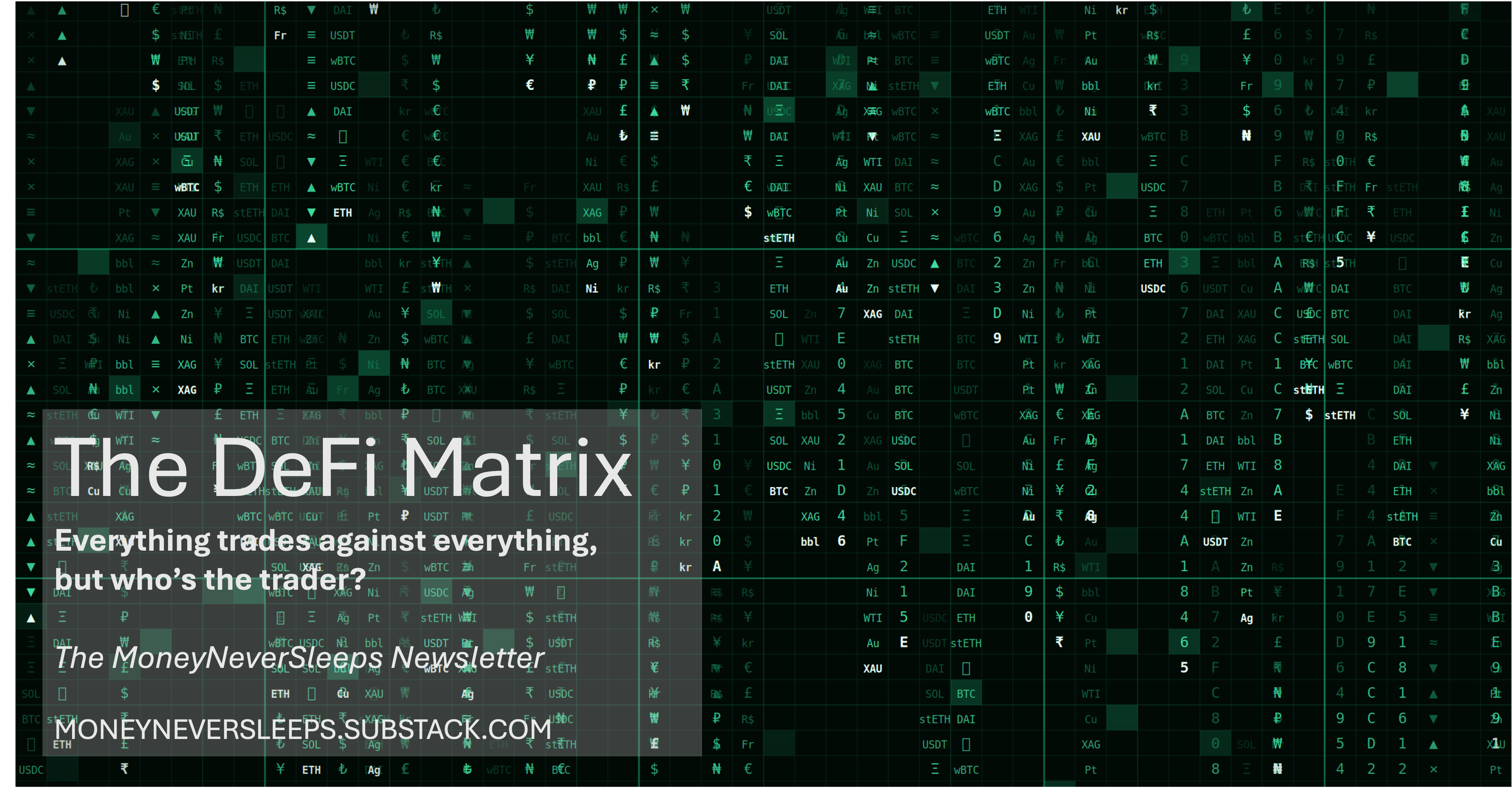
Balaji’s words first: the DeFi matrix is the table of all pairwise trades. Fiat against stablecoins, fiat against crypto, crypto against crypto, and much more besides.
The expansion: a digital wallet doesn’t just hold Bitcoin. It holds every asset. Fiat currencies, national digital currencies, personal tokens, every stock, every bond, every video game potion. The DeFi Matrix has billions of rows, but you don’t just hold them.
Everything trades against everything.
That’s the matrix. Every asset against every other asset, in one gigantic table. And the consequence he drew from it in the same breath: we’re about to enter an age of global monetary competition.
Every exchange you know is a sub-matrix
A crypto exchange is cryptocurrencies and fiat currencies versus each other. A stock exchange is stocks versus fiat. A foreign exchange is currencies versus currencies. Each one is a small rectangle carved out of the same table.
None of them is a new kind of thing. They are the cells that happened to get built first, because those were the pairs enough people wanted to trade.
Order books are the engine
This is the part people skip, and it’s the mechanism rather than the metaphor.
Prices don’t come from the shop. They come from the interaction of supply and demand, made visible.
Balaji’s example: you walk into a shop and buy a gallon of milk for five dollars. You’re a price taker. Now walk in and buy 200 gallons at $5 each. You clear out their inventory. The next store has thirty gallons, and those are $5.50 each. Keep going and word gets around, and the price climbs ahead of you.
Those are sell orders stacked at ascending prices. Demand stacks the other way, with a lot of buyers at a dollar and very few at twenty. The current market-clearing price sits where the two sides meet.
Put everything in an order book, and everything becomes priceable. A minute of your time. A JPEG - remember, Balaji wrote this in 2021. A megabyte on your hard drive. Things that never had an observable price now have one, continuously.
But order books need depth, and most cells don’t have it
The matrix has billions of cells. Almost none of them will ever have a liquid two-sided book. This is where the thread is more useful than the podcast, because it names the thing that fills the gap.
Automated market makers give liquidity for rare pairs. Uniswap-style automatic market making, as he put it, for everything. You don’t need a crowd of bidders standing in front of your obscure token to get a quote for it against another obscure token. The pool gives you a price - it may not be the price you want, but it’s a price.
That’s the difference between a table that is theoretically complete and one that actually functions. Order books explain how a price is born where there’s real depth. AMMs explain how the other 99.9% of the matrix gets a number at all.
But a price is not a trade. A quote tells you what a cell is worth; it does not tell you anyone was willing to be on the other side of it. Hold that thought, because it is the question the rest of this comes back to: everything trades against everything, but who, in the end, is the trader?
Two consequences follow, and he stated both.
The first is that everything can be priced in BTC terms, and anyone can switch out of BTC into their asset of choice. Balaji was candid that in practice this means a wrapped representation rather than BTC itself, and named WBTC, renBTC, or ETH.
That parenthetical has aged into the most instructive line in the thread - renBTC no longer exists. Ren went down with Alameda and the bridge went dark. WBTC survived but has been chipped at, after a 2024 custody restructuring pushed MakerDAO to reconsider it. Threshold’s tBTC, the one wrapper without a custodian, remains a rounding error next to both.
None of that was a failure of the pricing mechanism. Everything did get priced in BTC terms, continuously, exactly as described. What failed, and what keeps failing, is the counterparty standing behind the token doing the pricing. The reference cell is only as good as whoever holds the collateral.
The second is subtler. Balaji calls it a continuous liquidity event. We normally use “liquidity event” to mean the moment an illiquid asset converts to currency. With algorithmic liquidity there is no moment, because there is no conversion to schedule. The event never stops happening. In the DeFi Matrix, liquidity never sleeps.
What follows from this
Minimum necessary currency. Cash doesn’t make you money. In an inflating environment, it loses you money. So if you can liquidate anything at any time, why hold cash at all? You keep the minimum necessary currency on hand to render unto Caesar, and not a unit more. Everything beyond that goes into the matrix seeking a better return.
Balaji calls this the second attack on fiat. The first was that Bitcoin appreciates and can’t be seized. The second is quieter: reliable 24/7 mark-to-market on everything means a smaller percentage of anyone’s assets sits in currency. He framed the shift as the age of coercion yielding to the age of volition.
Geographic advantage disappears. Every newspaper went online. Then Google News indexed them, and suddenly every newspaper competed against every other newspaper. The ones surviving on reprinted AP wire copy died. The same thing happens to assets. Every asset competes against every other asset. This is extreme capitalism.
Currencies compete on features. Large countries can try to ban the matrix, but coercion only works inside your borders. Switzerland, Singapore, Dubai will see the opportunity and level up their currencies, recognizing they’ve lost the geographic protection that local newspapers lost. So they add privacy features. Transparent management of reserves. Bitcoin backing. Currencies start competing on product, not just monetary policy. Central bankers start behaving like protocol designers.
Cities get a live price. Municipal bonds trade. City coins trade. Municipal equity as an onchain REIT trades. Every city carries a price reflecting whether people are long on it. Is this the next Shanghai or the next Detroit? Today that signal is buried in opaque real estate values. Onchain, it becomes the determinant of reelection. Did you boost the REIT? Did more people buy into the city?
The matrix constrains states. Bitcoin is the zero-zero cell, the reference point everything else is quoted against. Or as he put it in the thread: the new no-op is to keep your assets in BTC. Doing nothing means holding it. Bitcoin at a hundred billion is an industry. At a trillion it’s a government. At ten or a hundred trillion it’s a world government, just not the one anyone imagined. A libertarian-issued one that constrains every state, because when a government prints too much, its users cash out to BTC through the matrix. The company analogy: issue too many shares, dilute your holders, and they liquidate to cash.
The two claims he only made on Twitter
The DeFi matrix is what comes after the social graph. He said something close to this on the podcast, that it would be to this decade what the social graph was to the last one. He was more direct on the thread - the social graph was the layer a decade of companies were built on. He’s claiming this is the next layer.
Your job gets marked to market too. He raised it as the hard case, and hedged. It’s an asset, one maintained by labor rather than capital. If everything else is continuously repriced and continuously rebalanced, why not that? He didn’t push it further, and neither will I, but it’s the clearest statement of how far he thought the logic would run.
His most aggressive version of the whole thesis is one line: every minute, every user runs an automatic search for the best return on their assets in a totally liquid global market, and auto-rebalances. It all becomes arbitrage.
Hold onto that one.
Five years on
Balaji wrote this in February 2021, at the top of the yield farming cycle, and put a date on the full version: every possession you have, constantly marked to market, by roughly 2040. Fourteen years out from here.
Some cells have filled in since. Others sit there addressable and untouched, technically liquid, nobody on the other side. The interesting thing is not which column that puts him in. It is that the two outcomes have completely different causes and nobody has agreed on what they are.
Ask what you’d expect to see if he were right and it were early, and then go look - rwa.xyz will show you what is onchain and, if you read the columns carefully, how much of it actually moves. DeFiLlama will show you where liquidity concentrates and where it doesn’t. Both are free, both are updated continuously, and neither will interpret anything for you.
I‘ll tell you what I think and you should take it lightly. The mechanism was never the hard part. Anything can be quoted against anything now; that fight is over. What nobody had a theory for in 2021, and what I am not sure anyone has a good theory for today, is why someone shows up to take the other side of a trade in an asset they have never held, priced against an asset they do not want, on a venue they have not heard of. Getting the asset onchain creates the row. The bid is a separate problem, and until recently it was a human one.
The question of who the trader is has been sitting under this whole piece, and the answer keeps changing shape. In the empty cells, the trader was simply absent, nobody on the other side. In the wrappers that failed, the trader was there but couldn’t be trusted, a counterparty behind the collateral who could blow up. And now there is a third answer.
Citi now projects $5.5 trillion (base case) in tokenized securities by 2030, two-thirds of it public equities. Alejandro Gutierrez and I went through that forecast in episode 318 of MoneyNeverSleeps, and the thing we kept circling was that Citi frames continuous markets as a retail feature, something for people who want to trade at three in the morning. It isn’t. Machines don’t sleep.
The reason you build always-on infrastructure is that the counterparty on the other side of your row may not be a person at all, but an agentic delegate of a portfolio manager with the compliance rules already programmed in. Cloudflare’s founder reckons agents already outnumber humans transacting on the internet.
Which reframes Balaji’s most aggressive line rather than settling it. Every minute, every user runs an automatic search for the best return and auto-rebalances. He wrote that as a claim about tooling. It might turn out to be a claim about who the user is.
The thread is four minutes of reading. The podcast is public. Go and see whether the rows you care about have bids under them, and if they don’t, ask what would have to be true for someone, or something, to place one.
Til next time
If you’ve been listening for a while, thank you. If you’re new here, welcome. Either way, the full back catalog of 320 episodes is at MoneyNeverSleeps.ie, reorganized into themed playlists so you can explore by topic rather than just scrolling chronologically.
📺 Video on YouTube
🎧 Audio and Video on Spotify
🎧 Audio on Apple Podcasts
🔎 Deeper-dive shownotes on MoneyNeverSleeps.ie
If this way of thinking resonates, follow along here. I’ll be writing more regularly - not show notes, but reflections like this one, connecting the threads across episodes as they emerge.
And if you’re building - particularly in crypto, fintech, or AI - I’m always happy to hear from founders thinking along these lines.
🔗 Connect on LinkedIn
❎ Follow me on X/Twitter
A quick note: if you’re receiving this and don’t remember signing up, it’s likely because we’ve interacted through Norio Ventures, MoneyNeverSleeps, or at a CryptoMondays event. If this isn’t for you, no hard feelings, and you can unsubscribe below. If it is, welcome back. More to come.