Spotify

 Apple Podcasts

 Amazon Music

 Overcast

 Castro

 PocketCasts

 Castbox

 RadioPublic

 RSS Feed
208: MoneyTalks: US Crypto Crackdown | Apple + NBA Top Shot | Solaris Setback | Revolut’s Irish Trojan Horse
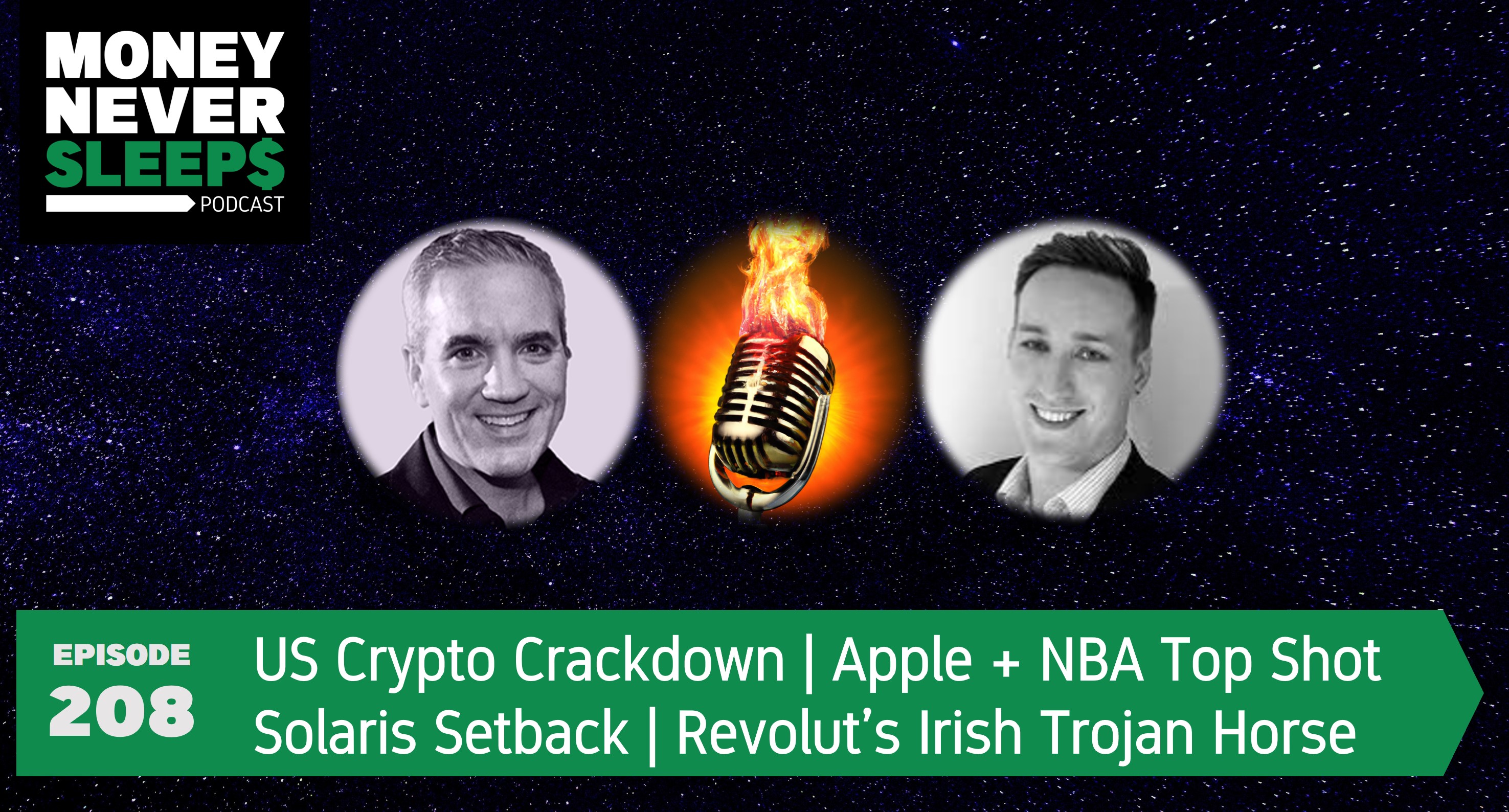
Eoin and Pete riff on the latest US regulatory crackdown in crypto markets, how NBA Top Shot on the Apple app store is a leading indicator of our wider society’s digital asset adoption whether we realize it or not, trouble in Banking-as-a-Service land with Solaris, Nova Credit’s entry to the UK market, and Revolut’s Irish Trojan Horse.
STORIES COVERED:
Crypto markets on edge as U.S. regulatory crackdown on industry intensifies (CNBC, 14-Feb-23)
NBA Top Shot Will Let Users Buy NFTs via Apple, Android Mobile Apps (Decrypt (via Pet Berisha @ Sporting Crypto) 16-Feb-23)
Solaris Setback Spells Trouble For European Fintech Scene (Meaghan Johnson in Forbes, 15-Feb-23)
Nova Credit wins FCA authorisation (Finextra, 19-Jan-23)
Revolut rolls out credit cards in Ireland (Finextra, 20-Feb-23)
NatWest to buy workplace savings fintech Cushon for $174 mln (Reuters (via Lex Sokolin's Fintech Blueprint) 13-Feb-23)
LINKS:
Leave a review and subscribe on Apple Podcasts | Spotify
Check out our MoneyNeverSleeps website and email us at info@moneyneversleeps.ie
Follow us on Twitter: MoneyNeverSleeps | Eoin Fitzgerald | Pete Townsend
--- Support this podcast: https://anchor.fm/moneyneversleeps/support
0:11 Hey there, I'm Pete Townsend, and this is money, never sleeps. We look inside the minds of entrepreneurs and the crossover of startups, Enterprise Finance, technology and Life. As we know it in this episode Owen Fitzgerald, my Riff on the latest us regulatory, Crackdown and crypto markets. How NBA Top Shot on the Apple App Store is a leading indicator of our wider societies. Digital asset adoption, whether we realize it or not trouble in banking as a service land with Solaris, Nova credits entry to the UK market and revolutes Irish Trojan Horse. All right here on money. Never sleeps. Hey Owen. Hey Pete. How you doing? Good? How are you not too bad and time with a cold here? But I'm more interested in finding out about your nice week in Sunny Spain.
0:57 The I it was like a on seasonably warm day in bright so wait January. So it was there's this wind that comes down from the Pyrenees down the west coast of sorry down the east coast of Spain called Levante and that They kept things a little bit windy, kept the sees a little bit choppy, no swimming, really tight, current all that. We brought all of our, you know, warm water, cold water swimming gear. Even didn't get to use any of that, but thankfully, our friends had a pool and so, you know, our kids got to go swimming in that which was nice but it was like, you know, a five-day sneak away Friday to Tuesday in the middle of this techstars web 3.
1:39 Yeah, Madness is a good way to say it because we've crunched this all down to leave applications open till February 1st. Pick the cohort basically by, you know, by the end of February. And so it's a lot to get through and I can't speak publicly about the number of applications. But we were impressively floored by the important applications that we got in and such high-quality propositions high quality teams. You know, that's what we double down on, is the high quality teams, the great founder. So it's just been, it's been non-stop. It's literally non-stop. So I did every night till after midnight. Before we went to Spain and then was able to shut off a little bit, because thanks to Paul Smith been working on that meditation, right? And I can quiet the brain a bit now and that we've got but then, you know, rep right back into and it's been non-stop since we went back.
2:33 So, the whole weekend before we left and all this past weekend but we're in pretty good shape now and it's really, really excited about. You know, they companies that we're getting closer to making offers to we made an offer to one already. So, you know, more to come, which is, you know, really really exciting times but it's it's Relentless and I was saying a folks this morning, what it's really opened. My eyes up to is a power deal flow, right? And that I genuinely get excited with humor GE who is our investment principle. When he finds a deal that he's really excited about because he's done all the Deep analysis on it. And he's talked to the team and he said I've got a good one here and I get really excited when he's like, Okay, we've got high quality one for me, to dig into to and what I found is that when I start expressing that passion and that sentiment that excitement to investors that, they it resonates with them too.
3:29 And that's what we want. We wanted absolute companies in front of investors, so this you know, high quality vetted deal flow when you're in early stage VC you should only be investing in one to two percent of the deals you see, right? And we're going to get to that. You know that's that's the The that's the rate we're going to be at here one to two percent of the deals we see. So we're finding a top-quality one is you know, but it's an amazing experience. So really exciting to see know what when the cord gets announced, what type of companies you have will be cool. Yeah, yeah, we were able to open this up more to infrastructure last year. We couldn't because we needed everything to be tokenized. Generally, you don't need to tokenize infrastructure companies in web 3 or in any You know, in any web and it's. So now that we have that Liberty to be able to say, hey we can invest, you know, we while last year we did invest in both equity and tokens that you know we are what the requirement was is that they needed to have some type of token. Now it's just okay, we can invest in equity and tokens if they have a token but we're going to look at that with a huge amount of scrutiny to see if they really do need a token. Yeah, it's tokens can.
4:44 Sometimes be used as a hey that's going to be an Easier way to raise money, not anymore from a market perspective and not anymore from a regulatory perspective. So there's two things to be to be looking at there but legitimately some have tokens the middle of the value propositions which are completely necessary, right that they do need them. And so okay let's see how we make sure we can get that into the right regulatory context with got a bunch of amazing folks with some great legal experience that are contributing to the program. So you know we're good shape there. Bruno's print. So what do I talk about today? What I want to talk about today, we got a few things going to do for, we're going to do half and half, but I think there's some, some topics here that are, you know, more crypto, web, three leaning that. I think you'll you've got some insights on. I think you do.
5:35 You know, and I, this is funny that you and I are now both speaking in these. Shall we say cloggy tones given that I wanted to make sure I said this was that we did have to take two weeks off because of the intensity. Of this screening process and the last time that I actually put my voice on are three weeks ago was when it was far worse than this when I was coming back from New York and I had lost my voice the night before, just like you nearly David last night, right? Yeah, absolutely. I was like trying to protect it all day yesterday and I, because I was lecturing. Lastly, for four hours. And at the end of us like it was, I was croaking. Yeah. Yang's like lots. And lots of breakout rooms you guys. Talk there. Amongst yourselves.
6:16 I know, I know. I spoke with someone at 5 a.m. after I lost my voice a night before or try to and it was just like, okay let's just yeah I'll see you on slack because that's not working, but go to buying no back with a bang back with a bang lot, so much stuff happening in the crypto market. And, you know, being over the US last month, felt a little bit of this from being there and buy, you know, it. But, you know, over the last four weeks, it's really come out strong in that, this is from CNBC. DC and it was just a general story that they did last week on Valentine's Day. Love crypto right. Crypto markets. On edge is US regulatory Crackdown on industry intensifies.
6:59 So the news items, the things that this article pointed to were paxos to stop, minting be USD. Now paxos do a couple of things. They provide they have their own stable coin right? Which is pegged to the u.s. dollar called I think it's usdp for SD paxos. And they also have a white label framework that they provide out to others that want to Mint and have a stable coin. So they provide their kit to finance and finance use the paxos kit to Mint be USD which is financed USD stable coin. Okay so what's happened is that the SEC or suggesting?
7:42 It's a security, how can a asset that's pegged? To the US dollar, be a security. So a good question. I don't know. Now, I've been thinking about this so stable coins. Can have a somewhat murky model behind them. Okay, so if you're familiar with eMoney and electronic money, institution regulatory framework in Europe and you're nodding your head. So I think that you are so to Monty. So, before, you know, take revolute, right? They are still in Imani institution in the UK. They're not yet a bank, they are a bank in Europe.
8:26 So if you're Annie money institution, you need to have 100% of the deposits into your entity, your institution. You need 100% of that safeguarded and it needs to be in a safeguarding account marked as such at a you know, at a bank. Okay. So even though you are an e money institution or you know, electi money, you still need to have that one for one match. You cannot lend that money out. So, and that is saying that this digital representation that you see in your app and your revolute app, where you have 500 quid or whatever, but that digital representation is actually backed 100% by real cash that is on deposit somewhere else.
9:07 In a banking model, you don't need to do that because you have the true banking license, a real banking license and that you can lend out the bank can lend out your deposits, right? No. The holder reserve of 10 to 15 percent or whatever it is so with e money. That is regulated. You need to have all the compliance of procedures the checks in place, to make sure that there is actually a hundred percent of the cash that customers deposit into your Imani, institution is actually on deposit and held and you do all the reconciliations are right. If you look at the stable coin model, the stable coin model is very, very similar to e money in that. What the way that stable coins work is that when you buy say USD, see that the The Fiat or the traditional currency that you exchange, for that, that is on deposit with that stable coin, issuer and whatever Bank they're using for that. Now, there are no regulatory rules in place that's different. So with emis, you need to have a hundred percent cash with stable coins.
10:14 You can do what you want. You could say, hey I'm going to do 85 90 percent in cash, and the rest and treasury bills. Right? So the fact that there is no regulation around this, there is no required compliance regime and that then suggest, okay, if there is a murky model or we don't, we know it, you know, USD see Circle have been pretty transparent on their model and how much cash is actually on deposit and what isn't t-bills and other type of instruments tether have been less. So you sdt be USD, who knows, right? Finances as we've been talking about their stable coin. So if be USD, has any murkiness to it, is there a risk that PUSD could go belly-up?
11:02 Perhaps that's one thing and that would be terrible if we had a widely-used stable coin with a billions and billions of billions worth of economic value in it, that just is, is gone because we have no transparency on how Bine answer actually have their Reserve model in place. So I think what they're doing is saying that this is a security in a roundabout way saying that if if you as a depositor are knowingly, it giving Seeing somebody cash and you're not sure what they're going to do with it. Maybe they'll lend it out, maybe they'll do something else with it, but they're going to give you back, you know, they say they'll give you back a dollar for every dollar you deposit then, is that a security?
11:46 Because there is an expectation that they're going to have to do something to turn a profit in order to pay you back that dollar that I think is where this is all going, which is incredibly complicated, adored it strikes me without Illness in the details, Eunice 30, would it does strike me that there isn't part of the issue in the u.s. is that there weren't regulations in place, you know, originally in the same way that there is any money license. For example, you know, you've got, you know, a strange kind of regulatory landscape in the US by state and from at a federal level and stuff. And I think now obviously with crypto kind of, doesn't it kind of expands on the gray areas that were already there and typically, what are they trying to do?
12:32 Do and what we've seen in Europe would like to kind of ask for licenses, do visitor, trying to just make these things fit into an existing one, is the quickest and easiest way to, you know, capture what's going on the crypto space and in the US, they don't have that option because they didn't really have the right legislation around even the fintech space or the, you know, the regulation that kind of covered some of the innovation in fintech prior to even crypto. So there are chasing their tails a little bit and they're trying to make it fit into whatever existing kind of framework is there. Which is why you need to probably try to classify things as Securities. When you know, they don't look like a security. Yeah, yeah. I'm you know I listen to the guys from on the brink Matt Walsh and Nick Carter from Castle Island Ventures or sieve as they call themselves internally, which I heard them say, and they were trying to dig into this and didn't really dive in, they switch to a deep dive into the custody role, which is a different kettle of fish, I won't get into, but I, I'm while listening to them and walking up in the step side Hills, I was thinking deeply about what could be the logic for saying that a stable coin is security.
13:43 And the only thing I could come up with was that, if you are, like I said, if you are willingly giving your cash to somebody knowing that they're going to have to turn a profit in order to pay you back one dollar that is that some type of a security, right? You know, without having that regulatory hate, this needs to be 100 backed Imani is not a security because I'm from a regulatory perspective, it needs to be 100% back by cash, you know? So, That's all I could get to. Also what happened was it crackin settled with the SEC for 30 million on its taking is a service being deemed a security? Which is like, I remember seeing that one and thinking and seeing a lot of commentary online thinking that that was look, that was a bit of that seemed like a bit of a reach. Yeah, in the end, Jesse Powell from cracking had a lot to say about that on Twitter.
14:31 But and they but they didn't seem like the quickest answer was to settle and make it go away. Yeah, yeah, exactly. Clean. This, this is where you are depositing crypto onto an exchange and because the exchange is collecting so many deposits from all their different users and customers that they can pull that together and put that, it's take that onto one of the blockchain. Protocols that rewards takers with additional tokens. Okay, so when you look at that under traditional Securities laws, there's some of that that may suggest that it, what is Is cracking themselves. Doing I disagree with the ruling 100% because you need to look at the technology. And when you piece apart the technology and how it works you can see oh actually no that's not a security. Yeah but the SEC is making some very high-level calls. I think I've said before I have met Gary Gensler before. He did a blockchain curriculum at MIT, he was over in Dublin. A few years ago I participated in a panel that he was part of the panel before very very smart guy. He knows this stuff.
15:41 But I think in order for that, you know, he's in a political position and the stuff that I hear him saying that the stuff that I hear him saying, Isn't the same Gary Gensler. I met four years ago, right? Because he was talking about it with a far more informed position, shall we say? No, the whole thing stinks of a need for a political point of view to address, you know, the crypto space, and feel like they're doing something. And the quickest way to do that is to shoehorn it into some existing regulation, exactly. Exactly. You know, and, and, and, you know, I'd take to close this one out. Why you get so excited about it and, and, and think so. Play about it is just because I can see and having so much familiarity. Now, with the Imani institution framework and having so much familiarity with the stable coin framework, that is, primarily driven out of the US.
16:32 And I'm like, can't we just all bring it together please? Yeah. Yeah, you know and I think Mica the market and crypto assets framework is very clearly pointing to the fact that stable coins re money. So let's just get it there. And I Circle have now issued the yurok, the EU. You Euro Circle, stable coin, there's only like 35 million in that. So very, very tiny. But, you know, I'm taking some steps in that direction, shall we say? But, you know, there's no upside on that. It's just to kind of, you know, get yourself into the middle of what are these day-to-day consumer? Transaction flow is going to look like, when we're basically all spending cryptographically secure tassets, right?
17:13 That's the joy of it all. Moving to the other side of the passion. Yeah, right. What do we pay? What am I passionate about? Audience, sports right? Of course family. And you know, NBA top shots, right? So Top Shot will let users by n FTS via Apple and Android mobile apps, which is a big deal. So up until now again just for those that don't know and be a top shots are and ftes non fungible tokens that are digital Collectibles of NBA players. Okay. And it isn't just static images, it can be 3D imagery. Re it can be highlight moments and but they're all issued on the flow blockchain, which is from Dapper labs and it is basically what we would call a, a private blockchain. Okay.
18:02 So you you can't really you can't move assets off of that blockchain to other blockchains. All of the transactions need to be done on that single flow blockchain which was set up specifically for NBA top shots so it's almost like a quasi centralized blockchain right. But For the purposes of enabling transfer amongst those who are all part of this. You know, that are that are basically customers of NBA Top Shot, it works. Okay. So what happens is that you go on to NBA top shots on to their website. So before they they're opening up an Apple Store, you go onto the website. You set up all your login details and you can use basically a credit card to buy a $9 pack of cards of digital cards and you see what you get now.
18:50 If you get one of the legendary LeBron James, that is now selling on NBA top shots, Marketplace for eighty, four thousand dollars. Well yeah, so all of that was done on the website because they hadn't yet figured out how to do this, on Apple Store on the App Store and but if you want to do it on your mobile, obviously you needed to do it through web right through a chrome interface through as far interface, whatever that can be a bit clunky. So now they have the app and the and as you remember Take rate is for apple 30% to exactly. So when you put 30 percent on top of the purchase of a nine dollar pack of these cards, not a big deal. You know, you're going to gross that into the price and apple gets their cut, you know, not a big deal but it's the upside. Are you going to go sell your eighty four? Thousand dollar LeBron James card? And wait a second.
19:46 You give away. No, you're not. So all that. They've done in the App Store is the primary Market Place, or you can just buy those cards. You can buy the initial pack for nine dollars. They have an open up the secondary yet, and I don't think they will. So this is kind of equivalent to back in the 80s and 90s. They had baseball card shows where you could, you know, you bought a pack of baseball cards for a dollar or two, and then if you got a really good one, you could bring it to this card Convention Show and you could sell it to a dealer for, you know. For, I don't know if you got one, that was worth a couple hundred Right? And it was that the, you know, the convention center itself, taking a 30% cut.
20:26 That's that never worked. And I don't think it, you know, that wouldn't work with Apple store, but I see this slowly starting to work and slowly starting to unfold with having these digital assets actually work on the app store, right? It's it's, there were some big conundrum in the last. As months or so that we talked about on this show, about that going back and it was very confusing. But now I think I got my head around it as to, you know, where this actually is all going to go. Yeah, you know what it seems like looking at. This is the first step, like it works for topper labs to be able to get up on the App, Store non-mobile and be able to kind of be integrated. And even if they just sell under nine dollars packs but like they did a billion in sales last year or something. So Apple, surely will look at it and be like look if it was I was Works.
21:21 Then we'll figure out some solution down the line. Oh, absolutely. Absolutely. And, you know, I wonder how it could work. So is the opportunity for Apple to have all-nba, Top Shot sales. Like you said, a billion, go through the App Store and for them to get 30% of that. Is that going to be enough to get them thinking about a new framework, for a secondary market for digital assets. And to create a new category of at a crate around that, right? That will be Progressive, that will be something that others can adapt to. And I think we stand because the more and more and more that we have of Apple supporting this stuff, the bigger it's going to get. Yeah, I mean, exactly, I read yesterday like 70% of gen Z, people gen Z in the u.s. prefer iPhone or Android, right? Yeah, you know, so it but it is the the, I think, France here kind of me is probably the resale is the fact that these can be traded multiple times.
22:27 So you know, whatever. Let's say they come down from 30% to 10%, you could get 10 percent of multiple transactions on the same nft and that's where, you know, I think once they figure out the number and the likelihood of resales and things like that, you know, the multiple is, will be worth it. Yeah, that's as opposed to, you know, your traditional a for you're paying once maybe for whatever. Whatever it is, you're buying or even Spotify or for an album or whatever, you know you're doing it one time. You can't reset it on necessarily. Yeah, I know, I think Spotify might actually be in this player in this reader app where I'm not sure if Spotify memberships. Are subject to the 30% Apple Store take. They may be because obviously they're a competitor to Apple.
23:08 So, yeah. Who knows what? One of the, one of the other things that came out of this. I mean, what I'm what I'm really looking for from an app, is that, you know, whatever my collection is and whether it's NBA top shots, or it's the tops candy baseball ones or generative art or some of this Robert Alice stuff with that. We, you know, we talked about a few years ago that he's doing Thing with these cuneiform discs all linked to the original Bitcoin blockchain. You know, first 40 blocks, link to historical moments, all this crazy mind-bending stuff, right? And seeing some really damn cool generative art stuff, come out of some of the companies were looking at for this next accelerator program having that single viewer where I can just engage with this stuff on my phone is probably going to be the single biggest way that I would engage with it.
23:57 No looking down at a browser on a laptop. I just don't want Do that. It's really about the ergonomics of the phone and what that phone was designed to do, right? It's to be this Communications portal in this Digital entertainment portal for you, right? You know, in the palm of your hands. And that's how people enjoy these things having NBA top shots. Now, in an app on a phone, I think is a big first step in that direction, especially for mainstream adoption. Like testimony have it in. Everybody's hand, like, you'll just look what I just got. Screenshot Click Boom, post it up on Instagram. All my friends. Wonderful. Hey, I'm cool. Right? You know, that, that is the way it's going.
24:39 The other thing I saw in this is where the shout-out to peppery, shh, who writes the sporting crypto newsletter because I hadn't seen this, because I didn't watch the NBA All-Star game where David Silber. Sorry, David silver. Is that his name? I think it is. Adam Davis was Adam, Silver. David silver was on Beverly Hills 90210, so let's say I'm good. Adam Silver, he Jesus, I'm dating myself with that. So him and Ahmad Rashad Ahmad Rashad senen. Be a announcer on NBC. I think the So Adam Silver took his phone and it did a 360 degree view, shot of Ahmad Rashad. And then showed this screen based representation is actually the game and it is an app overlay, on top of you watching a game where you create this Avatar of yourself and you can check over search into the game highlights. The I saw that, that's so cool.
25:36 Oh my God. And and pepper isha's, you know, title for this was the metaverse doesn't suck and it's like I saw that and seeing that paired with the stuff going on with NBA top shots. Seeing the opportunity to start to link all that together and see this multimedia. Augmented reality type of stuff, that's all happening. Be able to have that in the palm of your hands and your phone that is just, that's huge. It's a game change. Such a big moneymaker. And, you know, I think the biggest thing that I'm seeing again with, you know, looking at all these different companies that are applying to this program. I've said I said we're seeing so much of this stuff, right? We're seeing so much of it. All these different propositions that are, you know, close cousins of each other. The biggest biggest ones, the ones that will really be able to have an impact, are those who can bring the fame, right, those that have the networks in the relationships to bring the fame. And obviously, you know, nbar, great example, of that and Dapper Labs.
26:31 Now, being a great example of that, but lots of nice little things happening with really smart people from these businesses that are saying, hey, I can go do something to, I'm gonna go launch my own but I have this great network from being part of this. So yeah, that's that's a way to look at it. So yeah, exciting stuff happening coming out of that, would again be a and having both Jason Tatum and Jalen Brown in the NBA. All-Star game from the Boston Celtics of protocol. So there you go. Did you have? Did you see? It was named the guy who won the dunk contest? I watched his dogs, they were brilliant. I usually just, he just I joined the league from like the g-league reserves. This is because he's only unlike a rookie contract. One-year contract, he made more money and winning the dunk contest any door. Then he gets paid for the year, but like, not a guy you would look at and think is going to win dear. He got four.
27:19 He did four dunks. And three of them were like perfect scores. Mac McClung McClung. Yep. Wow. From the seven White Men. Can't Jump. You want to see his dunks. They were brilliant. I'm so good now. I'm definitely going to have to check that out. Yeah, Sixers guard Mac McClung, outshines tray Murphy to claim the slam dunk title. Yeah, so watch that, watch that somebody was really good. Yeah, yeah, I know, I will check that out. I will check it out. Cool. So moving from crypto and then ba back to Europe, we see some trouble with Solaris, don't we? Yeah. Joe, what? This was an interesting one. It was in Forbes. On the 15th of February, this is around, it's called Solaris setback spells trouble, for European fintechs scene. And this was, was it even necessarily trouble as it call it for Solaris, but it speaks to The Wider, kind of banking as a service and embedded Finance piece because Solaris of Z is a German bank is service provider and they've and baffled German Regulators come down on these types of operations to say that, like in in this particular example, Solaris is going to need approval from the You later for the onboarding new customers, which obviously is going to hit it Ambitions but it's the idea of kind of launching any sort of digital Finance solution, where you have multiple partners is going to be an issue and like the these are similar. This was kind of this restriction was put on in 26. And another kind of German banking is a service provider and it's around there, obviously it's on the back of kind of wire card, you know, that the
28:51 regulator is operating with caution but it really extends out to the What kind of moving parts of banking slash tech company going to see if you remember from our cards? You know, I was actually only talked about it last night as an example, with the cohort in the pat fintech course. Then it was around the fact that the regulator got sued by customers who'd lost money and The Regulators argument was, well, we didn't need to regulate wire card because it was a tech company, you know, they they regulated the license payment side of the house, not their Tech part of the business. And obviously that's where this that kind of experience is feeding in now. Because you know, the idea of banking as a service and being able to offer multiple different parts as a tech platform in out of Germany, is getting kind of really hampered by The View that the back that said ermine Regulators taking So you know we're Solaris we're looking to provide kind of embedded Finance Solutions with for earlier stage companies Etc. But notes they're going to have to extend their kind of existing relationships with larger players because the really restricted from bringing on new customers. So It'd be interesting to see, does that kind of flow out Beyond Germany?
30:04 Because they're an incredibly, like they've been doing very well. They've been really attractive kind of supporter and solution in the market. And I think they'd been in Spain and Italy and France as well. But yeah, it really is going to have a top business for what kind of knock on effect? Does that have on the kind of embedded Finance banking? The service Market will be interesting. Yeah yeah. I mean the the sentence that stood out for me in this article on Forbes by Megan Johnson whose form Lee with a one of the original cofounders of eleven fs and she is. She said that the Baffin appears who is German regulator. The Baffin appears to be cracking down on institutions with full banking licenses, due to concerns about proper business organization. In quotes, proper business organization. You look at that.
30:49 That's a, you know, Minefield right there? That's a big, big, big suitcase down pack but you know, you talk about governance. How organizations are set up, what the reporting lines are like, what Management framework is like the reporting structure. The compliance program. The risk management having evidence of all that stuff, proper business governance and business organization. We know what that looks like from our time in the corporate world right now. But you can't just inject that sense of you know what's good or not into the mindset of a technology executive you can't write. And when it's you know, when you are just a bag Bank, you're just a financial player you know your day-to-day decisions are hell of a lot more governed by regulation than they are technology. No matter what.
31:41 Goldman Sachs has about them being a tech company, can't do lots of things and you can't offer lots of products and you know, you can't move quickly because you have to deal with the Regulatory and compliance aspects of it and like I always use the example. He's a last night when we launched a Future Finance, we were able to launch with a provisional license with the To lend money. Like in theory, you should never been allowed to just have a provisional license to lend money like we process through our we had about like 5,000 customers or something that we'd given loans to without being fully licensed. You know, it's just, there's something not right about that. Well, it allowed us to get up and running and obviously it kept a cast fairly low and to do that at the same time, you're thinking those 5,000 people who we lent money to like, you know, it's just a material risk to the business.
32:27 And we were only kind of lightly. Ernst. Yeah. Yeah, well I mean but was that small amounts? I mean of 10 up to kind of a Max of 15 cave alone so like a big enough but even that even in that respect you know did the Contain what is it to Contagion or whatever? Effect, you know if anything went bad with us, was it likely to impact anybody else? Not necessarily. Maybe that maybe the institutional lender gave us the money. Yeah, yeah, exactly. But it's this sort of stuff and this is like it comes into kind of the next article. I'd mentioned as well and even what you're saying, you know, infrastructure players like you know, they're really difficult kind of category to regulate or to account for where they're providing a technology solution that enables lots of different products.
33:17 But the same time they have a material impact on the market. Over. They do they do. And we start out with wire card and that's obviously why Baffin are taken the view. That know we're going to like thump down on what you do here now because the more you do it, the more you scale, the more risk you are and I get it because In fairness at least two taken a stand on it because iíve always use Solaris as a, you know, as an example is a case study in the pat fintech night that I do the full occulting as I call it right and that you know, talking about them as a Say, you know, as a hybrid player is that they have their technology but at that they offer out as an on a banking as a service basis, but they also have the regulatory license that they offer out. And that just creates a very, very not impossible, but a very challenging business models are wrong because you've got your, you're getting it from all sides, basically. So I get this and I see Germany, you know, to see Baffin what they're up to recently.
34:17 And I think, you know, it with comparing this to the regime. Him again in the US where FTX was allowed to operate under a money transmitter license, which is akin to what you use for, check cashing businesses. It's like okay, ya know, when you have a good strong regulatory regime in place, the good positive things that it brings to your business in terms of control and Frameworks and governance organization. They're good things, right. They're expensive. But they're the proper way to run a business, you know, not With the way FDX. We're doing that at on error, under a money transmitter license. Right? So the US has to start getting a framework in place. I I keep talking about how far ahead Europe is with all this stuff.
35:04 Yeah. And so, did the next article and actually there, but this was no over credit. Only wanted to flag this one, cuz we spoke about them recently. Nova credit, do I suppose pass porting of credit scores, you know, they're one of the few credit reference agency type operations that, you know, allows You two are have created a kind of cross-border credit score that allows you to bring your credit score with you into a new market. I think they're, I think they're set up in about 20 different markets and as I've kind of lost the end of last month, they've just got approval to be the UK's first cross-border kind of credit. Reference provider. So like this is huge from a customer and a consumer point of view because you know what, I'm trying to find the stats here. I had them Thursday of over 2 billion, credit profiles, but more than that, there's a A huge number of kind of immigrants in the UK.
35:54 So let's see the 2021 census had 10 million people in the UK were born overseas and 40% to move to the UK in the last decade. So, the big issue, this is addressing, is that people move to the UK, like you, for example, either of us could move to the UK tomorrow for work. And we can't bring our, we couldn't previously. Bring our credit history with us, we'd be starting off with nothing, you know? And so this is huge for the industry and like that being the first, you know, this is they have their Nova passport, which pulls your kind of established Credit Data in different. Trees and translated into an equivalent score in a new market, which allows you obviously to apply for loans and financial services products in New Market, which is brilliant. And getting that kind of regulatory approval, opens a, huge Market opportunity for them.
36:35 They're in the UK, they could have the other thing we'd mention when we talked about this before me, obviously we just address that there is, you know how structurally important does. This company then become to the market. It's the only company out there offering this kind of solution at the moment because even the big name players I can, Equifax TransUnion Experian, they don't they despite being in multiple markets, they don't necessarily provide this service. So, Nova credit is now the only one who potentially can help unlock credit for, you know, millions of people are in the world in different countries. The FCA authorization they got is that as a credit bureau is at an FCA authorization type? Yeah, it must be because it's let's see. It says, if it's got there got the permissions to provide credit references in the UK.
37:21 Okay, so yeah. So it allows them to operate as a credit reference agency similar to an echo effect, so transient okay, yeah. And I mean it this is it this is you know getting truly Global with all this stuff because it's not just you know people moving around its people who are say living in you know Backwater France, right? That are that have a bank account that are employed by someone in Ireland, for example, right? And being able to have financial services and and just following people wherever they go, you know? And and interesting part of this for me is seeing that, you know, the proportion of consumer spending right now that would point to somebody's credit history, credit risk, the proportion of that that's on a blockchain right now is Tiny, you know, compared to, you know, that in traditional banking institutions. But as that continues to grow, that information is far more available and far more public.
38:23 If you have somebody's address, you can see all of their history, everything. So it's going to be I you know who's going to start to move first, and it's really saying that, well, you've got Gemini, you've got coinbase, you've got others, that are crypto players, that issue credit cards and that where that spending is then linked back to your crypto account. So it's not exactly on a blockchain, but it is the first step in that direction. And you know, there are others out there that I'm talking to that are building that where you can link a credit card directly back to a And just spend directly on their on chain, which is just nuts, but that, that's what's happening.
39:04 So I'd love to see Nova credit, you know, their need for a blockchain strategy right now and probably over the next two to three years is incredibly minimal. You know, there's plenty of leg room for them to grow in this industry, especially with that 10 million they got from HSBC. Last year, I was but just about to bring it up weights going, you know, because the question now are like, you could argue that this really benefits HSBC because they're an investor In a company that now provides credit references in the market where he just be, is his main Marcus or like one with main markets, maybe they'll. So, you know, does that create an unfair Advantage? Would the u.s. Department of Justice? Look at this differently as it has a due to Visa implant because now with becoming like I said, strategically important in markets and for consumers.
39:50 So on one hand it's excellent like it's great for the market and it meets a real lead. But is it to important? Now to allow a bank for example, Bill to investors and my thing, you know what, how far could they go with this because they have all this data, right? And could they use that to offer credit cards? But surely. Yeah, exactly. Surely, they could go into lending themselves because they, I have my credit passport with no credit. Why wouldn't I allowed him to provide me alone? They already have all my details. I'd probably get a better, right? Yeah. Now it's you can read into these things and start to see the future. ER, right, absolutely, you can.
40:30 And speaking of credit cards, revolute revolutes, favorite customer base, we are better than that, aren't we? And you think more and more about that there's what? There's two million revolute account holders. In Ireland, out of a population of five million that is significant. And someone was saying to me, well, what's going to happen in Ireland with, you know, now it's just Bank of Ireland, aib and Permanent TSB, left is a bag. So I said, revolute, revolute have the most customers. It hardly and they are a bank, you know, they have their banking license in Lithuania. They're now starting to convert your eye bands over from Lithuania and I bands to Irish I bands so that you can, you know, there are a number of payment providers and payment receivers that won't do anything in Ireland unless it's an Irish iban, so that's happening.
41:24 Did you know quite OK later solutions? They do buy now pay later. You do loans basic loans, and now, credit cards, they're issuing, and they're starting to do that. And all of this is a trojan horse for getting your banking data from other banks. In order to do be npl, you need to hook up to their door. Open banking feeds that take your bank account data, your main bank account data and revolutions, all that and comes up with a credit amount that they would give you. And whether that is a one-off loan, whether that is buy, now pay later or a credit card. That's They're looking at. So there's really, it's really smart. It's a really smart play. Hmm, they got their tentacles out and you know it's a great place to do it here in Ireland.
42:06 And you know, been saying that for years is that because of the the different economic circumstances of demographics, all over in are all over our than a very concentrated, you know, portfolio people that it's it's relatively it's very logical and sensible and pragmatic to do this type of Market testing here because you got a huge audience. Yep. So, That guy will be first in the queue to get a revolute credit card though no no nor will I boss at the same time you could see it very easily being kind of adopted because you know even they have their one-off disposable card. If you want to use that to make you to make an online transaction and just use a one-off can a number so you can see these, you know, this being kind of rolled out or people applying for this for a period of time if you're going on holiday for a period or something like that. You know, you might say okay well I'll apply and get the credit card because it'll have a Defined kind of time period on it.
43:01 Yep, the things like that again. You're not going to use it as your main bank bought, you will use it in specific circumstances, and then if that goes, well, you'll probably look to use it again more often, and etc. Etc. So like you said, trojan horse is the ideal way to kind of think about it. In terms of rolling out more product building up, very monetizing that user base even more. But in a kind of slow, quiet can away. Yep, yep. And you know my I was talking to my wife about this and I'm just like so Sick of Bank of Ireland. You know, it's the only app where you don't get the dang, when money gets deposited, and when you're running a business you it. Having that Ding is incredibly helpful. So that's why don't you just move? I said, where am I going to move? She's lucky, that's a problem.
43:44 I said I'm not moving a revolute. I'm not putting my business accounting. Two revolute, two reasons, one. I've had problems with them. Before to, you know, hack ability of of revolute, right. That it hasn't happened yet. Knock on wood but just Just knowing that shortcomings of their operating model like just I don't. Yeah. So I'm not going there but that's the only other option for an Irish, you know, registered business. So not gonna do it last one. Yeah, that's why I stopped buying workplace savings fintech cushion, who for a hundred and seventy four million dollars. So this is Reuters, but V Alexa: from the fintech blueprint. I picked this up out of his note newsletter on the 13th of February.
44:24 So it was just a, shout out to bow. Do you know from RBS which are vs is not West, isn't it? Yes, yes, oh yes, RBS isn't is not West when that they launched bow, which was the short-lived Neo bank. And just seeing this gorilla in the bunny context again and just seeing if how long cushion will last with in NatWest in that cushion, was a pretty good app for helping people to make sense of their pensions and save and savings and direct that appropriately. So we'll see what happens there. But you know it could just be, you know, if they do it right? It will be a nice top of the funnel catchment area, for their wealth management business and perhaps cross-sell until until what I think this fits in more broadly taken on my view on the opportunity, be getting into large corporates.
45:16 Yeah. And being able to provide so you see it a lot with payroll companies in the US you brought out kind of expense platforms and stuff and even like the breaks and things where there are now kind of trying to reverse themselves in Because they're in there, providing one solution to a business to bring in more kind of products that fit for the employees of those companies. Yeah, you know, because they're already already providing, especially those ones providing kind of early Payment Solutions on your payroll like your again you're starting in you're getting access to data around people's payments, you know, you know when they're getting paid and you access to that, then you're providing another Financial Services product, but you're not going, wrote it as a bank almost So, listen REO. They're, you know, they're taking a company that does workplace savings, and then they're trying to roll out more solutions, more financial services products for the employees of those were places. There you go.
46:05 You always want to get those bigger corporate customers to start moving up, the moving up the chain. Yeah, so it's, it's an, it was an interesting play. Like, to me, it doesn't matter if cushion kind of disappears, it's if they keep the business and keep the customers, and then able to further kind of monetize or cross, sell to those customers. Oh yeah, every MMA analysis I ever did way back in the day was always, is this a cost deal or is this a revenue deal and, you know, can you cut cost out of this business or can you use it to expand your own revenue and expand the revenue of what you're acquiring even faster because of that Synergy between the so it looks like you're so it lets it looked. I could be an interesting one, it makes a lot more sense and ball anyway it does God Rest in Peace about so let's leave it there there.
46:53 Our pleasure. As always this week we'll be back next week and I've got two guests lined up already. Having told you about it yet but we've got without Liang. Whoo-hoo is a techstars mentor and also an investor at a deep thinker on web three teed up for next week. So it's going to be a phenomenal chat with him. So looking forward to that, burn it you need speed. All right. Thanks about adios. That does it for this week folks, you can learn more about the stories we covered in the show, notes on our website money, never sleeps. That IE, if you like what you heard, please leave us a rating, and, or review on Apple podcast or Spotify. Is it helps others find the show? Thanks to Kona, Brophy from created, for mixing and editing. This episode Conan is an excellent medium and to get in touch with when you're thinking about launching your own podcast.
47:39 As for me, I'm an early stage, startup investor focused on where fintech meets crypto and crypto meets web three and I'd lie detector as well. Three accelerator there are plenty of links in the show notes on money never sleeps that IE on how to get in touch with us. So don't hesitate to reach out finally till next time. Thanks for listening. See you So don't hesitate to reach out finally till next time. Thanks for listening. See you