


The Drive to Five: Unpacking Citi's $5.5T Tokenization Forecast
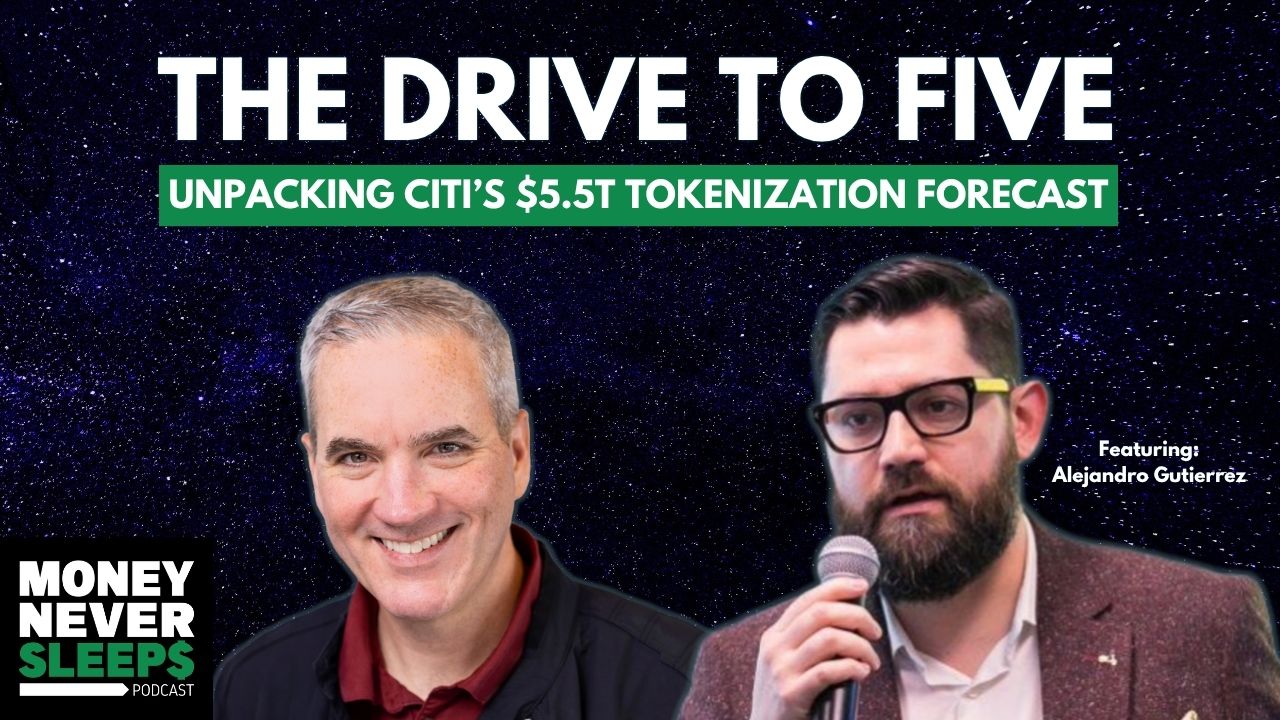


The Drive to Five: Unpacking Citi's $5.5T Tokenization Forecast
In June 2026, Citi Institute released "Tokenization 2030: Wall Street On-Chain" — a report that puts a hard number on a question the industry has been circling for years. Their base case: $5.5 trillion in tokenized financial assets by 2030, with a bear case of $2.7 trillion and a bull case of $8.2 trillion. For a market sitting at roughly $17 billion today, that's not an incremental forecast. It's a bet on structural change.
Alejandro Gutierrez, who leads Solana Superteam Ireland and has appeared on this show more times than almost any other guest, joined me to go through the report — not as a summary, but as a genuine stress test. We agreed with parts of it. We pushed back on others. And we spent most of the conversation on what we think Citi's model leaves out entirely.
Citi's Three Stated Drivers
The report frames three forces behind its base case. First, institutional infrastructure: DTCC, NYSE and Nasdaq are integrating tokenization directly into core issuance, trading and settlement rails, rather than running parallel experiments. Second, the growth of regulated on-chain money — stablecoins, projected at $1.9 trillion by 2030, alongside tokenized deposits — providing the settlement foundation earlier tokenization efforts lacked. Third, improving regulatory clarity, with the U.S. Clarity Act moving toward a Senate vote alongside frameworks like MiCA in Europe.
Of the $5.5 trillion base case, public equities represent the single largest line item at $3.6 trillion, nearly two-thirds of the total. We opened by asking whether that's realistic or whether it's the most aggressive number in the whole report. Alejandro's take: it sounds aggressive in isolation, but once you look at the size of the underlying pie — an $86 trillion U.S. public equity market, for example — you don't need a large share of it moving onchain for the number to work.
The Flywheel Citi Missed
Citi's report models stablecoin growth generating roughly $1 trillion of incremental demand for U.S. treasuries by 2030, as issuers hold government securities as reserve assets. We think that's only half the story. Once those treasuries are tokenized and onchain, rather than just backing stablecoins through the old system, they can be used directly as collateral for lending, trading and other financial activity — which brings more assets onchain, which increases demand for stablecoins as the settlement layer, which drives further treasury tokenization. It's a flywheel, not a one-way input, and Alejandro's view is that this bucket may be more understated in Citi's model than any other.
24/7 Isn't for Retail — It's for the Agents
Citi attributes growing demand for continuous, always-on markets to younger, digitally native retail investors. We think that's the wrong unit of analysis. Continuous markets matter because machines don't sleep, not because twenty-five-year-olds want to trade at 3am. If stablecoins are the default settlement leg for tokenized securities, and AI agents are becoming significant users of stablecoins, then agents become significant users of tokenized securities too. These aren't autonomous systems running wild; they're well-controlled delegates of portfolio managers and traders, with compliance and risk rules already built in — closer to a very fast, very literal junior trader than anything resembling rogue AI.
Who's Actually Setting the Pace
Citi's framing positions DTCC, NYSE and Nasdaq as the institutions driving tokenization forward. We think the pressure increasingly runs the other way. Platforms like Ondo and Superstate are already doing native on-chain issuance and distribution, and the lines between a crypto-native exchange like Coinbase or Kraken and a retail platform like Revolut or Robinhood are blurring fast. As that distribution layer matures, the pressure flows back onto incumbent infrastructure — and from there, onto the security issuers themselves — to keep pace.
Ireland, Luxembourg and the Jurisdictional Question
Citi's report barely touches on jurisdictional arbitrage. Ireland's funds industry and Luxembourg's, combined, represent a pool north of €12.5 trillion today, trending toward €14-15 trillion by 2030 — meaning even a modest 10% migration onchain would represent a meaningful chunk of Citi's entire $5.5 trillion global forecast. But the real question isn't whether the assets exist. It's whether fund managers will have the influence to get security issuers to actually issue natively on-chain, rather than simply wrapping existing analog holdings in a token. As we discussed on the show, a tokenized fund holding mostly analog assets underneath is like taking a beautifully reworked 4K version and playing it back on a VHS tape — the wrapper looks modern, but the infrastructure behind it isn't.
Listen to the Full Conversation
This episode is a joint stress-test of one of the most ambitious forecasts published on tokenization to date — not a simple recap, but a real look at where Citi's model holds up and where we think it's missing the bigger picture.
Read the full report, "Tokenization 2030: Wall Street Onchain," published by Citi Institute, Global Perspectives & Solutions, June 2026: https://www.citigroup.com/global/insights/tokenization-2030
Find Solana Superteam Ireland's upcoming Castle DAO builder residency at Slane Castle: https://tally.so/r/ODJv1k
Follow Alejandro on X and LinkedIn:
https://x.com/A_gutierro
https://www.linkedin.com/in/alejandro-gutierrez-98979b43/
Follow Superteam Ireland on X and LinkedIn:
https://x.com/SuperteamIE
https://www.linkedin.com/company/superteam-ireland/
Subscribe on Spotify: https://open.spotify.com/show/4F8uOLxiscYVWVGEfNxTnd
Watch on YouTube: https://www.youtube.com/@moneyneversleeps1814
Listen on Apple Podcasts: https://podcasts.apple.com/ie/podcast/moneyneversleeps/id1455819294
CHAPTERS
00:00 Cold open — for the agents
00:37 Introduction
01:18 Citi's stated case: three drivers behind $5.5 trillion
02:19 Is public equities at $3.6 trillion an aggressive number?
03:25 Public permissionless vs. private permissioned chains
04:30 The flywheel Citi missed: stablecoins, treasuries and collateral
06:28 24/7 isn't for retail — it's for the agents
08:50 Ondo, Superstate and the pressure on incumbents
10:53 Ireland, Luxembourg and the €12.5 trillion opportunity
12:02 The wrapper problem: tokenized funds without tokenized holdings
12:41 Castle DAO at Slane Castle
MoneyNeverSleeps — sharp riffs, big ideas, and real insights from smart people, in under 15 minutes. Hosted by early-stage investor Pete Townsend, GP at Norio Ventures, sitting at the intersection of crypto, fintech, AI and onchain finance.
LinkedIn: https://www.linkedin.com/in/petetownsendnv/
X/Twitter: https://x.com/PeteTownsendNV
Instagram: https://www.instagram.com/petetownsend353/
Email: info@norioventures.com
[00:00:00] Alejandro Gutierrez: When we are talking about, 24/7 and agents, et cetera. Like that, that's going to be a huge, huge, growth point for, stablecoins.
[00:00:09] Pete Townsend: The continuous always-on markets matter because machines don't sleep, right?
[00:00:13] Alejandro Gutierrez: Machines don't sleep, yep.
[00:00:14] Pete Townsend: Not because 25-year-olds wanna trade at 3:00 a.m.
[00:00:18] Pete Townsend: The drive of being able to have infrastructure that supports 24/7 trading, isn't for them. It's not for you and me. It's for the agents.
[00:00:27] Alejandro Gutierrez: So when you are, you are seeing the magnitude, , that these agents are using like, stablecoins, that is going to be a huge bucket from the growth perspective of onchain assets.
[00:00:37] Pete Townsend: This is Money Never Sleeps: sharp riffs, big ideas, and real insights from smart people. I'm Pete Townsend, GP at Norio Ventures. Let's go My guest today leads Solana Superteam Ireland, and he's been on this show more times than almost anyone else. Back on episode 312, he told us that tokenization doesn't matter unless it helps you to sell more of whatever you're tokenizing.
[00:01:03] Pete Townsend: Citi just put a number on that idea, $5.5 trillion in tokenized securities by 2030. Alejandro Gutierrez, welcome back to Money Never Sleeps.
[00:01:14] Alejandro Gutierrez: Thank you very much, Pete.
[00:01:15] Alejandro Gutierrez: Really excited to be here today for this episode
[00:01:18] Pete Townsend: Just to set the scene, what Citi have laid out as their stated case is that what's driving more assets onchain, driving asset tokenization are three things. One, institutional infrastructure.
[00:01:32] Pete Townsend: DTCC, New York Stock Exchange, Nasdaq are integrating tokenization into core rails, right?
[00:01:38] Pete Townsend: That's point one. The second one, onchain money, stablecoins. They're projected about two trillion by 2030, and also tokenized deposits, both of those together providing the settlement foundation. The third thing is regulatory clarity improving. The US Clarity Act. We had Genius in the US last year. We have MiCA in Europe.
[00:01:58] Pete Townsend: So all of that is driving us towards 2030, and this is right out of their report. So they're quoting public fixed income, including treasuries and other longer dated fixed income at one point four trillion. The biggest single item in this is public equities at three point six trillion out of the five and a half trillion.
[00:02:19] Pete Townsend: So listen, my question for you, Alejandro, just to kind of get us started, is that with that two third of the asset base bet on this with public equities going onchain, does that ring true to you, or do you feel like that is an aggressive number?
[00:02:37] Alejandro Gutierrez: I've started looking at it, right? And I thought in the beginning like I look, it sounds like an aggressive number, but then when you're starting seeing how big that pie is, you don't need a big chunk of all those assets to come onchain to just make it happen. And that's probably the angle that they are taking.
[00:02:57] Pete Townsend: Yeah, I had been projecting two, and I was comfortable with that, right? And so 2 trillion in tokenized securities by 2030, and that was what I had been using for, my own base case for things. And then I saw the five and a half trillion number pop up. Yes, it's aggressive, but I think your point is once you start looking at the pockets of assets that are around the world and what could move onchain, that it starts to add up quickly.
[00:03:25] Pete Townsend: So yes, the DTCC and yes, Nasdaq and New York Stock Exchange are all integrating here, and they're handling hundreds of trillions of assets. And so there's an immediate, well, if they even get 1% on, you know, each one of them, or even 2 or 3 or 5% on, we're there. Uh, a- and so it's gonna depend on them doing this.
[00:03:50] Pete Townsend: I think the other distinction as well is that what types of onchain infrastructure are they moving into? Are they moving into public permissionless chains or are they moving onto private and permissioned chains?
[00:04:05] Alejandro Gutierrez: I personally, I think if they want or they're expecting the growth that they needed, like having a closed blockchain does not make any sense or, a permissioned blockchain.
[00:04:16] Alejandro Gutierrez: Like have... we have seen how a lot of these blockchains end up. And, a lot of people tend to underestimate how expensive and time-consuming it is to just maintain these pieces of infrastructure
[00:04:30] Pete Townsend: The second point I wanted to dig into is that they're talking about how stablecoins will create more demand for US Treasuries, but I think the relationship definitely goes further than that, and that there's a bit of a flywheel effect here, is that once the Treasuries are brought onchain, and these are the reserve assets that are backing stablecoins, and that they're not just issued through the old way, they're issued onchain, that they can be used as collateral for lending, for trading, for other financial activity.
[00:05:02] Pete Townsend: And that helps to bring more assets onchain, which then creates more demand for stablecoins as a settlement layer. So I don't think it's just a one-way relationship, this flywheel component of stablecoin growth driving tokenization, and then tokenization drives further stablecoin growth. I think that's an important factor here as well.
[00:05:22] Alejandro Gutierrez: I think that's something that was missing in that paper. And, and personally, I believe that there is potentially more growth from this bucket than the previous one. I think this one is, is under, under, understated
[00:05:38] Pete Townsend: Yeah. Yeah. So the, the 2 trillion in stablecoin projections, that hasn't moved. That was the number that's been floating around for the last 12 to 18 months or so. And Citi actually went a little bit down and they said 1.9 trillion, and they're looking at growth of tokenized deposits. Now, regardless whether it's a stablecoin or it's tokenized deposits or it's some type of hybrid like what's being implemented or what's being built by Qivalis, the stablecoin consortium in Europe, that it's still onchain money. but I think if you're in a tokenized deposit realm, again, you're gonna have less fluidity less capital mobility around the globe with these assets.
[00:06:22] Pete Townsend: I think there's more to come on the stablecoin side yet that, that Citi have not yet addressed with this.
[00:06:28] Alejandro Gutierrez: When we are talking about, 24/7 and agents, et cetera. Like that, that's going to be a huge, huge, growth point for, for stablecoins
[00:06:37] Pete Townsend: Yeah, definitely. I think that's one of the other things that they missed, right? Citi was talking about how 24/7 was for kinda Gen Z retail traders but in reality, that's not what's going to happen here. The continuous always-on markets matter because machines don't sleep, right?
[00:06:58] Alejandro Gutierrez: Machines don't sleep, yep.
[00:06:59] Pete Townsend: Yeah, not because 25-year-olds wanna trade at 3:00 a.m. And I think that the, the drive of being able to have infrastructure that supports 24/7 trading, isn't for them. It's not for you and me. It's for the agents.
[00:07:14] Alejandro Gutierrez: I read a really interesting quote from, the founder of Cloudflare today, and he was saying that
[00:07:24] Alejandro Gutierrez: on the internet, there are more agents transacting than humans, which is insane. | was never expecting this early for that to happen. But the figure that he was putting was that we're going to be outnumbered, a thousand times by agents on the internet
[00:07:45] Pete Townsend: The volume will be massive. And I was talking to someone about this who when I started talking about, listen, AI will become a dominant user of stablecoins as a default as well, because stablecoins are used as the settlement leg for tokenized assets, that AI will become a dominant user of tokenized securities.
[00:08:05] Pete Townsend: And when I explained this he looked a bit worried when he's like, "Agents?" And he was almost implying that, this isn't like Agent Smith from "The Matrix" replicating himself and wreaking havoc all over the place. And I said, "No, no, no.
[00:08:19] Pete Townsend: Listen, listen. These are well-controlled delegates of portfolio managers and traders. They've got the compliance and risk rules already built in, and it's closer to a very, very fast, but literally junior trader than anything that looks like good old Agent Smith from 'The Matrix,'" right?
[00:08:37] Alejandro Gutierrez: So when you are, you are seeing the magnitude, , that these agents are going to be using like, stablecoins, that is going to be a huge bucket from the growth perspective of onchain assets.
[00:08:50] Pete Townsend: One of the other factors that I thought was important as well was where is the push gonna come from? Is it the fact that the infrastructure providers like Nasdaq and DTCC make this available, or that you're going to have demand coming from the digital native side, right? Or the crypto native side.
[00:09:07] Pete Townsend: You've got a lot going on with Ondo, with Superstate, doing native onchain issuance and distribution today, and this kind of blurring of the lines between like a Kraken and a Revolut or a Kraken and a Robinhood, that there's-- the ability to provide these options to consumers is, is significant.
[00:09:30] Pete Townsend: And so imagine that being my portfolio of, public equities that I could just trade that way, and that it isn't necessarily walking into a shop and buying something with shares of stock of Nvidia, but it's pretty damn close,
[00:09:48] Alejandro Gutierrez: It will get closer as well, huh? Because as soon as we are having all these on-ramping, off-ramping systems be more seamless, right? And the, and the abstraction from the wallet perspective is going to be one or two clicks and that's it. It's not going to be way more than that
[00:10:05] Pete Townsend: I'm piecing together these steps right now into, you know, five or six or seven of them, but it's gonna be seamless,
[00:10:12] Alejandro Gutierrez: Yeah.
[00:10:14] Pete Townsend: Before we know it
[00:10:15] Alejandro Gutierrez: going back to your point, Pete,
[00:10:16] Alejandro Gutierrez: I think that, that question, right, is a twofold, right? One part is going to be the pressure that all these new digital assets providers are going to be putting to the incumbents. For incumbents to actually just open all the distribution. Because at the end of the day, what we're talking here is, is all this is distribution.
[00:10:39] Alejandro Gutierrez: Whomever has the distribution is going to be winning the game. But the pressure for these new, new suppliers and these new providers is going to be probably a trigger for incumbents to just say, "Okay, it's time. I will need to just move quick on it."
[00:10:53] Pete Townsend: So just looking at what we have here in our backyard, we've got Ireland's funds industry, and also not too far away from us is Luxembourg.
[00:11:02] Pete Townsend: Both could move a meaningful share of money market funds and ETF assets onchain if fund managers and service providers get aligned on this. But, you know, the real question is, fund managers can set up tokenized funds and there's regulatory things happening now where the pieces are moving, but will they actually have the influence to get security issuers to issue natively onchain?
[00:11:29] Pete Townsend: DTCC and Nasdaq will give issuers the option, but do the security issuers want to go in this direction? I'm sure they will, but you're going to need some alignment to take place here And just looking at the opportunity set here, so the combined Ireland plus Luxembourg pool is somewhere north of 12.5 trillion euro today,
[00:11:51] Alejandro Gutierrez: Yeah
[00:11:51] Pete Townsend: that's trending towards 14 to 15 trillion euro by 2030. So even just 10% of that is a good chunk of the 5.5 trillion that Citi is projecting here.
[00:12:02] Pete Townsend: The one warning shot on all of this is that if you just tokenize the fund and you don't have the underlying holdings tokenized, that is like taking a beautifully reworked 4K version and playing it on a VHS tape,
[00:12:19] Alejandro Gutierrez: like the wrapper looks pretty modern and it looks pretty good, but the infrastructure is still pretty analog behind.
[00:12:26] Alejandro Gutierrez: So there's no point to just kick the can and just push the problem somewhere else, right? Like I, I think like when we're talking about onchain assets, right? We need to just think about the end-to-end and what is going to happen in the end-to-end.
[00:12:41] Pete Townsend: Well, listen, Alejandro, thank you for talking through this with me. But before we go, you gave us a heads-up on Castle DAO last month, but now it's out there everywhere. So Superteam Ireland is holding a two-week Solana builder residency at Slane Castle, which is about an hour north of Dublin, and this place is just dripping with history of rulers and rock stars, as you said in some of the social media posts that you guys put out in the last couple of days.
[00:13:08] Pete Townsend: Now, I know your list of partners for this is impressive so far, but for other potential partners, what's on tap?
[00:13:14] Alejandro Gutierrez: Having the chance to get together, talented founders is not easy. And for whomever wants to be part of it, it will have some of the top talent not just in Ireland, but in Europe and, and some other people are coming from, from farther than that in one place, in one spot to learn from them, work with them, but also best test case for implementation on new products. Like I-- It's one of those opportunities, that do not happen too, too frequently. also I, I think if people want to just start aligning and say like with all these digital assets onchain is a perfect place for them.
[00:13:56] Pete Townsend: it is hard to get this kind of talent together in one place, and when I used to do this at Techstars, I would have people come up to me, whether they were investors, VCs, corporate VC people, those that just wanted to talk to the talent and, or innovation labs that would say, "Thank you.
[00:14:12] Pete Townsend: You've done three months' worth of work for us by bringing together this much talent in one place." So I think that's, that's the goal, you know?
[00:14:21] Alejandro Gutierrez: Exactly
[00:14:22] Pete Townsend: Wonderful. Well, listen, thank you again, Alejandro. Great to have you on the show.
[00:14:26] Alejandro Gutierrez: you much, Pete. Thank you.
[00:14:27] Pete Townsend: And to all of you out there, thanks for watching and listening, and don't forget to follow or subscribe wherever you get your podcasts.
[00:14:33] Pete Townsend: It helps others to find the show, and it means a heck of a lot to me. Till next time. See ya
